OCR · A-Level · Physics
Course version: H556 · Version from Sept 2015
Practical skills: (l) use of ionising radiation, including detectors.
This practical skill involves handling ionising radiation sources safely and using detectors to measure radiation.
Checked against the OCR H556 specification (opens in a new tab) on .
- Point 11 of 11
- 4 key terms
Study notes
From the checked teaching notes for this specification point.
The idea
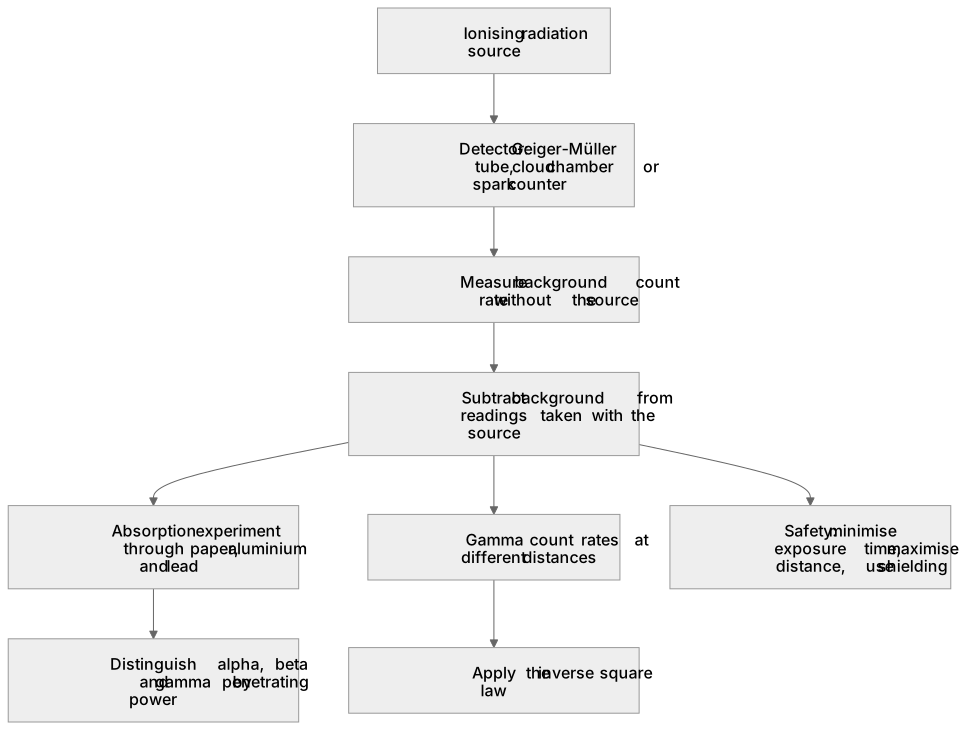
This practical skill involves handling ionising radiation sources safely and using detectors to measure radiation. You should know that alpha, beta and gamma radiation have different penetrating and ionising powers, and that detectors such as the Geiger-Müller tube, cloud chamber or spark counter are used to detect them. A typical investigation measures the count rate from a source at various distances or through different absorbers to determine the type of radiation or the half-life of a source. You must apply the inverse square law for gamma radiation intensity and correct for background radiation by measuring count rate without the source and subtracting it. Safety procedures include minimising exposure time, maximising distance and using shielding.
What earns the marks
- Identifies appropriate detectors for ionising radiation, such as a Geiger-Müller tube for count-rate measurement or a cloud chamber for visualising tracks.
- Describes how to correct for background radiation by measuring the count rate without the source and subtracting it from readings taken with the source.
- Explains how absorption experiments distinguish alpha, beta and gamma radiation by their differing penetrating powers through paper, aluminium and lead.
- Applies the inverse square law to gamma radiation count rates at different distances from a point source.
- States safety precautions: minimising exposure time, maximising distance from the source, and using appropriate shielding.
Common mistakes and how to put them right
Forgetting to subtract background count rate.
Put it right: Measure background count rate separately and subtract it from all readings taken with the source present.
Confusing count rate with activity.
Put it right: Count rate is the number of detected counts per second, while activity is the number of nuclear decays per second; the detector may not detect every decay.
Assuming alpha radiation requires thick lead shielding.
Put it right: Alpha particles are stopped by a few centimetres of air or a sheet of paper, so lead shielding is unnecessary for alpha.
Exam tips
- Always mention background radiation correction when describing count-rate experiments, as it is a standard assessed point.
- State the safety precautions explicitly: time, distance and shielding.
- When comparing penetrating powers, give specific absorber materials and approximate thicknesses to show precise knowledge.
Try the lesson
The start of the Practical skills: (l) use of ionising radiation, including detectors. lesson, made from checked teaching notes for this specification point.
Listen
This practical skill involves handling ionising radiation sources safely and using detectors to measure radiation. You should know that alpha, beta and gamma radiation have different penetrating and ionising powers, and that detectors such as the Geiger-Müller tube, cloud chamber or spark counter are used to detect them. A typical investigation measures the count rate from a source at various distances or through different absorbers to determine the type of radiation or the half-life of a source. You must apply the inverse square law for gamma radiation intensity and correct for background radiation by measuring count rate without the source and subtracting it. Safety procedures include minimising exposure time, maximising distance and using shielding. A strong answer earns marks for these points. Identifies appropriate detectors for ionising radiation, such as a Geiger-Müller tube for count-rate measurement or a cloud chamber for visualising tracks. Describes how to correct for background radiation by measuring the count rate without the source and subtracting it from readings taken with the source. Explains how absorption experiments distinguish alpha, beta and gamma radiation by their differing penetrating powers through paper, aluminium and lead. Applies the inverse square law to gamma radiation count rates at different distances from a point source. A common slip: Forgetting to subtract background count rate. Instead, measure background count rate separately and subtract it from all readings taken with the source present. Exam tip: Always mention background radiation correction when describing count-rate experiments, as it is a standard assessed point.
See it
Key words
Say what each word means before you turn the card.
Ionising radiation
Try answering aloud or in your head before turning the card.
Detectors
Try answering aloud or in your head before turning the card.
Background radiation
Try answering aloud or in your head before turning the card.
Safety procedures
Try answering aloud or in your head before turning the card.
See every definition
- Ionising radiation
- Radiation for which alpha, beta and gamma types have different penetrating and ionising powers, and which is handled safely and measured using detectors.
- Detectors
- Devices such as the Geiger-Müller tube, cloud chamber or spark counter that are used to detect ionising radiation.
- Background radiation
- Radiation corrected for by measuring the count rate without the source and subtracting it from readings taken with the source.
- Safety procedures
- Precautions including minimising exposure time, maximising distance and using shielding.
Label the diagram
Some boxes have lost their names. Pick the right name for each number.
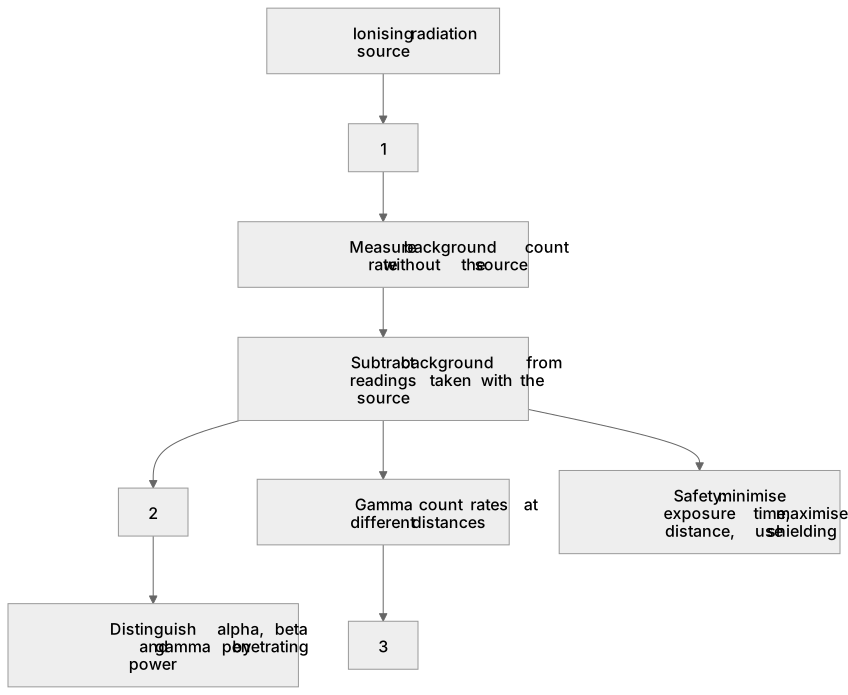
1Box 1
2Box 2
3Box 3
There is more to this lesson
The full lesson goes on to check your understanding and help you earn the marks. Create a free account to carry on, with your progress saved.
A week of Premium from your first lesson · Then the free plan continues · No card, no charge
Test your understanding of Practical skills: (l) use of ionising radiation, including detectors.
Active recall beats re-reading. Take an instant quiz now to test what you’ve learned and lock it into long-term memory.
A week of Premium from your first lesson · Then the free plan continues · No card, no charge