OCR · A-Level · Physics
Course version: H556 · Version from Sept 2015
(i) the equations e A A t 0 = m - and e N N t 0 = m - , where A is the…
Full specification wording
Radioactivity: (i) the equations e A A t 0 = m - and e N N t 0 = m - , where A is the activity and N is the number of undecayed nuclei
These equations describe exponential decay of activity and of undecayed nuclei.
Checked against the OCR H556 specification (opens in a new tab) on .
- Point 8 of 11
- 4 key terms
Study notes
From the checked teaching notes for this specification point.
The idea
These equations describe exponential decay of activity and of undecayed nuclei. In the intended form, A = A₀e^(−λt) and N = N₀e^(−λt), where A is activity at time t, A₀ is initial activity, N is the number of undecayed nuclei at time t, N₀ is the initial number, λ is the decay constant and t is elapsed time. Activity is the rate of decay, measured in becquerels, where 1 Bq = 1 decay per second. The decay constant λ has unit s⁻¹. Because both A and N follow the same exponential form, the ratio A/N is constant and equals λ. Half-life is related to the decay constant by T½ = ln2/λ. The equations apply to large numbers of nuclei and describe random decay statistically.
What earns the marks
- The equation A = A₀e^(−λt) relates activity at time t to initial activity, decay constant and elapsed time.
- The equation N = N₀e^(−λt) relates the number of undecayed nuclei at time t to the initial number.
- λ is the decay constant with unit s⁻¹, and t is the elapsed time.
- Activity is the rate of decay measured in becquerels, where 1 Bq = 1 decay per second.
- The ratio A/N equals the decay constant λ because both quantities decay with the same exponential form.
- Half-life is related to the decay constant by T½ = ln2/λ.
Common mistakes and how to put them right
Using a positive exponent instead of a negative one, which would describe growth rather than decay.
Put it right: The exponent is −λt.
Confusing activity with the number of undecayed nuclei.
Put it right: Activity is the rate of decay in Bq, while N is a count of nuclei.
Treating λ as having unit s rather than s⁻¹.
Put it right: λ has unit s⁻¹ because λt must be dimensionless.
Assuming the equations predict exactly when an individual nucleus decays.
Put it right: Decay is random and the equations describe statistical behaviour of large numbers.
Exam tips
- Check that λt is dimensionless before substituting values into the exponential.
- Remember that A and N share the same exponential factor, so their ratio stays constant at λ.
- Convert half-life to the decay constant using λ = ln2/T½ before applying the decay equations.
Try the lesson
The start of the Radioactivity: (i) the equations e A A t 0 = m - and e N N t 0 = m - , where A is the activity and N is the number of undecayed nuclei lesson, made from checked teaching notes for this specification point.
Listen
These equations describe exponential decay of activity and of undecayed nuclei. In the intended form, A = A₀e^(−λt) and N = N₀e^(−λt), where A is activity at time t, A₀ is initial activity, N is the number of undecayed nuclei at time t, N₀ is the initial number, λ is the decay constant and t is elapsed time. Activity is the rate of decay, measured in becquerels, where 1 Bq = 1 decay per second. The decay constant λ has unit s⁻¹. Because both A and N follow the same exponential form, the ratio A/N is constant and equals λ. Half-life is related to the decay constant by T½ = ln2/λ. The equations apply to large numbers of nuclei and describe random decay statistically. A strong answer earns marks for these points. The equation A = A₀e^(−λt) relates activity at time t to initial activity, decay constant and elapsed time. The equation N = N₀e^(−λt) relates the number of undecayed nuclei at time t to the initial number. λ is the decay constant with unit s⁻¹, and t is the elapsed time. Activity is the rate of decay measured in becquerels, where 1 Bq = 1 decay per second. A common slip: Using a positive exponent instead of a negative one, which would describe growth rather than decay. Instead, the exponent is −λt. Exam tip: Check that λt is dimensionless before substituting values into the exponential.
See it
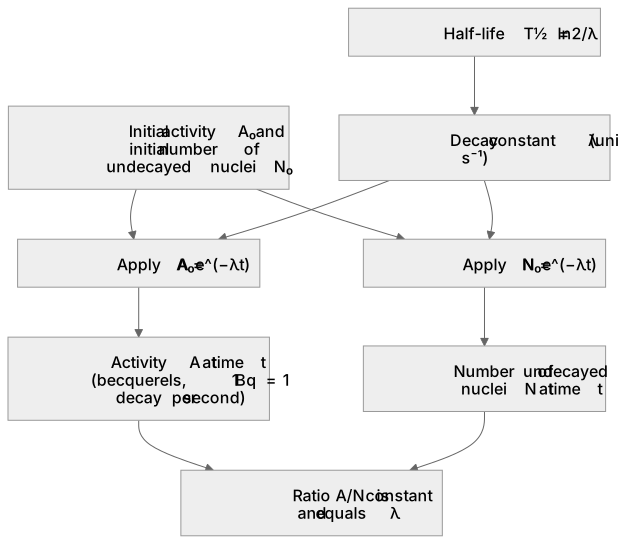
Key words
Say what each word means before you turn the card.
Exponential decay of activity
Try answering aloud or in your head before turning the card.
Exponential decay of undecayed nuclei
Try answering aloud or in your head before turning the card.
Decay constant and its unit
Try answering aloud or in your head before turning the card.
Relationship between half-life and decay constant
Try answering aloud or in your head before turning the card.
See every definition
- Exponential decay of activity
- The equation A = A₀e^(−λt) relates activity at time t to initial activity, decay constant and elapsed time.
- Exponential decay of undecayed nuclei
- The equation N = N₀e^(−λt) relates the number of undecayed nuclei at time t to the initial number.
- Decay constant and its unit
- λ is the decay constant with unit s⁻¹, and t is the elapsed time.
- Relationship between half-life and decay constant
- Half-life is related to the decay constant by T½ = ln2/λ.
Label the diagram
Some boxes have lost their names. Pick the right name for each number.
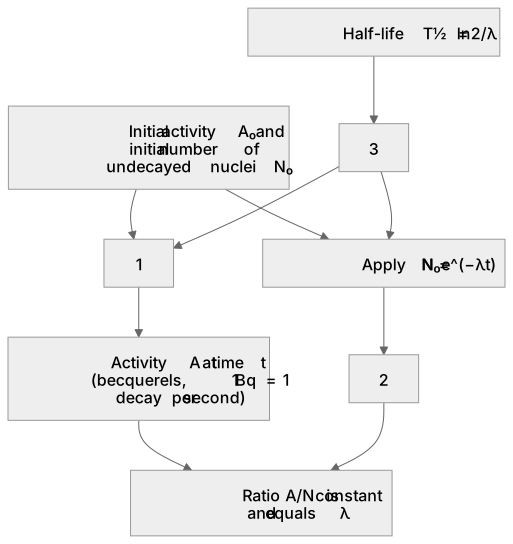
1Box 1
2Box 2
3Box 3
There is more to this lesson
The full lesson goes on to check your understanding and help you earn the marks. Create a free account to carry on, with your progress saved.
A week of Premium from your first lesson · Then the free plan continues · No card, no charge
Test your understanding of Radioactivity: (i) the equations e A A t 0 = m - and e N N t 0 = m - , where A is the activity and N is the number of undecayed nuclei
Active recall beats re-reading. Take an instant quiz now to test what you’ve learned and lock it into long-term memory.
A week of Premium from your first lesson · Then the free plan continues · No card, no charge