OCR · A-Level · Physics
Course version: H556 · Version from Sept 2015
(ii) techniques and procedures used to determine the half-life of an…
Full specification wording
Radioactivity: (ii) techniques and procedures used to determine the half-life of an isotope such as protactinium
Half-life is the time for the number of undecayed nuclei, or the activity, to fall to half its initial value.
Checked against the OCR H556 specification (opens in a new tab) on .
- Point 7 of 11
- 4 key terms
Study notes
From the checked teaching notes for this specification point.
The idea
Half-life is the time for the number of undecayed nuclei, or the activity, to fall to half its initial value. To determine it experimentally, a source such as protactinium-234 is used because it has a conveniently short half-life. A sample is placed near a Geiger-Muller tube connected to a counter or ratemeter, and the count rate is recorded at regular time intervals. Background count rate is measured with the source removed and subtracted from each reading. Corrected count rate is plotted against time on a graph, and the half-life is read as the time for the count rate to halve, or found from a suitable exponential fit. Repeating readings and using consistent geometry reduce random and systematic error.
What earns the marks
- Half-life is the time taken for the number of undecayed nuclei or the activity of a sample to halve.
- Background count rate must be measured separately and subtracted from each recorded count rate.
- A Geiger-Muller tube with a counter or ratemeter is used to record count rate at regular time intervals.
- A graph of corrected count rate against time allows the half-life to be read as the time for the value to halve, or an exponential curve to be fitted.
- Protactinium is chosen because its half-life is short enough to measure conveniently in a school laboratory.
- Repeating measurements and keeping the source-detector geometry fixed improves reliability and reduces systematic error.
Common mistakes and how to put them right
Forgetting to subtract background count rate, which makes the measured half-life too long.
Put it right: Measure background with the source removed and subtract it from every reading.
Reading the half-life from the raw count rate rather than the corrected count rate.
Put it right: Plot or analyse corrected values.
Assuming the count rate falls to zero after one half-life.
Put it right: It halves each half-life and approaches but does not reach zero.
Using a source with a very long half-life, which gives almost no measurable change during the experiment.
Put it right: Choose an isotope such as protactinium with a suitably short half-life.
Exam tips
- State explicitly that background count rate is subtracted before any analysis.
- Describe the graph method clearly: plot corrected count rate against time and read the time for the value to halve.
- Mention at least one control measure, such as fixed source-detector distance, to show awareness of systematic error.
Try the lesson
The start of the Radioactivity: (ii) techniques and procedures used to determine the half-life of an isotope such as protactinium lesson, made from checked teaching notes for this specification point.
Listen
Half-life is the time for the number of undecayed nuclei, or the activity, to fall to half its initial value. To determine it experimentally, a source such as protactinium-234 is used because it has a conveniently short half-life. A sample is placed near a Geiger-Muller tube connected to a counter or ratemeter, and the count rate is recorded at regular time intervals. Background count rate is measured with the source removed and subtracted from each reading. Corrected count rate is plotted against time on a graph, and the half-life is read as the time for the count rate to halve, or found from a suitable exponential fit. Repeating readings and using consistent geometry reduce random and systematic error. A strong answer earns marks for these points. Half-life is the time taken for the number of undecayed nuclei or the activity of a sample to halve. Background count rate must be measured separately and subtracted from each recorded count rate. A Geiger-Muller tube with a counter or ratemeter is used to record count rate at regular time intervals. A graph of corrected count rate against time allows the half-life to be read as the time for the value to halve, or an exponential curve to be fitted. A common slip: Forgetting to subtract background count rate, which makes the measured half-life too long. Instead, measure background with the source removed and subtract it from every reading. Exam tip: State explicitly that background count rate is subtracted before any analysis.
See it
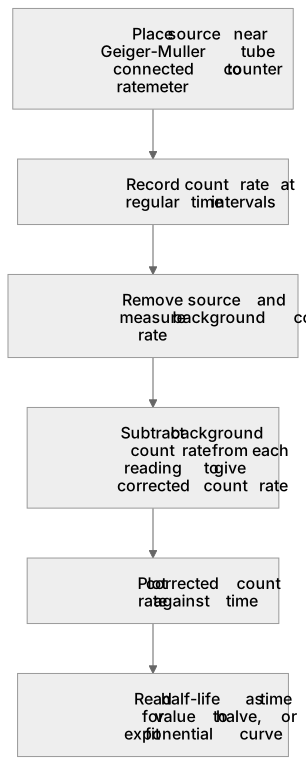
Put it in order
Put these steps in the order they happen.
- 1. Remove source and measure background count rate
- 2. Record count rate at regular time intervals
- 3. Place source near Geiger-Muller tube connected to counter or ratemeter
- 4. Read half-life as time for value to halve, or fit exponential curve
- 5. Plot corrected count rate against time
- 6. Subtract background count rate from each reading to give corrected count rate
Key words
Say what each word means before you turn the card.
Experimental measurement of half-life
Try answering aloud or in your head before turning the card.
Background radiation correction
Try answering aloud or in your head before turning the card.
Graphical analysis of exponential decay
Try answering aloud or in your head before turning the card.
Choice of suitable isotope
Try answering aloud or in your head before turning the card.
See every definition
- Experimental measurement of half-life
- A sample is placed near a Geiger-Muller tube connected to a counter or ratemeter, and the count rate is recorded at regular time intervals.
- Background radiation correction
- Background count rate is measured with the source removed and subtracted from each reading.
- Graphical analysis of exponential decay
- Corrected count rate is plotted against time on a graph, and the half-life is read as the time for the count rate to halve, or found from a suitable exponential fit.
- Choice of suitable isotope
- A source such as protactinium-234 is used because it has a conveniently short half-life.
Label the diagram
Some boxes have lost their names. Pick the right name for each number.
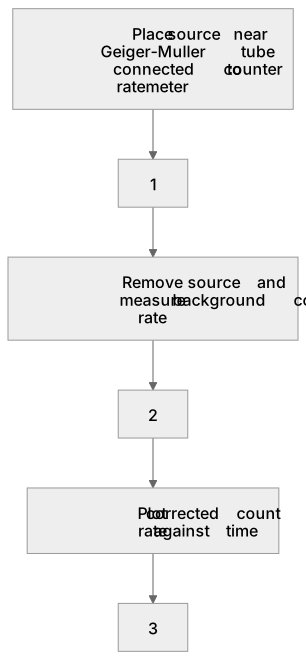
1Box 1
2Box 2
3Box 3
There is more to this lesson
The full lesson goes on to check your understanding and help you earn the marks. Create a free account to carry on, with your progress saved.
A week of Premium from your first lesson · Then the free plan continues · No card, no charge
Test your understanding of Radioactivity: (ii) techniques and procedures used to determine the half-life of an isotope such as protactinium
Active recall beats re-reading. Take an instant quiz now to test what you’ve learned and lock it into long-term memory.
A week of Premium from your first lesson · Then the free plan continues · No card, no charge