OCR · A-Level · Physics
Course version: H556 · Version from Sept 2015
S.I. units: (s), current (A), temperature (K), amount of substance
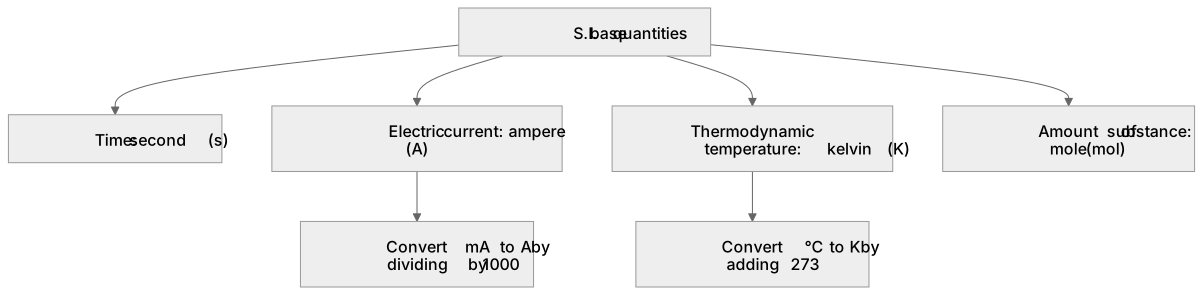
This row lists four S.I. base quantities and their units: time in seconds (s), electric current in amperes (A), thermodynamic temperature in kelvin (K), and amount of substance in moles (mol).
Checked against the OCR H556 specification (opens in a new tab) on .
- Point 4 of 16
Study notes
From the checked teaching notes for this specification point.
The idea
This row lists four S.I. base quantities and their units: time in seconds (s), electric current in amperes (A), thermodynamic temperature in kelvin (K), and amount of substance in moles (mol). A base unit is defined independently, not derived from other units. In calculations, convert to these units before substituting: for example, 25 °C becomes 298 K by adding 273, and 250 mA becomes 0.250 A by dividing by 1000. The kelvin scale starts at absolute zero, so 0 K is the lowest possible temperature. Amount of substance counts particles in moles, where one mole contains the Avogadro constant of entities. Recognising each quantity's unit helps you check equations for consistency.
What earns the marks
- Time is measured in seconds (s), symbol s.
- Electric current is measured in amperes (A), symbol A.
- Thermodynamic temperature is measured in kelvin (K), symbol K.
- Amount of substance is measured in moles (mol), symbol mol.
- Convert temperatures from degrees Celsius to kelvin by adding 273.
- Convert milliamperes to amperes by dividing by 1000.
Common mistakes and how to put them right
Writing 'sec' or 'secs' instead of the correct symbol s.
Put it right: The S.I. symbol for second is s.
Using °C in an equation that requires kelvin.
Put it right: Convert by adding 273, so 20 °C becomes 293 K.
Treating the mole as a unit of mass.
Put it right: It is the unit of amount of substance, and molar mass links it to mass.
Confusing ampere with coulomb.
Put it right: Current is measured in A, while charge is measured in C.
Exam tips
- In multiple-choice questions, eliminate options that use non-S.I. units such as °C or mA when the question asks for S.I. base units.
- Check the unit of every quantity in an equation; if the result should be in joules, the base units must combine to kg m² s⁻².
- Remember that temperature differences in °C and K are the same size, so a change of 10 °C equals a change of 10 K.
Try the lesson
The start of the S.I. units: (s), current (A), temperature (K), amount of substance lesson, made from checked teaching notes for this specification point.
Listen
This row lists four S.I. base quantities and their units: time in seconds (s), electric current in amperes (A), thermodynamic temperature in kelvin (K), and amount of substance in moles (mol). A base unit is defined independently, not derived from other units. In calculations, convert to these units before substituting: for example, 25 °C becomes 298 K by adding 273, and 250 mA becomes 0.250 A by dividing by 1000. The kelvin scale starts at absolute zero, so 0 K is the lowest possible temperature. Amount of substance counts particles in moles, where one mole contains the Avogadro constant of entities. Recognising each quantity's unit helps you check equations for consistency. A strong answer earns marks for these points. Time is measured in seconds (s), symbol s. Electric current is measured in amperes (A), symbol A. Thermodynamic temperature is measured in kelvin (K), symbol K. Amount of substance is measured in moles (mol), symbol mol. Exam tip: In multiple-choice questions, eliminate options that use non-S.I. units such as °C or mA when the question asks for S.I. base units.
See it
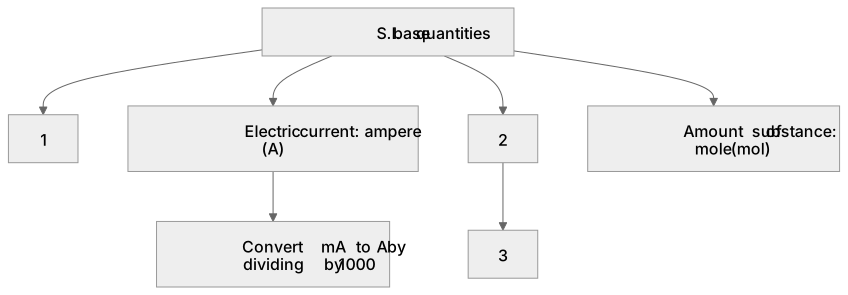
Label the diagram
Some boxes have lost their names. Pick the right name for each number.
1Box 1
2Box 2
3Box 3
There is more to this lesson
The full lesson goes on to check your understanding and help you earn the marks. Create a free account to carry on, with your progress saved.
A week of Premium from your first lesson · Then the free plan continues · No card, no charge
Test your understanding of S.I. units: (s), current (A), temperature (K), amount of substance
Active recall beats re-reading. Take an instant quiz now to test what you’ve learned and lock it into long-term memory.
A week of Premium from your first lesson · Then the free plan continues · No card, no charge