OCR · A-Level · Physics
Course version: H556 · Version from Sept 2015
Scalars and vectors: (a) scalar and vector quantities
A scalar quantity has magnitude only, while a vector quantity has both magnitude and direction.
Checked against the OCR H556 specification (opens in a new tab) on .
- Point 1 of 4
- 4 key terms
Study notes
From the checked teaching notes for this specification point.
The idea
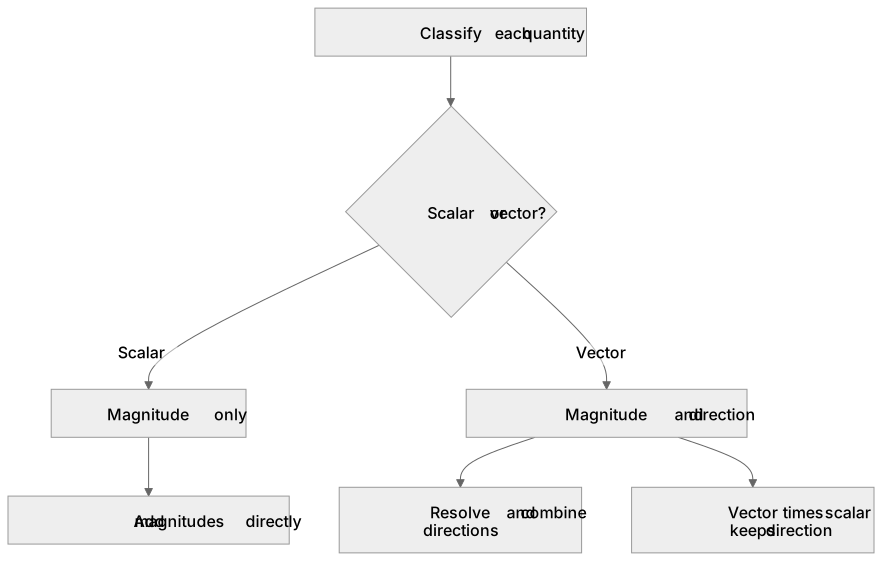
A scalar quantity has magnitude only, while a vector quantity has both magnitude and direction. Mass, time, temperature, speed, distance, energy and power are scalars. Displacement, velocity, acceleration, force, momentum, weight and electric field strength are vectors. Direction matters because vector quantities combine by direction as well as size: walking 3 m east then 4 m north gives a displacement of 5 m on a bearing, not 7 m. When solving problems, first classify each quantity, then decide whether to add magnitudes directly for scalars or resolve and combine directions for vectors. In equations, a scalar such as mass multiplies a vector such as velocity to give the vector momentum, so the direction is retained.
What earns the marks
- A scalar has magnitude only; examples include mass, time, temperature, speed, distance, energy and power.
- A vector has magnitude and direction; examples include displacement, velocity, acceleration, force, momentum and weight.
- Scalars combine by ordinary arithmetic addition of their magnitudes.
- Vectors must be combined using direction, for example by resolving components or drawing a vector triangle.
- Multiplying or dividing a vector by a scalar changes the magnitude but not the direction, unless the scalar is negative.
- Distance is a scalar while displacement is a vector; speed is a scalar while velocity is a vector.
Common mistakes and how to put them right
Treating speed as a vector.
Put it right: Speed has magnitude only, whereas velocity includes direction.
Adding vector magnitudes arithmetically regardless of direction.
Put it right: Two perpendicular 3 N and 4 N forces give a resultant of 5 N, not 7 N.
Assuming distance and displacement are interchangeable.
Put it right: Displacement is the straight-line distance in a specified direction.
Believing that a negative sign on a scalar quantity indicates spatial direction.
Put it right: For scalars like temperature or charge, a negative sign indicates a value below zero or a type of charge, not a physical direction.
Exam tips
- Underline the direction words in a question, such as north, upwards or at 30°, before choosing a method.
- When asked to classify quantities, give the reason: state whether direction is needed to define the quantity.
- Use standard symbols and units consistently, for example velocity $v$ in m s⁻¹ and displacement $s$ in m.
Try the lesson
The start of the Scalars and vectors: (a) scalar and vector quantities lesson, made from checked teaching notes for this specification point.
Listen
A scalar quantity has magnitude only, while a vector quantity has both magnitude and direction. Mass, time, temperature, speed, distance, energy and power are scalars. Displacement, velocity, acceleration, force, momentum, weight and electric field strength are vectors. Direction matters because vector quantities combine by direction as well as size: walking 3 m east then 4 m north gives a displacement of 5 m on a bearing, not 7 m. When solving problems, first classify each quantity, then decide whether to add magnitudes directly for scalars or resolve and combine directions for vectors. In equations, a scalar such as mass multiplies a vector such as velocity to give the vector momentum, so the direction is retained. A strong answer earns marks for these points. A scalar has magnitude only; examples include mass, time, temperature, speed, distance, energy and power. A vector has magnitude and direction; examples include displacement, velocity, acceleration, force, momentum and weight. Scalars combine by ordinary arithmetic addition of their magnitudes. Vectors must be combined using direction, for example by resolving components or drawing a vector triangle. Exam tip: Underline the direction words in a question, such as north, upwards or at 30°, before choosing a method.
See it
Key words
Say what each word means before you turn the card.
Scalar quantity
Try answering aloud or in your head before turning the card.
Vector quantity
Try answering aloud or in your head before turning the card.
Magnitude and direction
Try answering aloud or in your head before turning the card.
Classification of physical quantities
Try answering aloud or in your head before turning the card.
See every definition
- Scalar quantity
- A quantity that has magnitude only, such as mass, time, temperature, speed, distance, energy and power.
- Vector quantity
- A quantity that has both magnitude and direction, such as displacement, velocity, acceleration, force, momentum and weight.
- Magnitude and direction
- The two features a vector quantity has, where direction matters because vectors combine by direction as well as size.
- Classification of physical quantities
- Deciding whether a quantity is scalar or vector by stating whether direction is needed to define it.
There is more to this lesson
The full lesson goes on to check your understanding and help you earn the marks. Create a free account to carry on, with your progress saved.
A week of Premium from your first lesson · Then the free plan continues · No card, no charge
Test your understanding of Scalars and vectors: (a) scalar and vector quantities
Active recall beats re-reading. Take an instant quiz now to test what you’ve learned and lock it into long-term memory.
A week of Premium from your first lesson · Then the free plan continues · No card, no charge