OCR · A-Level · Physics
Course version: H556 · Version from Sept 2015
Scalars and vectors: (b) vector addition and subtraction
Vector addition combines two or more vectors to find a resultant, taking direction into account.
Checked against the OCR H556 specification (opens in a new tab) on .
- Point 2 of 4
- 4 key terms
Study notes
From the checked teaching notes for this specification point.
The idea
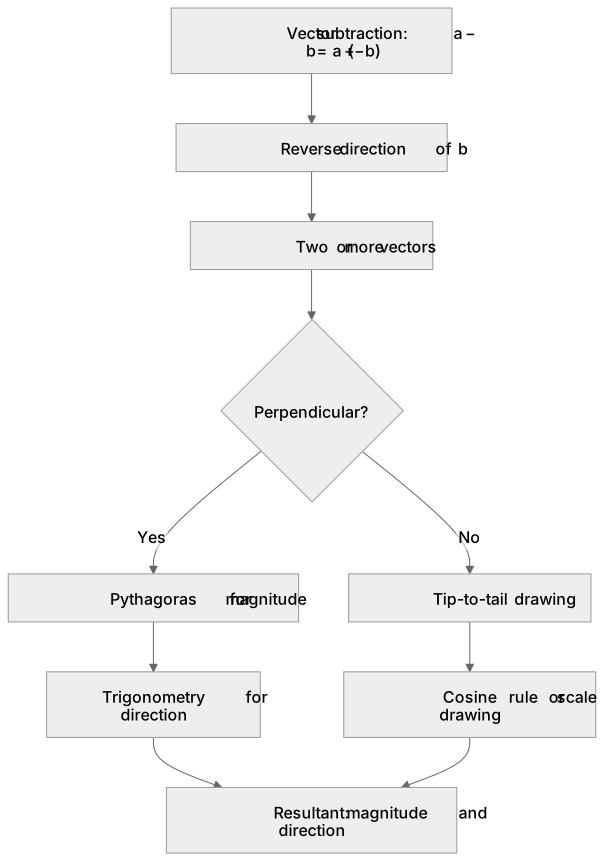
Vector addition combines two or more vectors to find a resultant, taking direction into account. For perpendicular vectors, resolve into components and use Pythagoras with trigonometry: a 3 N force east plus a 4 N force north gives a resultant of 5 N at an angle where tan θ = 4 ÷ 3, so θ ≈ 53° from the east direction. For non-perpendicular vectors, draw them tip-to-tail and use the cosine rule or scale drawing. Vector subtraction means adding the negative of the vector: a − b = a + (−b), where −b has the same magnitude as b but the opposite direction. Always state the magnitude and direction of the resultant, and check that the answer is sensible relative to the original vectors.
What earns the marks
- Vector addition must account for direction; magnitudes are not simply added unless the vectors are parallel.
- Perpendicular vectors can be combined using Pythagoras' theorem for magnitude and trigonometry for direction.
- Non-perpendicular vectors can be combined by scale drawing or by resolving into perpendicular components.
- Vector subtraction is addition of the reversed vector: a − b = a + (−b).
- The resultant should be stated with both magnitude and direction, for example 5.0 N at 53° north of east.
- A scale drawing must have a stated scale, and the resultant measured with a ruler and protractor.
Common mistakes and how to put them right
Adding magnitudes directly for perpendicular vectors.
Put it right: 3 N and 4 N at right angles give 5 N, not 7 N.
Forgetting to reverse the second vector in a subtraction.
Put it right: A − b requires the direction of b to be reversed before adding.
Giving only the magnitude of a resultant.
Put it right: A vector answer needs a direction as well.
Using the wrong trigonometric ratio when finding the angle.
Put it right: Check which sides are opposite and adjacent to the required angle.
Exam tips
- Sketch the vectors tip-to-tail before calculating so the geometry is clear.
- For perpendicular vectors, calculate the magnitude with Pythagoras first, then find the direction with tan θ = opposite ÷ adjacent.
- State the direction relative to a named reference direction, such as 40° above the horizontal.
Try the lesson
The start of the Scalars and vectors: (b) vector addition and subtraction lesson, made from checked teaching notes for this specification point.
Listen
Vector addition combines two or more vectors to find a resultant, taking direction into account. For perpendicular vectors, resolve into components and use Pythagoras with trigonometry: a 3 N force east plus a 4 N force north gives a resultant of 5 N at an angle where tan θ = 4 ÷ 3, so θ ≈ 53° from the east direction. For non-perpendicular vectors, draw them tip-to-tail and use the cosine rule or scale drawing. Vector subtraction means adding the negative of the vector: a − b = a + (−b), where −b has the same magnitude as b but the opposite direction. Always state the magnitude and direction of the resultant, and check that the answer is sensible relative to the original vectors. A strong answer earns marks for these points. Vector addition must account for direction; magnitudes are not simply added unless the vectors are parallel. Perpendicular vectors can be combined using Pythagoras' theorem for magnitude and trigonometry for direction. Non-perpendicular vectors can be combined by scale drawing or by resolving into perpendicular components. Vector subtraction is addition of the reversed vector: a − b = a + (−b). Exam tip: Sketch the vectors tip-to-tail before calculating so the geometry is clear.
See it
Key words
Say what each word means before you turn the card.
Resultant vectors
Try answering aloud or in your head before turning the card.
Tip-to-tail addition
Try answering aloud or in your head before turning the card.
Vector subtraction as reversed addition
Try answering aloud or in your head before turning the card.
Magnitude and direction of a resultant
Try answering aloud or in your head before turning the card.
See every definition
- Resultant vectors
- The single vector found by combining two or more vectors, taking direction into account.
- Tip-to-tail addition
- A method for non-perpendicular vectors in which the vectors are drawn tip-to-tail and the cosine rule or a scale drawing is used.
- Vector subtraction as reversed addition
- Adding the negative of the vector, a − b = a + (−b), where −b has the same magnitude as b but the opposite direction.
- Magnitude and direction of a resultant
- Both must always be stated for a resultant, and the answer checked to see that it is sensible relative to the original vectors.
There is more to this lesson
The full lesson goes on to check your understanding and help you earn the marks. Create a free account to carry on, with your progress saved.
A week of Premium from your first lesson · Then the free plan continues · No card, no charge
Test your understanding of Scalars and vectors: (b) vector addition and subtraction
Active recall beats re-reading. Take an instant quiz now to test what you’ve learned and lock it into long-term memory.
A week of Premium from your first lesson · Then the free plan continues · No card, no charge