OCR · A-Level · Physics
Course version: H556 · Version from Sept 2015
(c) vector triangle to determine the resultant of any two coplanar vectors
Full specification wording
Scalars and vectors: (c) vector triangle to determine the resultant of any two coplanar vectors
A vector triangle determines the resultant of any two coplanar vectors, whether or not they are perpendicular.
Checked against the OCR H556 specification (opens in a new tab) on .
- Point 3 of 4
- 4 key terms
Study notes
From the checked teaching notes for this specification point.
The idea
A vector triangle determines the resultant of any two coplanar vectors, whether or not they are perpendicular. Draw the first vector to scale in its direction, then draw the second vector starting from the tip of the first, keeping its own direction. The resultant is the single vector drawn from the tail of the first vector to the tip of the second, closing the triangle. Measure its length with a ruler and its angle with a protractor, converting both using the scale. Alternatively, use the cosine rule for the magnitude and the sine rule for an angle. For perpendicular vectors the triangle is right-angled, so Pythagoras and tan θ apply. Always state the scale, the magnitude and the direction of the resultant.
What earns the marks
- A vector triangle is drawn by placing the second vector tip-to-tail with the first, preserving each vector's direction.
- The resultant is the closing side drawn from the start of the first vector to the end of the second.
- A stated scale allows the resultant's magnitude to be found by measuring the closing side.
- The direction of the resultant is measured with a protractor relative to a named reference direction.
- For non-right-angled triangles, the cosine rule gives the resultant magnitude and the sine rule gives an angle.
- For perpendicular vectors, the triangle is right-angled and Pythagoras with trigonometry can be used instead of scale drawing.
Common mistakes and how to put them right
Drawing the second vector from the tail of the first instead of from its tip.
Put it right: The vectors must be placed tip-to-tail.
Measuring the resultant from the wrong end of the triangle.
Put it right: The resultant runs from the start of the first vector to the end of the second.
Omitting the scale or the direction.
Put it right: A scale drawing answer needs both a magnitude and a direction.
Using the cosine rule with the wrong included angle.
Put it right: The angle between the two vectors must be identified correctly.
Exam tips
- Choose a scale that makes the triangle large enough to measure accurately, for example 1 cm represents 2 N.
- Draw the vectors in pencil with a sharp ruler and protractor, and label each side clearly.
- Check the resultant is longer than the difference and shorter than the sum of the two vector magnitudes.
Try the lesson
The start of the Scalars and vectors: (c) vector triangle to determine the resultant of any two coplanar vectors lesson, made from checked teaching notes for this specification point.
Listen
A vector triangle determines the resultant of any two coplanar vectors, whether or not they are perpendicular. Draw the first vector to scale in its direction, then draw the second vector starting from the tip of the first, keeping its own direction. The resultant is the single vector drawn from the tail of the first vector to the tip of the second, closing the triangle. Measure its length with a ruler and its angle with a protractor, converting both using the scale. Alternatively, use the cosine rule for the magnitude and the sine rule for an angle. For perpendicular vectors the triangle is right-angled, so Pythagoras and tan θ apply. Always state the scale, the magnitude and the direction of the resultant. A strong answer earns marks for these points. A vector triangle is drawn by placing the second vector tip-to-tail with the first, preserving each vector's direction. The resultant is the closing side drawn from the start of the first vector to the end of the second. A stated scale allows the resultant's magnitude to be found by measuring the closing side. The direction of the resultant is measured with a protractor relative to a named reference direction. Exam tip: Choose a scale that makes the triangle large enough to measure accurately, for example 1 cm represents 2 N.
See it
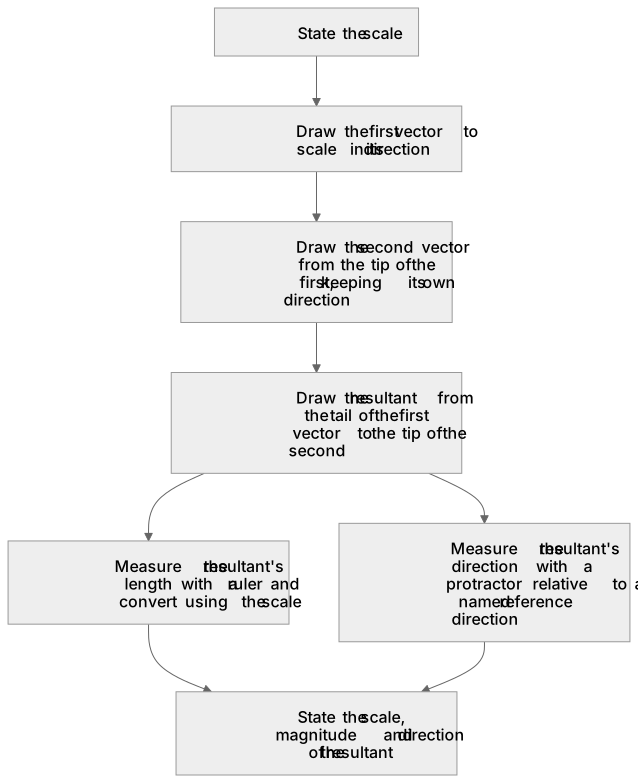
Key words
Say what each word means before you turn the card.
Vector triangle construction
Try answering aloud or in your head before turning the card.
Tip-to-tail method
Try answering aloud or in your head before turning the card.
Scale drawing
Try answering aloud or in your head before turning the card.
Cosine and sine rules for non-perpendicular vectors
Try answering aloud or in your head before turning the card.
See every definition
- Vector triangle construction
- A diagram in which the first vector is drawn to scale in its direction and the second is drawn starting from the tip of the first, keeping its own direction.
- Tip-to-tail method
- Placing the second vector starting from the tip of the first, preserving each vector's direction.
- Scale drawing
- A stated scale allows the resultant's magnitude to be found by measuring the closing side, with its angle measured using a protractor.
- Cosine and sine rules for non-perpendicular vectors
- For non-right-angled triangles, the cosine rule gives the resultant magnitude and the sine rule gives an angle.
Label the diagram
Some boxes have lost their names. Pick the right name for each number.
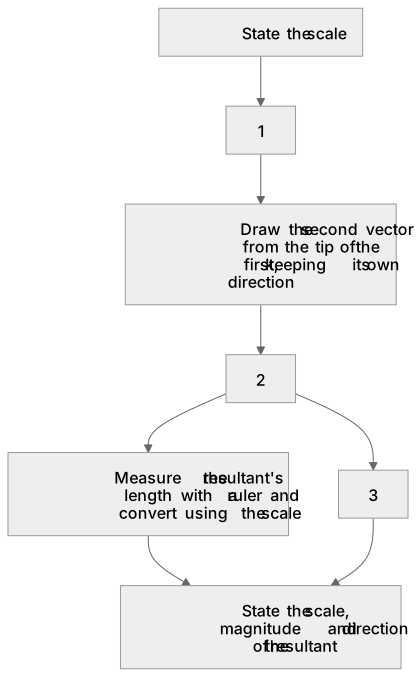
1Box 1
2Box 2
3Box 3
There is more to this lesson
The full lesson goes on to check your understanding and help you earn the marks. Create a free account to carry on, with your progress saved.
A week of Premium from your first lesson · Then the free plan continues · No card, no charge
Test your understanding of Scalars and vectors: (c) vector triangle to determine the resultant of any two coplanar vectors
Active recall beats re-reading. Take an instant quiz now to test what you’ve learned and lock it into long-term memory.
A week of Premium from your first lesson · Then the free plan continues · No card, no charge