OCR · A-Level · Physics
Course version: H556 · Version from Sept 2015
(b) Kirchhoff’s first and second laws applied to electrical circuits
Full specification wording
Series and parallel circuits: (b) Kirchhoff’s first and second laws applied to electrical circuits
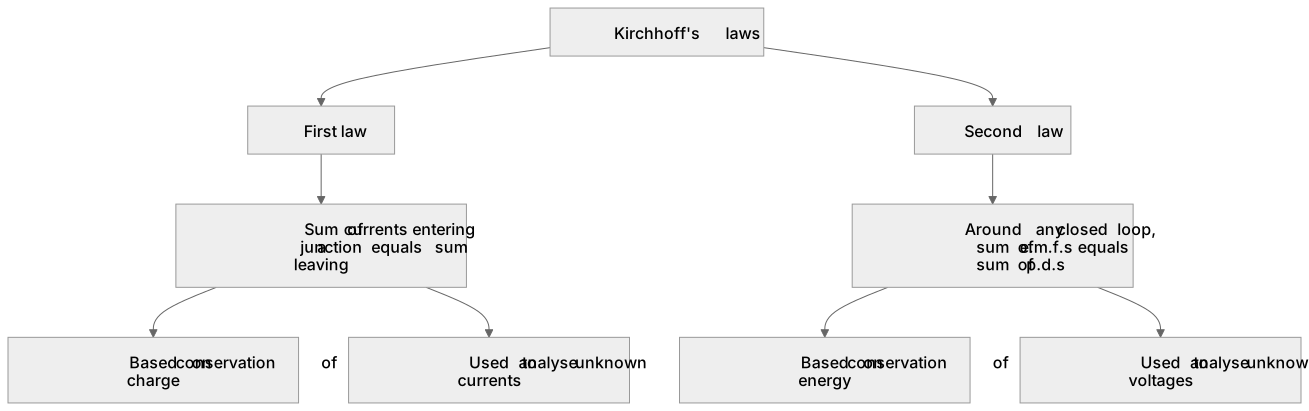
Kirchhoff’s first law states that the sum of currents entering a junction equals the sum leaving it, because charge is conserved.
Checked against the OCR H556 specification (opens in a new tab) on .
- Point 2 of 6
- 4 key terms
Study notes
From the checked teaching notes for this specification point.
The idea
Kirchhoff’s first law states that the sum of currents entering a junction equals the sum leaving it, because charge is conserved. At a junction where 2.0 A enters and splits into I₁ and I₂, I₁ + I₂ = 2.0 A. Kirchhoff’s second law states that around any closed loop, the sum of e.m.f.s equals the sum of p.d.s, because energy is conserved per unit charge. In a series circuit with a 6.0 V battery and two resistors, the p.d.s add to 6.0 V. These laws apply to any circuit, including series and parallel combinations, and are used to analyse unknown currents and voltages. They are fundamental to circuit analysis and are assessed in multiple-choice questions requiring calculation or identification of correct statements.
What earns the marks
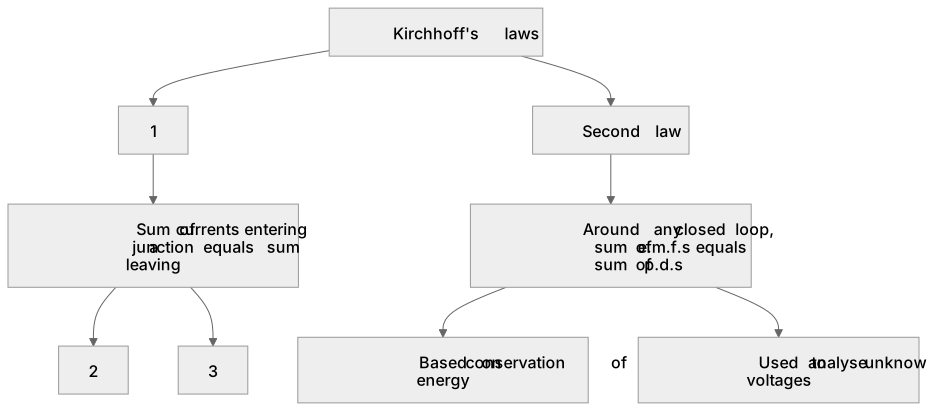
- Kirchhoff’s first law: sum of currents entering a junction equals sum leaving, based on conservation of charge.
- Kirchhoff’s second law: around any closed loop, sum of e.m.f.s equals sum of p.d.s, based on conservation of energy.
- Application to junctions: at a node, total current in equals total current out, e.g. I₁ = I₂ + I₃.
- Application to loops: in a series circuit, the sum of potential differences across components equals the supply e.m.f.
- Use in circuit analysis: these laws allow calculation of unknown currents and voltages in series and parallel networks.
Common mistakes and how to put them right
Misunderstanding: Kirchhoff’s first law applies to any point in a circuit, not just junctions.
Put it right: It applies specifically to junctions where current can split or combine.
Misunderstanding: Kirchhoff’s second law applies only to simple series circuits.
Put it right: It applies to any closed loop, including those with parallel branches.
Misunderstanding: Kirchhoff’s laws are independent of conservation principles.
Put it right: They are direct consequences of conservation of charge and energy.
Misunderstanding: The sum of currents entering a junction is always zero.
Put it right: The algebraic sum is zero if directions are considered, but the sum of magnitudes entering equals that leaving.
Exam tips
- For multiple-choice questions, check each option against the laws: first law involves currents at a junction, second law involves voltages around a loop.
- When calculating, ensure you use consistent signs for currents and voltages; define a direction and stick to it.
- Remember that in a series circuit, current is the same everywhere, so Kirchhoff’s first law is trivially satisfied at any point.
Try the lesson
The start of the Series and parallel circuits: (b) Kirchhoff’s first and second laws applied to electrical circuits lesson, made from checked teaching notes for this specification point.
Listen
Kirchhoff’s first law states that the sum of currents entering a junction equals the sum leaving it, because charge is conserved. At a junction where 2.0 A enters and splits into I₁ and I₂, I₁ + I₂ = 2.0 A. Kirchhoff’s second law states that around any closed loop, the sum of e.m.f.s equals the sum of p.d.s, because energy is conserved per unit charge. In a series circuit with a 6.0 V battery and two resistors, the p.d.s add to 6.0 V. These laws apply to any circuit, including series and parallel combinations, and are used to analyse unknown currents and voltages. They are fundamental to circuit analysis and are assessed in multiple-choice questions requiring calculation or identification of correct statements. A strong answer earns marks for these points. Kirchhoff’s first law: sum of currents entering a junction equals sum leaving, based on conservation of charge. Kirchhoff’s second law: around any closed loop, sum of e.m.f.s equals sum of p.d.s, based on conservation of energy. Application to junctions: at a node, total current in equals total current out, e.g. I₁ = I₂ + I₃. Application to loops: in a series circuit, the sum of potential differences across components equals the supply e.m.f. A common slip: Misunderstanding: Kirchhoff’s first law applies to any point in a circuit, not just junctions. Instead, it applies specifically to junctions where current can split or combine. Exam tip: For multiple-choice questions, check each option against the laws: first law involves currents at a junction, second law involves voltages around a loop.
See it
Key words
Say what each word means before you turn the card.
Conservation of charge
Try answering aloud or in your head before turning the card.
Conservation of energy
Try answering aloud or in your head before turning the card.
Circuit analysis
Try answering aloud or in your head before turning the card.
Junction and loop rules
Try answering aloud or in your head before turning the card.
See every definition
- Conservation of charge
- The principle that charge is conserved, which is why the sum of currents entering a junction equals the sum leaving it.
- Conservation of energy
- The principle that energy is conserved per unit charge, which is why around any closed loop the sum of e.m.f.s equals the sum of p.d.s.
- Circuit analysis
- The use of Kirchhoff's laws to analyse unknown currents and voltages in series and parallel combinations.
- Junction and loop rules
- Kirchhoff's first law concerns currents at a junction, and his second law concerns voltages around a closed loop.
Label the diagram
Some boxes have lost their names. Pick the right name for each number.
1Box 1
2Box 2
3Box 3
There is more to this lesson
The full lesson goes on to check your understanding and help you earn the marks. Create a free account to carry on, with your progress saved.
A week of Premium from your first lesson · Then the free plan continues · No card, no charge
Test your understanding of Series and parallel circuits: (b) Kirchhoff’s first and second laws applied to electrical circuits
Active recall beats re-reading. Take an instant quiz now to test what you’ve learned and lock it into long-term memory.
A week of Premium from your first lesson · Then the free plan continues · No card, no charge