OCR · A-Level · Physics
Course version: H556 · Version from Sept 2015
(c) total resistance of two or more resistors in series; R = R₁ + R₂ + ...
Full specification wording
Series and parallel circuits: (c) total resistance of two or more resistors in series; R = R₁ + R₂ + ...
For resistors connected in series, the total resistance is the sum of individual resistances: R = R₁ + R₂ + ... .
Checked against the OCR H556 specification (opens in a new tab) on .
- Point 3 of 6
Study notes
From the checked teaching notes for this specification point.
The idea
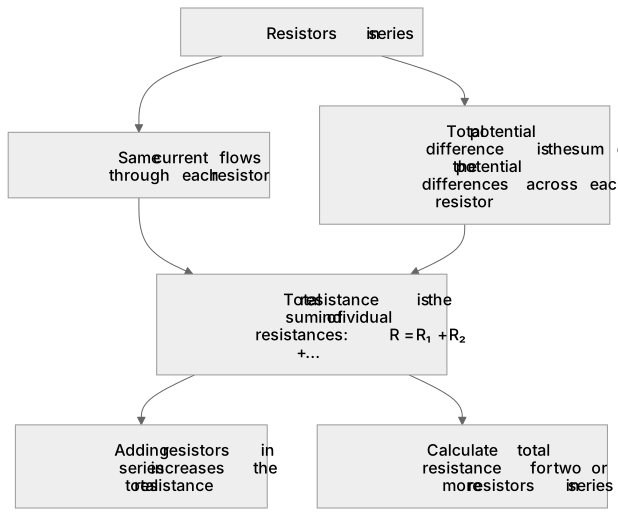
For resistors connected in series, the total resistance is the sum of individual resistances: R = R₁ + R₂ + ... . This is because the same current flows through each resistor, and the total potential difference is the sum of the potential differences across each resistor. For example, a 10 Ω and a 20 Ω resistor in series give a total resistance of 30 Ω. This rule applies to any number of resistors in series. In multiple-choice questions, you may be asked to calculate total resistance or identify the correct expression. Remember that series connections increase total resistance, and the formula is straightforward addition.
What earns the marks
- Total resistance in series is the sum of individual resistances: R = R₁ + R₂ + ... .
- The same current flows through each resistor in series.
- The total potential difference is the sum of the potential differences across each resistor.
- Adding resistors in series increases the total resistance.
- Application: calculate total resistance for two or more resistors in series.
Common mistakes and how to put them right
Misunderstanding: total resistance in series is less than the smallest resistance.
Put it right: It is always greater than the largest individual resistance.
Misunderstanding: the formula R = R₁ + R₂ + ... applies to parallel circuits.
Put it right: It applies only to series circuits; parallel uses reciprocals.
Misunderstanding: current is different through each resistor in series.
Put it right: Current is the same through all components in series.
Misunderstanding: voltage across each resistor is the same in series.
Put it right: Voltage divides according to resistance; only current is common.
Exam tips
- In multiple-choice questions, if you see resistors in a line, they are in series; simply add their resistances.
- Check units: ensure all resistances are in ohms before adding.
- If a question asks for total resistance of a series combination, look for the sum; do not use the parallel formula.
Try the lesson
The start of the Series and parallel circuits: (c) total resistance of two or more resistors in series; R = R₁ + R₂ + ... lesson, made from checked teaching notes for this specification point.
Listen
For resistors connected in series, the total resistance is the sum of individual resistances: R = R₁ + R₂ + ... This is because the same current flows through each resistor, and the total potential difference is the sum of the potential differences across each resistor. For example, a 10 Ω and a 20 Ω resistor in series give a total resistance of 30 Ω. This rule applies to any number of resistors in series. In multiple-choice questions, you may be asked to calculate total resistance or identify the correct expression. Remember that series connections increase total resistance, and the formula is straightforward addition. A strong answer earns marks for these points. Total resistance in series is the sum of individual resistances: R = R₁ + R₂ + ... The same current flows through each resistor in series. The total potential difference is the sum of the potential differences across each resistor. Adding resistors in series increases the total resistance. A common slip: Misunderstanding: total resistance in series is less than the smallest resistance. Instead, it is always greater than the largest individual resistance. Exam tip: In multiple-choice questions, if you see resistors in a line, they are in series; simply add their resistances.
See it
Label the diagram
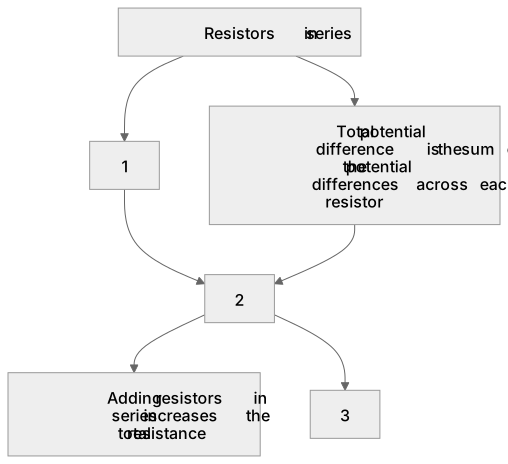
Some boxes have lost their names. Pick the right name for each number.
1Box 1
2Box 2
3Box 3
There is more to this lesson
The full lesson goes on to check your understanding and help you earn the marks. Create a free account to carry on, with your progress saved.
A week of Premium from your first lesson · Then the free plan continues · No card, no charge
Test your understanding of Series and parallel circuits: (c) total resistance of two or more resistors in series; R = R₁ + R₂ + ...
Active recall beats re-reading. Take an instant quiz now to test what you’ve learned and lock it into long-term memory.
A week of Premium from your first lesson · Then the free plan continues · No card, no charge