OCR · A-Level · Physics
Course version: H556 · Version from Sept 2015
(d) solutions to the equation a = -ω²x e.g. x = A cos(ωt) or x = A sin(ωt)
Full specification wording
Simple harmonic oscillations: (d) solutions to the equation a = -ω²x e.g. x = A cos(ωt) or x = A sin(ωt)
The defining equation of simple harmonic motion is a = -ω²x, where a is acceleration, x is displacement from equilibrium and ω is angular frequency.
Checked against the OCR H556 specification (opens in a new tab) on .
- Point 4 of 7
- 4 key terms
Study notes
From the checked teaching notes for this specification point.
The idea
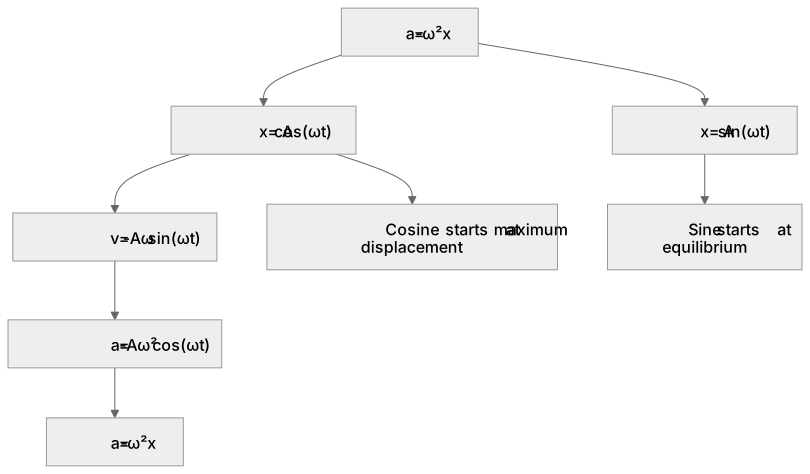
The defining equation of simple harmonic motion is a = -ω²x, where a is acceleration, x is displacement from equilibrium and ω is angular frequency. Its solutions are sinusoidal functions of time: x = A cos(ωt) or x = A sin(ωt), where A is the amplitude. Differentiating x = A cos(ωt) gives v = -Aω sin(ωt) and a = -Aω² cos(ωt), which equals -ω²x. The cosine form starts at maximum displacement when t = 0; the sine form starts at equilibrium moving in the positive direction. Both describe the same motion with a different choice of starting time, and the period is T = 2π/ω.
What earns the marks
- Recognises that x = A cos(ωt) and x = A sin(ωt) are both solutions of a = -ω²x.
- Identifies A as the amplitude and ω as the angular frequency, with ω = 2πf = 2π/T.
- Differentiates a displacement solution to obtain velocity and acceleration, showing that a = -ω²x follows.
- Distinguishes the initial conditions: cosine starts at maximum displacement, sine starts at equilibrium.
- Uses the relationship between ω, period and frequency to convert between forms.
Common mistakes and how to put them right
Treating ω as the frequency f rather than the angular frequency.
Put it right: Use ω = 2πf.
Believing that only one of the sine and cosine forms is a valid solution.
Put it right: Recognise that both satisfy the equation and differ only in initial conditions.
Dropping the minus sign in a = -ω²x, which reverses the direction of the restoring acceleration.
Put it right: Keep the negative sign because acceleration is always directed towards equilibrium.
Confusing amplitude A with displacement x.
Put it right: Note that x varies with time while A is the maximum value of x.
Exam tips
- Check the initial condition described in the question before choosing sine or cosine.
- Convert between period and angular frequency using ω = 2π/T before substituting into a solution.
- Verify a proposed solution by differentiating twice and comparing with a = -ω²x.
Try the lesson
The start of the Simple harmonic oscillations: (d) solutions to the equation a = -ω²x e.g. x = A cos(ωt) or x = A sin(ωt) lesson, made from checked teaching notes for this specification point.
Listen
The defining equation of simple harmonic motion is a = -ω²x, where a is acceleration, x is displacement from equilibrium and ω is angular frequency. Its solutions are sinusoidal functions of time: x = A cos(ωt) or x = A sin(ωt), where A is the amplitude. Differentiating x = A cos(ωt) gives v = -Aω sin(ωt) and a = -Aω² cos(ωt), which equals -ω²x. The cosine form starts at maximum displacement when t = 0; the sine form starts at equilibrium moving in the positive direction. Both describe the same motion with a different choice of starting time, and the period is T = 2π/ω. A strong answer earns marks for these points. Recognises that x = A cos(ωt) and x = A sin(ωt) are both solutions of a = -ω²x. Identifies A as the amplitude and ω as the angular frequency, with ω = 2πf = 2π/T. Differentiates a displacement solution to obtain velocity and acceleration, showing that a = -ω²x follows. Distinguishes the initial conditions: cosine starts at maximum displacement, sine starts at equilibrium. A common slip: Treating ω as the frequency f rather than the angular frequency. Instead, use ω = 2πf. Exam tip: Check the initial condition described in the question before choosing sine or cosine.
See it
Key words
Say what each word means before you turn the card.
Angular frequency
Try answering aloud or in your head before turning the card.
Amplitude
Try answering aloud or in your head before turning the card.
Cosine form
Try answering aloud or in your head before turning the card.
Sine form
Try answering aloud or in your head before turning the card.
See every definition
- Angular frequency
- The quantity ω in the solutions, linked to period and frequency by ω = 2πf = 2π/T.
- Amplitude
- The quantity A in x = A cos(ωt) or x = A sin(ωt), being the maximum value of displacement x.
- Cosine form
- The solution x = A cos(ωt), which starts at maximum displacement when t = 0.
- Sine form
- The solution x = A sin(ωt), which starts at equilibrium moving in the positive direction.
There is more to this lesson
The full lesson goes on to check your understanding and help you earn the marks. Create a free account to carry on, with your progress saved.
A week of Premium from your first lesson · Then the free plan continues · No card, no charge
Test your understanding of Simple harmonic oscillations: (d) solutions to the equation a = -ω²x e.g. x = A cos(ωt) or x = A sin(ωt)
Active recall beats re-reading. Take an instant quiz now to test what you’ve learned and lock it into long-term memory.
A week of Premium from your first lesson · Then the free plan continues · No card, no charge