OCR · A-Level · Physics
Course version: H556 · Version from Sept 2015
Simple harmonic oscillations: (e) velocity v = ±ω√(A² - x²) hence vmax = ωA
For a simple harmonic oscillator the speed at displacement x is given by v = ±ω√(A² - x²), where A is the amplitude and ω is the angular frequency.
Checked against the OCR H556 specification (opens in a new tab) on .
- Point 5 of 7
- 3 key terms
Study notes
From the checked teaching notes for this specification point.
The idea
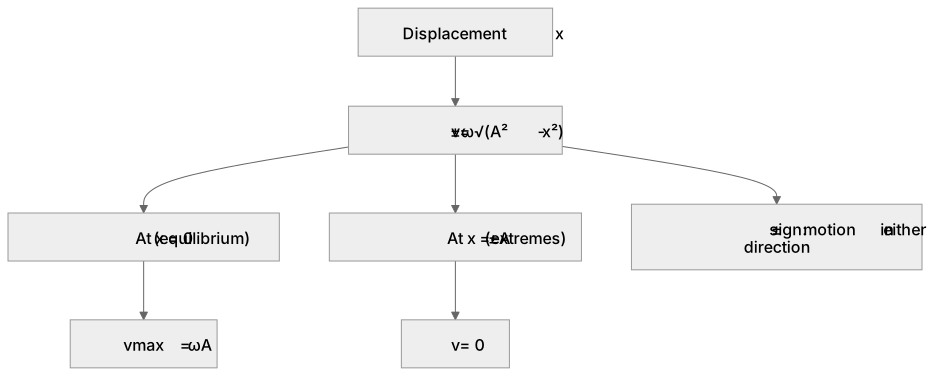
For a simple harmonic oscillator the speed at displacement x is given by v = ±ω√(A² - x²), where A is the amplitude and ω is the angular frequency. The ± sign shows that the oscillator passes through a given displacement in either direction. Speed is greatest at the equilibrium position, where x = 0, giving vmax = ωA. Speed is zero at the extremes of the motion, where x = ±A, because the oscillator momentarily stops before reversing. The equation follows from energy conservation or from combining the sinusoidal displacement and velocity expressions, and it allows the speed to be found at any displacement without knowing the time.
What earns the marks
- States or applies v = ±ω√(A² - x²) with A as amplitude, x as displacement and ω as angular frequency.
- Recognises that vmax = ωA occurs at x = 0, the equilibrium position.
- Recognises that v = 0 at x = ±A, the extremes of the oscillation.
- Interprets the ± sign as showing the two possible directions of motion at a given displacement.
- Calculates ω from the period or frequency before substituting into the velocity equation.
Common mistakes and how to put them right
Using vmax = ωA² or vmax = A/ω.
Put it right: Use vmax = ωA, which has units of m s⁻¹.
Substituting x = A into the velocity equation and expecting a maximum.
Put it right: Note that v = 0 at x = ±A.
Treating the ± sign as an error.
Put it right: Explain that it represents motion in either direction through the same displacement.
Using frequency f in place of angular frequency ω.
Put it right: Convert with ω = 2πf.
Exam tips
- Check that ω has units of rad s⁻¹ before substituting into the velocity equation.
- Use vmax = ωA as a quick check on the maximum speed at equilibrium.
- Keep the square root until the final step to avoid premature rounding.
Try the lesson
The start of the Simple harmonic oscillations: (e) velocity v = ±ω√(A² - x²) hence vmax = ωA lesson, made from checked teaching notes for this specification point.
Listen
For a simple harmonic oscillator the speed at displacement x is given by v = ±ω√(A² - x²), where A is the amplitude and ω is the angular frequency. The ± sign shows that the oscillator passes through a given displacement in either direction. Speed is greatest at the equilibrium position, where x = 0, giving vmax = ωA. Speed is zero at the extremes of the motion, where x = ±A, because the oscillator momentarily stops before reversing. The equation follows from energy conservation or from combining the sinusoidal displacement and velocity expressions, and it allows the speed to be found at any displacement without knowing the time. A strong answer earns marks for these points. States or applies v = ±ω√(A² - x²) with A as amplitude, x as displacement and ω as angular frequency. Recognises that vmax = ωA occurs at x = 0, the equilibrium position. Recognises that v = 0 at x = ±A, the extremes of the oscillation. Interprets the ± sign as showing the two possible directions of motion at a given displacement. A common slip: Using vmax = ωA² or vmax = A/ω. Instead, use vmax = ωA, which has units of m s⁻¹. Exam tip: Check that ω has units of rad s⁻¹ before substituting into the velocity equation.
See it
Key words
Say what each word means before you turn the card.
Velocity-displacement relationship in simple harmonic motion
Try answering aloud or in your head before turning the card.
Maximum speed at equilibrium
Try answering aloud or in your head before turning the card.
Angular frequency and its units
Try answering aloud or in your head before turning the card.
See every definition
- Velocity-displacement relationship in simple harmonic motion
- The speed at displacement x is given by v = ±ω√(A² - x²), where A is the amplitude and ω is the angular frequency.
- Maximum speed at equilibrium
- Speed is greatest at the equilibrium position, where x = 0, giving vmax = ωA.
- Angular frequency and its units
- A quantity with units of rad s⁻¹ that must be checked before substituting into the velocity equation.
Label the diagram
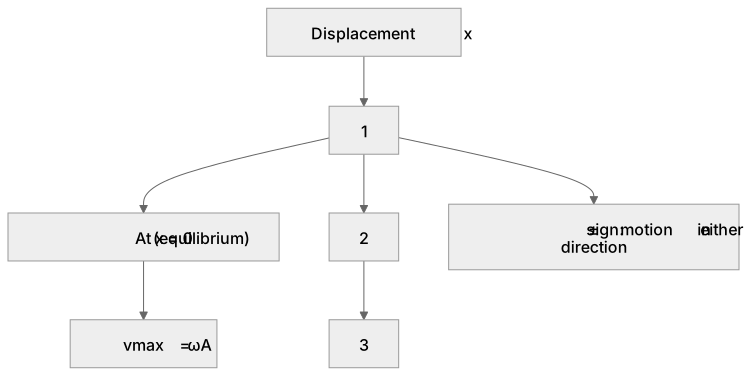
Some boxes have lost their names. Pick the right name for each number.
1Box 1
2Box 2
3Box 3
There is more to this lesson
The full lesson goes on to check your understanding and help you earn the marks. Create a free account to carry on, with your progress saved.
A week of Premium from your first lesson · Then the free plan continues · No card, no charge
Test your understanding of Simple harmonic oscillations: (e) velocity v = ±ω√(A² - x²) hence vmax = ωA
Active recall beats re-reading. Take an instant quiz now to test what you’ve learned and lock it into long-term memory.
A week of Premium from your first lesson · Then the free plan continues · No card, no charge