OCR · A-Level · Physics
Course version: H556 · Version from Sept 2015
(a) the terms planets, planetary satellites, comets, solar systems,…
Full specification wording
Stars: (a) the terms planets, planetary satellites, comets, solar systems, galaxies and the universe
This section builds the vocabulary of scale used throughout astronomy.
Checked against the OCR H556 specification (opens in a new tab) on .
- Point 1 of 7
- 4 key terms
Study notes
From the checked teaching notes for this specification point.
The idea
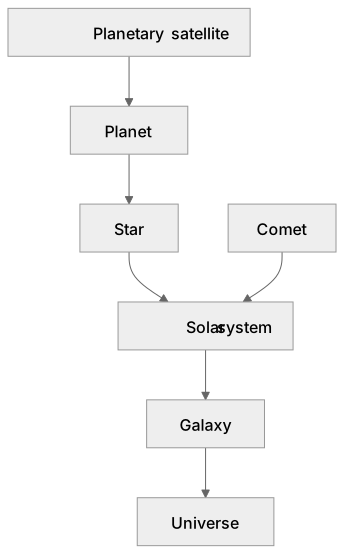
This section builds the vocabulary of scale used throughout astronomy. A planet orbits a star, is massive enough for gravity to make it approximately spherical, and has cleared other bodies from its orbital neighbourhood; a planetary satellite (moon) orbits a planet rather than the Sun. A comet is a small icy body, often on a highly eccentric orbit, that develops a coma and tail when heated near the Sun. A solar system is a star together with the planets, satellites, comets and other bodies gravitationally bound to it. A galaxy is a gravitationally bound system of stars, gas, dust and dark matter, typically containing many billions of stars; the universe is all matter, energy and space, including every galaxy. Learn the nesting order: satellite orbits planet, planet orbits star, stars group into galaxies, galaxies make up the universe.
What earns the marks
- A planet orbits a star and has cleared its orbital neighbourhood.
- A planetary satellite orbits a planet, not a star directly.
- A comet is a small icy body that forms a coma and tail near the Sun.
- A solar system comprises a star and all bodies gravitationally bound to it.
- A galaxy is a gravitationally bound system of many stars, gas, dust and dark matter.
- The universe is the totality of matter, energy and space, containing all galaxies.
Common mistakes and how to put them right
Confusing a planetary satellite with a planet.
Put it right: A satellite orbits a planet, whereas a planet orbits a star.
Believing a comet is a star or a burning body.
Put it right: A comet is icy and shines mainly by reflected sunlight and emission from its coma.
Treating a galaxy and a solar system as the same scale.
Put it right: A galaxy contains many millions or billions of stars, while a solar system contains one star and its bound bodies.
Exam tips
- Learn the definitions as a nested hierarchy so you can place any named object correctly.
- In multiple-choice questions, eliminate options that mix up what orbits what.
- Use precise terms such as planetary satellite rather than moon if the option wording is technical.
Try the lesson
The start of the Stars: (a) the terms planets, planetary satellites, comets, solar systems, galaxies and the universe lesson, made from checked teaching notes for this specification point.
Listen
This section builds the vocabulary of scale used throughout astronomy. A planet orbits a star, is massive enough for gravity to make it approximately spherical, and has cleared other bodies from its orbital neighbourhood; a planetary satellite (moon) orbits a planet rather than the Sun. A comet is a small icy body, often on a highly eccentric orbit, that develops a coma and tail when heated near the Sun. A solar system is a star together with the planets, satellites, comets and other bodies gravitationally bound to it. A galaxy is a gravitationally bound system of stars, gas, dust and dark matter, typically containing many billions of stars; the universe is all matter, energy and space, including every galaxy. Learn the nesting order: satellite orbits planet, planet orbits star, stars group into galaxies, galaxies make up the universe. A strong answer earns marks for these points. A planet orbits a star and has cleared its orbital neighbourhood. A planetary satellite orbits a planet, not a star directly. A comet is a small icy body that forms a coma and tail near the Sun. A solar system comprises a star and all bodies gravitationally bound to it. Exam tip: Learn the definitions as a nested hierarchy so you can place any named object correctly.
See it
Key words
Say what each word means before you turn the card.
Planet
Try answering aloud or in your head before turning the card.
Planetary satellite
Try answering aloud or in your head before turning the card.
Comet
Try answering aloud or in your head before turning the card.
Solar system
Try answering aloud or in your head before turning the card.
See every definition
- Planet
- Orbits a star, is massive enough for gravity to make it approximately spherical, and has cleared other bodies from its orbital neighbourhood.
- Planetary satellite
- Orbits a planet rather than the Sun.
- Comet
- A small icy body, often on a highly eccentric orbit, that develops a coma and tail when heated near the Sun.
- Solar system
- A star together with the planets, satellites, comets and other bodies gravitationally bound to it.
Label the diagram
Some boxes have lost their names. Pick the right name for each number.
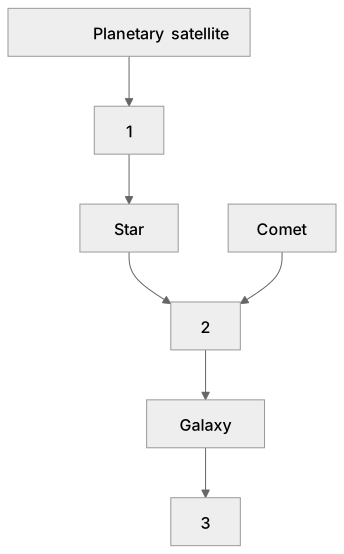
1Box 1
2Box 2
3Box 3
There is more to this lesson
The full lesson goes on to check your understanding and help you earn the marks. Create a free account to carry on, with your progress saved.
A week of Premium from your first lesson · Then the free plan continues · No card, no charge
Test your understanding of Stars: (a) the terms planets, planetary satellites, comets, solar systems, galaxies and the universe
Active recall beats re-reading. Take an instant quiz now to test what you’ve learned and lock it into long-term memory.
A week of Premium from your first lesson · Then the free plan continues · No card, no charge