OCR · A-Level · Physics
Course version: H556 · Version from Sept 2015
(b) formation of a star from interstellar dust and gas in terms of…
Full specification wording
Stars: (b) formation of a star from interstellar dust and gas in terms of gravitational collapse, fusion of hydrogen into helium, radiation and gas pressure
Stars form when a region of interstellar dust and gas, mainly hydrogen, becomes dense enough for gravity to overcome internal pressure.
Checked against the OCR H556 specification (opens in a new tab) on .
- Point 2 of 7
- 4 key terms
Study notes
From the checked teaching notes for this specification point.
The idea
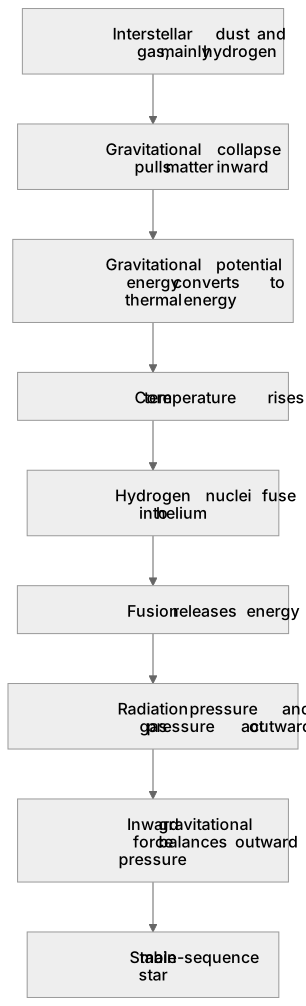
Stars form when a region of interstellar dust and gas, mainly hydrogen, becomes dense enough for gravity to overcome internal pressure. Gravitational collapse pulls matter inward, gravitational potential energy converts to thermal energy, and the core temperature rises. When the core reaches roughly 10⁷ K, hydrogen nuclei fuse into helium, releasing energy. Fusion products include gamma-ray photons, which are absorbed and re-emitted at lower energies, and the resulting radiation pressure plus gas pressure acts outward. A stable main-sequence star exists when inward gravitational force balances outward pressure, a condition called hydrostatic equilibrium. The mass of the collapsing cloud determines the star's eventual luminosity, surface temperature and lifetime.
What earns the marks
- Interstellar dust and gas, mainly hydrogen, collapses under gravity.
- Gravitational potential energy converts to thermal energy, raising core temperature.
- At sufficiently high temperature, hydrogen nuclei fuse into helium.
- Fusion releases energy, producing radiation pressure.
- Gas pressure and radiation pressure act outward against gravity.
- A stable star forms when inward gravitational force balances outward pressure.
Common mistakes and how to put them right
Saying stars form from burning gas.
Put it right: Star formation begins with gravitational collapse, and fusion only starts once the core is hot enough.
Claiming fusion produces only light with no pressure effect.
Put it right: The radiation from fusion contributes significantly to the outward pressure.
Ignoring gas pressure and mentioning only radiation pressure.
Put it right: Both gas pressure and radiation pressure support the star against gravity.
Exam tips
- Use the sequence collapse, heating, fusion, pressure balance as a mental checklist.
- Link each stage to an energy transfer: gravitational to thermal, then nuclear to radiation.
- In multiple-choice questions, reject options that place fusion before gravitational heating.
Try the lesson
The start of the Stars: (b) formation of a star from interstellar dust and gas in terms of gravitational collapse, fusion of hydrogen into helium, radiation and gas pressure lesson, made from checked teaching notes for this specification point.
Listen
Stars form when a region of interstellar dust and gas, mainly hydrogen, becomes dense enough for gravity to overcome internal pressure. Gravitational collapse pulls matter inward, gravitational potential energy converts to thermal energy, and the core temperature rises. When the core reaches roughly 10⁷ K, hydrogen nuclei fuse into helium, releasing energy. Fusion products include gamma-ray photons, which are absorbed and re-emitted at lower energies, and the resulting radiation pressure plus gas pressure acts outward. A stable main-sequence star exists when inward gravitational force balances outward pressure, a condition called hydrostatic equilibrium. The mass of the collapsing cloud determines the star's eventual luminosity, surface temperature and lifetime. A strong answer earns marks for these points. Interstellar dust and gas, mainly hydrogen, collapses under gravity. Gravitational potential energy converts to thermal energy, raising core temperature. At sufficiently high temperature, hydrogen nuclei fuse into helium. Fusion releases energy, producing radiation pressure. Exam tip: Use the sequence collapse, heating, fusion, pressure balance as a mental checklist.
See it
Key words
Say what each word means before you turn the card.
Gravitational collapse
Try answering aloud or in your head before turning the card.
Nuclear fusion in stellar cores
Try answering aloud or in your head before turning the card.
Hydrostatic equilibrium
Try answering aloud or in your head before turning the card.
Mass dependence of stellar properties
Try answering aloud or in your head before turning the card.
See every definition
- Gravitational collapse
- A region of interstellar dust and gas, mainly hydrogen, becomes dense enough for gravity to overcome internal pressure, pulling matter inward.
- Nuclear fusion in stellar cores
- When the core reaches roughly 10⁷ K, hydrogen nuclei fuse into helium, releasing energy.
- Hydrostatic equilibrium
- A stable main-sequence star exists when inward gravitational force balances outward pressure.
- Mass dependence of stellar properties
- The mass of the collapsing cloud determines the star's eventual luminosity, surface temperature and lifetime.
Label the diagram
Some boxes have lost their names. Pick the right name for each number.
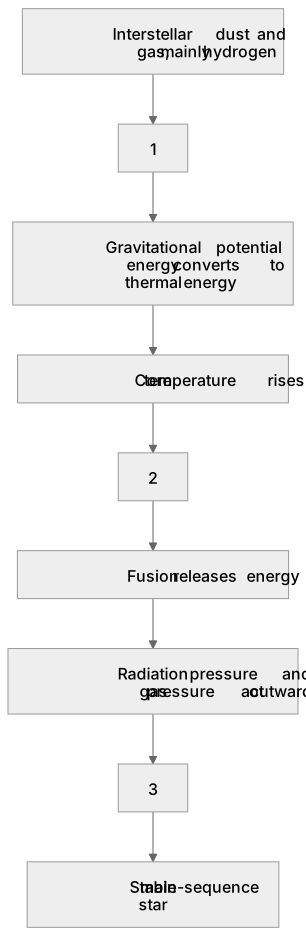
1Box 1
2Box 2
3Box 3
There is more to this lesson
The full lesson goes on to check your understanding and help you earn the marks. Create a free account to carry on, with your progress saved.
A week of Premium from your first lesson · Then the free plan continues · No card, no charge
Test your understanding of Stars: (b) formation of a star from interstellar dust and gas in terms of gravitational collapse, fusion of hydrogen into helium, radiation and gas pressure
Active recall beats re-reading. Take an instant quiz now to test what you’ve learned and lock it into long-term memory.
A week of Premium from your first lesson · Then the free plan continues · No card, no charge