OCR · A-Level · Physics
Course version: H556 · Version from Sept 2015
(c) evolution of a low-mass star like our Sun into a red giant and white…
Full specification wording
Stars: (c) evolution of a low-mass star like our Sun into a red giant and white dwarf; planetary nebula
A low-mass star such as the Sun spends most of its life on the main sequence fusing hydrogen into helium in its core.
Checked against the OCR H556 specification (opens in a new tab) on .
- Point 3 of 7
- 4 key terms
Study notes
From the checked teaching notes for this specification point.
The idea
A low-mass star such as the Sun spends most of its life on the main sequence fusing hydrogen into helium in its core. When core hydrogen is exhausted, the core contracts and heats while hydrogen fusion continues in a shell around it. The outer layers expand and cool, so the star becomes a red giant with a larger radius and lower surface temperature. Later, the outer layers are ejected as a planetary nebula, an expanding shell of gas ionised by the exposed hot core. The remaining core is a white dwarf, supported by electron degeneracy pressure rather than fusion. It gradually cools and fades over billions of years. The planetary nebula has nothing to do with planets; the name is historical.
What earns the marks
- A low-mass star fuses hydrogen in its core on the main sequence.
- When core hydrogen is exhausted, the core contracts and hydrogen shell fusion begins.
- The outer layers expand and cool, forming a red giant.
- The outer layers are ejected as a planetary nebula.
- The exposed core becomes a white dwarf supported by electron degeneracy pressure.
- The white dwarf cools and fades over a long time.
Common mistakes and how to put them right
Thinking a red giant is hotter than the Sun.
Put it right: A red giant has a larger radius but a cooler surface, so it appears red.
Believing a planetary nebula forms planets.
Put it right: It is an expanding shell of ejected gas, and the name is historical.
Saying a white dwarf continues fusion.
Put it right: Fusion has ceased, and the white dwarf is supported by electron degeneracy pressure.
Exam tips
- Sequence the stages: main sequence, red giant, planetary nebula, white dwarf.
- Link colour to surface temperature, not to the star's age alone.
- In multiple-choice questions, reject options that give a white dwarf an active fusion core.
Try the lesson
The start of the Stars: (c) evolution of a low-mass star like our Sun into a red giant and white dwarf; planetary nebula lesson, made from checked teaching notes for this specification point.
Listen
A low-mass star such as the Sun spends most of its life on the main sequence fusing hydrogen into helium in its core. When core hydrogen is exhausted, the core contracts and heats while hydrogen fusion continues in a shell around it. The outer layers expand and cool, so the star becomes a red giant with a larger radius and lower surface temperature. Later, the outer layers are ejected as a planetary nebula, an expanding shell of gas ionised by the exposed hot core. The remaining core is a white dwarf, supported by electron degeneracy pressure rather than fusion. It gradually cools and fades over billions of years. The planetary nebula has nothing to do with planets; the name is historical. A strong answer earns marks for these points. A low-mass star fuses hydrogen in its core on the main sequence. When core hydrogen is exhausted, the core contracts and hydrogen shell fusion begins. The outer layers expand and cool, forming a red giant. The outer layers are ejected as a planetary nebula. Exam tip: Sequence the stages: main sequence, red giant, planetary nebula, white dwarf.
See it
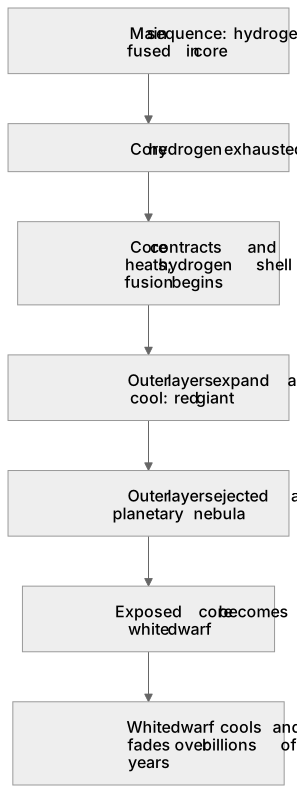
Put it in order
Put these steps in the order they happen.
- 1. White dwarf cools and fades over billions of years
- 2. Exposed core becomes white dwarf
- 3. Core contracts and heats; hydrogen shell fusion begins
- 4. Outer layers ejected as planetary nebula
- 5. Main sequence: hydrogen fused in core
- 6. Core hydrogen exhausted
- 7. Outer layers expand and cool: red giant
Key words
Say what each word means before you turn the card.
Red giant
Try answering aloud or in your head before turning the card.
Planetary nebula
Try answering aloud or in your head before turning the card.
White dwarf
Try answering aloud or in your head before turning the card.
Electron degeneracy pressure
Try answering aloud or in your head before turning the card.
See every definition
- Red giant
- A star whose outer layers expand and cool after core hydrogen is exhausted, giving a larger radius and lower surface temperature.
- Planetary nebula
- An expanding shell of gas ejected from the star and ionised by the exposed hot core; the name is historical and has nothing to do with planets.
- White dwarf
- The remaining core after the outer layers are ejected, supported by electron degeneracy pressure rather than fusion, which gradually cools and fades over billions of years.
- Electron degeneracy pressure
- The pressure that supports a white dwarf once fusion has ceased.
Label the diagram
Some boxes have lost their names. Pick the right name for each number.
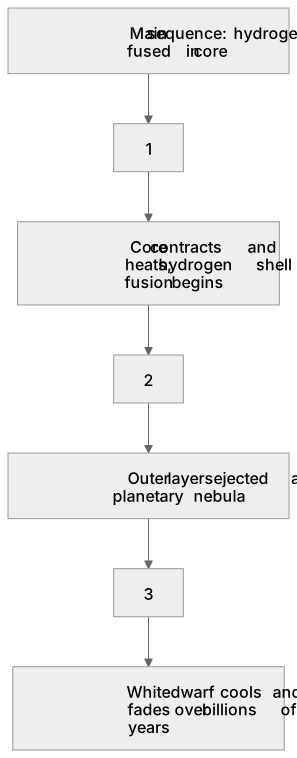
1Box 1
2Box 2
3Box 3
There is more to this lesson
The full lesson goes on to check your understanding and help you earn the marks. Create a free account to carry on, with your progress saved.
A week of Premium from your first lesson · Then the free plan continues · No card, no charge
Test your understanding of Stars: (c) evolution of a low-mass star like our Sun into a red giant and white dwarf; planetary nebula
Active recall beats re-reading. Take an instant quiz now to test what you’ve learned and lock it into long-term memory.
A week of Premium from your first lesson · Then the free plan continues · No card, no charge