OCR · A-Level · Physics
Course version: H556 · Version from Sept 2015
(e) evolution of a massive star into a red super giant and then either a…
Full specification wording
Stars: (e) evolution of a massive star into a red super giant and then either a neutron star or black hole; supernova
A massive star, meaning one with much more mass than the Sun, leaves the main sequence and expands into a red super giant.
Checked against the OCR H556 specification (opens in a new tab) on .
- Point 5 of 7
- 4 key terms
Study notes
From the checked teaching notes for this specification point.
The idea
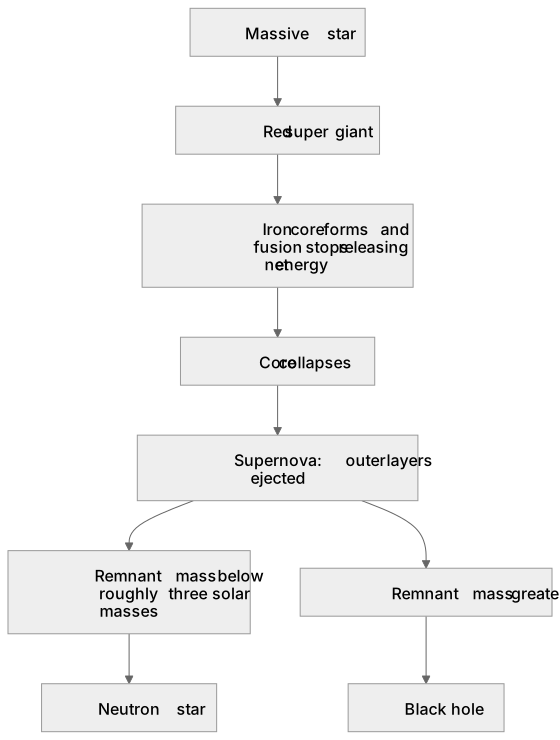
A massive star, meaning one with much more mass than the Sun, leaves the main sequence and expands into a red super giant. Its core continues fusing heavier nuclei until iron builds up, and fusion can no longer release net energy. The core then collapses rapidly, and the outer layers are blown away in a supernova explosion. What remains depends on the mass of the collapsed core: a neutron star forms if the remnant mass is below roughly three solar masses, while a black hole forms if it is greater. So the route is massive star, red super giant, supernova, then either neutron star or black hole.
What earns the marks
- A massive star evolves off the main sequence to become a red super giant.
- Core fusion proceeds to heavier elements until an iron core forms and fusion stops releasing net energy.
- The core collapses and the outer layers are ejected in a supernova.
- The final remnant is a neutron star or a black hole, depending on the mass of the collapsed core.
Common mistakes and how to put them right
Thinking every star becomes a red super giant.
Put it right: Only massive stars do, while lower-mass stars become red giants.
Believing the supernova leaves only a black hole.
Put it right: A neutron star is the more common remnant for many massive stars.
Assuming the supernova creates the remnant from nothing.
Put it right: The remnant is the collapsed core left behind after the outer layers are ejected.
Exam tips
- Learn the sequence as a chain: massive star, red super giant, supernova, neutron star or black hole.
- Link the final outcome to the mass of the remaining core, not to the original mass alone.
- Use the term supernova for the explosion and super red giant or red super giant for the expanded star, keeping the two ideas separate.
Try the lesson
The start of the Stars: (e) evolution of a massive star into a red super giant and then either a neutron star or black hole; supernova lesson, made from checked teaching notes for this specification point.
Listen
A massive star, meaning one with much more mass than the Sun, leaves the main sequence and expands into a red super giant. Its core continues fusing heavier nuclei until iron builds up, and fusion can no longer release net energy. The core then collapses rapidly, and the outer layers are blown away in a supernova explosion. What remains depends on the mass of the collapsed core: a neutron star forms if the remnant mass is below roughly three solar masses, while a black hole forms if it is greater. So the route is massive star, red super giant, supernova, then either neutron star or black hole. A strong answer earns marks for these points. A massive star evolves off the main sequence to become a red super giant. Core fusion proceeds to heavier elements until an iron core forms and fusion stops releasing net energy. The core collapses and the outer layers are ejected in a supernova. The final remnant is a neutron star or a black hole, depending on the mass of the collapsed core. Exam tip: Learn the sequence as a chain: massive star, red super giant, supernova, neutron star or black hole.
See it
Key words
Say what each word means before you turn the card.
Massive stars
Try answering aloud or in your head before turning the card.
Supernova
Try answering aloud or in your head before turning the card.
Neutron star
Try answering aloud or in your head before turning the card.
Black hole
Try answering aloud or in your head before turning the card.
See every definition
- Massive stars
- Stars with much more mass than the Sun, which evolve off the main sequence to become a red super giant.
- Supernova
- The explosion in which the core collapses rapidly and the outer layers are blown away.
- Neutron star
- The remnant that forms if the mass of the collapsed core is below roughly three solar masses.
- Black hole
- The remnant that forms if the mass of the collapsed core is greater than roughly three solar masses.
Label the diagram
Some boxes have lost their names. Pick the right name for each number.
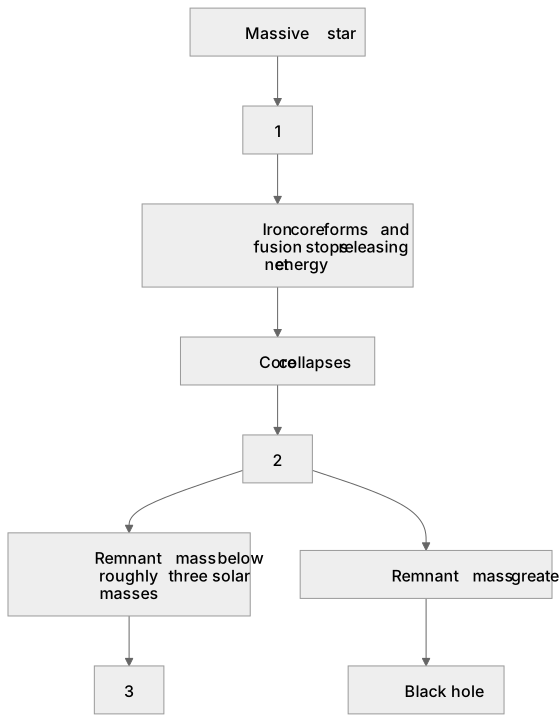
1Box 1
2Box 2
3Box 3
There is more to this lesson
The full lesson goes on to check your understanding and help you earn the marks. Create a free account to carry on, with your progress saved.
A week of Premium from your first lesson · Then the free plan continues · No card, no charge
Test your understanding of Stars: (e) evolution of a massive star into a red super giant and then either a neutron star or black hole; supernova
Active recall beats re-reading. Take an instant quiz now to test what you’ve learned and lock it into long-term memory.
A week of Premium from your first lesson · Then the free plan continues · No card, no charge