OCR · A-Level · Physics
Course version: H556 · Version from Sept 2015
Stars: (f) characteristics of a neutron star and a black hole
A neutron star is the collapsed core left after a supernova.
Checked against the OCR H556 specification (opens in a new tab) on .
- Point 6 of 7
- 4 key terms
Study notes
From the checked teaching notes for this specification point.
The idea
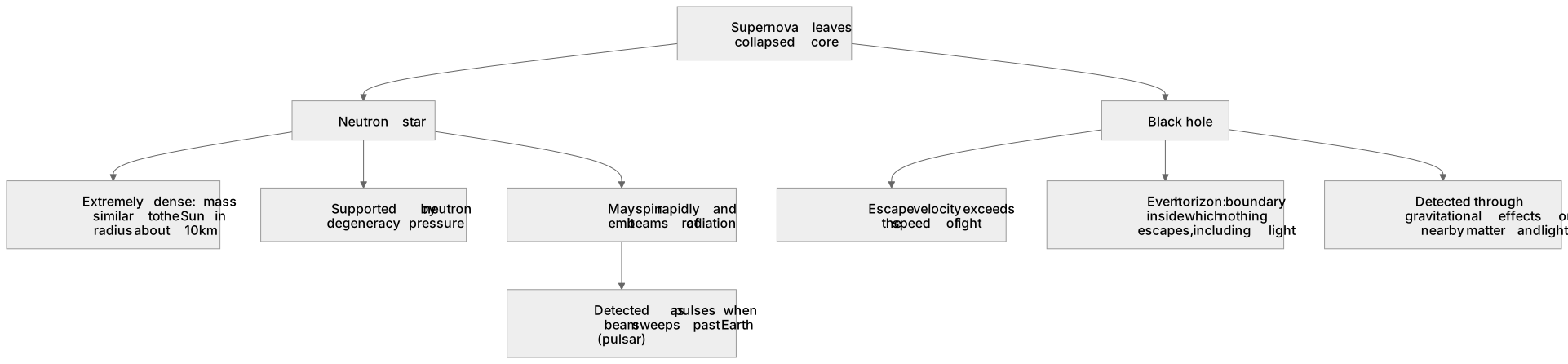
A neutron star is the collapsed core left after a supernova. It is extremely dense, with a mass similar to the Sun packed into a radius of about 10 km, and it is supported against further collapse by neutron degeneracy pressure. Many neutron stars spin rapidly and emit beams of radiation, detected as pulses when the beam sweeps past Earth. A black hole is a region where gravity is so strong that the escape velocity exceeds the speed of light, so nothing, not even light, can escape from inside the event horizon. Its observable effects come from its gravitational pull on nearby matter and light.
What earns the marks
- A neutron star is extremely dense, with a mass comparable to the Sun in a radius of roughly 10 km.
- Neutron stars are supported by neutron degeneracy pressure and may be observed as pulsars.
- A black hole has an escape velocity greater than the speed of light.
- The event horizon marks the boundary inside which nothing can escape, including light.
Common mistakes and how to put them right
Confusing a neutron star with a white dwarf.
Put it right: A white dwarf is supported by electron degeneracy pressure and is much less dense.
Thinking a black hole can be seen directly.
Put it right: It is detected through its gravitational effects on nearby matter and light.
Believing a black hole has a solid surface.
Put it right: The event horizon is a boundary in space, not a material surface.
Exam tips
- Compare the two objects using density, size and escape velocity.
- Use the phrase event horizon when describing the boundary of a black hole.
- Remember that a pulsar is a rotating neutron star emitting beams of radiation, not a separate type of remnant.
Try the lesson
The start of the Stars: (f) characteristics of a neutron star and a black hole lesson, made from checked teaching notes for this specification point.
Listen
A neutron star is the collapsed core left after a supernova. It is extremely dense, with a mass similar to the Sun packed into a radius of about 10 km, and it is supported against further collapse by neutron degeneracy pressure. Many neutron stars spin rapidly and emit beams of radiation, detected as pulses when the beam sweeps past Earth. A black hole is a region where gravity is so strong that the escape velocity exceeds the speed of light, so nothing, not even light, can escape from inside the event horizon. Its observable effects come from its gravitational pull on nearby matter and light. A strong answer earns marks for these points. A neutron star is extremely dense, with a mass comparable to the Sun in a radius of roughly 10 km. Neutron stars are supported by neutron degeneracy pressure and may be observed as pulsars. A black hole has an escape velocity greater than the speed of light. The event horizon marks the boundary inside which nothing can escape, including light. Exam tip: Compare the two objects using density, size and escape velocity.
See it
Key words
Say what each word means before you turn the card.
Neutron star
Try answering aloud or in your head before turning the card.
Pulsar
Try answering aloud or in your head before turning the card.
Black hole
Try answering aloud or in your head before turning the card.
Event horizon
Try answering aloud or in your head before turning the card.
See every definition
- Neutron star
- The collapsed core left after a supernova, extremely dense, with a mass similar to the Sun packed into a radius of about 10 km, and supported against further collapse by neutron degeneracy pressure.
- Pulsar
- A rapidly spinning neutron star that emits beams of radiation, detected as pulses when the beam sweeps past Earth.
- Black hole
- A region where gravity is so strong that the escape velocity exceeds the speed of light, so nothing, not even light, can escape from inside the event horizon.
- Event horizon
- The boundary inside which nothing can escape, including light.
Label the diagram
Some boxes have lost their names. Pick the right name for each number.
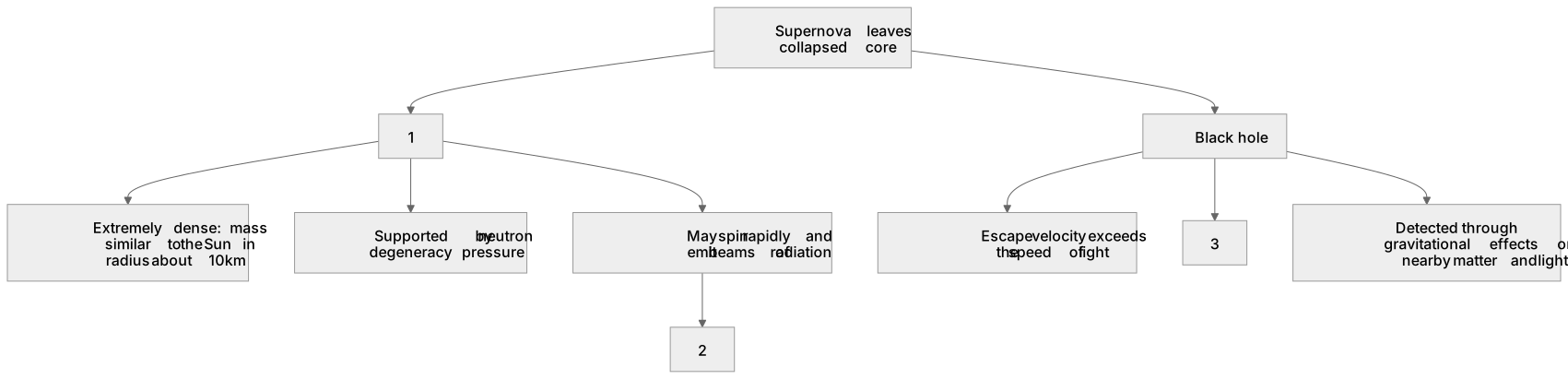
1Box 1
2Box 2
3Box 3
There is more to this lesson
The full lesson goes on to check your understanding and help you earn the marks. Create a free account to carry on, with your progress saved.
A week of Premium from your first lesson · Then the free plan continues · No card, no charge
Test your understanding of Stars: (f) characteristics of a neutron star and a black hole
Active recall beats re-reading. Take an instant quiz now to test what you’ve learned and lock it into long-term memory.
A week of Premium from your first lesson · Then the free plan continues · No card, no charge