OCR · A-Level · Physics
Course version: H556 · Version from Sept 2015
(d) constructive interference and destructive interference in terms of…
Full specification wording
Superposition: (d) constructive interference and destructive interference in terms of path difference and phase difference
When two waves meet, their displacements add.
Checked against the OCR H556 specification (opens in a new tab) on .
- Point 4 of 10
- 4 key terms
Study notes
From the checked teaching notes for this specification point.
The idea
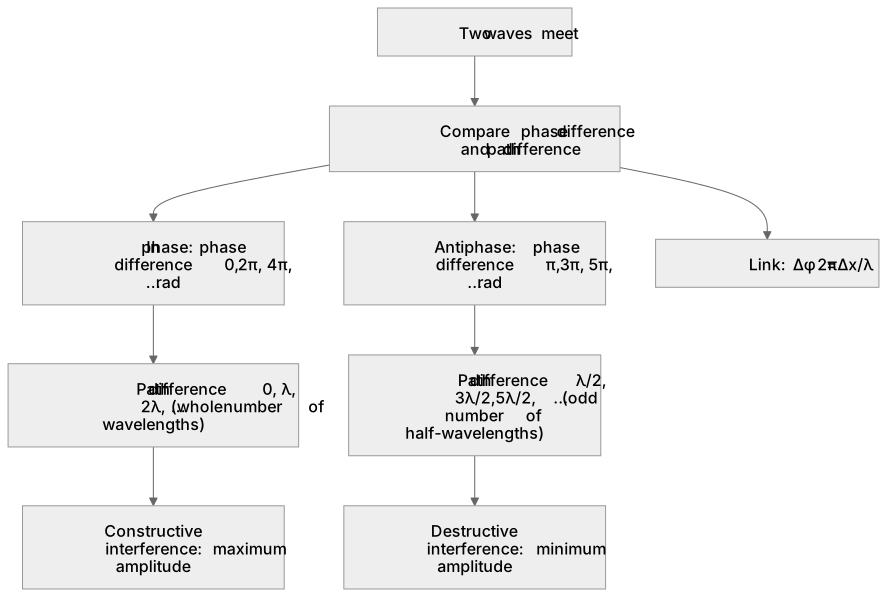
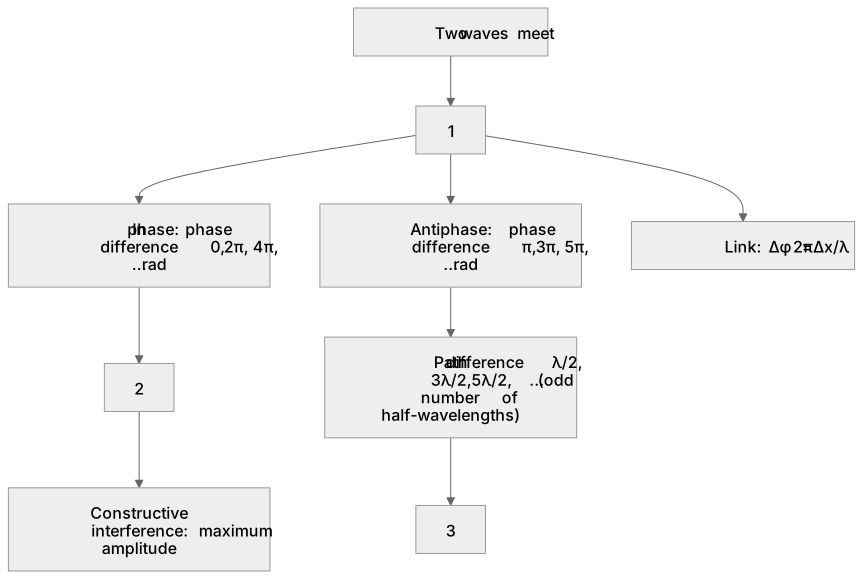
When two waves meet, their displacements add. Constructive interference gives maximum amplitude when the waves arrive in phase: phase difference is zero or a whole number of cycles (0, 2π, 4π, ...), and path difference is zero or a whole number of wavelengths (0, λ, 2λ, ...). Destructive interference gives minimum amplitude when the waves arrive in antiphase: phase difference is an odd number of π (π, 3π, 5π, ...), and path difference is an odd number of half-wavelengths (λ/2, 3λ/2, 5λ/2, ...). Phase difference and path difference are linked by Δφ = 2πΔx/λ, where Δx is path difference and λ is wavelength.
For example: If λ = 0.60 m and Δx = 0.90 m, then Δx = 1.5λ, so Δφ = 3π rad and the interference is destructive.
What earns the marks
- Constructive interference occurs when waves arrive in phase, with phase difference 0, 2π, 4π, ... rad.
- Constructive interference occurs when path difference is 0, λ, 2λ, ... (a whole number of wavelengths).
- Destructive interference occurs when waves arrive in antiphase, with phase difference π, 3π, 5π, ... rad.
- Destructive interference occurs when path difference is λ/2, 3λ/2, 5λ/2, ... (an odd number of half-wavelengths).
- Phase difference and path difference are related by Δφ = 2πΔx/λ.
Common mistakes and how to put them right
Thinking that destructive interference means the waves cancel completely everywhere.
Put it right: At a point of destructive interference the resultant displacement is zero at that instant, but energy is redistributed and the waves still exist.
Confusing path difference with phase difference.
Put it right: Path difference is a distance in metres, while phase difference is an angle in radians, linked by Δφ = 2πΔx/λ.
Assuming any path difference produces constructive interference.
Put it right: Only whole-number multiples of λ give constructive interference, while odd multiples of λ/2 give destructive interference.
Forgetting that phase difference can be expressed in radians or degrees.
Put it right: 2π rad equals 360°, so π rad equals 180° and represents antiphase.
Exam tips
- Read the question carefully to see whether it asks about path difference or phase difference, and give the answer in the correct unit.
- When calculating, convert path difference to a multiple of wavelength first; this makes it easy to classify as constructive or destructive.
- Remember that a path difference of exactly λ/2 gives destructive interference, not constructive, because it corresponds to a phase difference of π rad.
- If a question gives phase difference in degrees, convert to radians before using Δφ = 2πΔx/λ, or work directly with the fraction of a cycle.
Try the lesson
The start of the Superposition: (d) constructive interference and destructive interference in terms of path difference and phase difference lesson, made from checked teaching notes for this specification point.
Listen
When two waves meet, their displacements add. Constructive interference gives maximum amplitude when the waves arrive in phase: phase difference is zero or a whole number of cycles (0, 2π, 4π, ...), and path difference is zero or a whole number of wavelengths (0, λ, 2λ, ... Destructive interference gives minimum amplitude when the waves arrive in antiphase: phase difference is an odd number of π (π, 3π, 5π, ...), and path difference is an odd number of half-wavelengths (λ/2, 3λ/2, 5λ/2, ... Phase difference and path difference are linked by Δφ = 2πΔx/λ, where Δx is path difference and λ is wavelength. For example, if λ = 0.60 m and Δx = 0.90 m, then Δx = 1.5λ, so Δφ = 3π rad and the interference is destructive. A strong answer earns marks for these points. Constructive interference occurs when waves arrive in phase, with phase difference 0, 2π, 4π, ... rad. Constructive interference occurs when path difference is 0, λ, 2λ, ... a whole number of wavelengths). Destructive interference occurs when waves arrive in antiphase, with phase difference π, 3π, 5π, ... rad. Destructive interference occurs when path difference is λ/2, 3λ/2, 5λ/2, ... an odd number of half-wavelengths). A common slip: Thinking that destructive interference means the waves cancel completely everywhere. Instead, at a point of destructive interference the resultant displacement is zero at that instant, but energy is redistributed and the waves still exist. Exam tip: Read the question carefully to see whether it asks about path difference or phase difference, and give the answer in the correct unit.
See it
Key words
Say what each word means before you turn the card.
Constructive interference
Try answering aloud or in your head before turning the card.
Destructive interference
Try answering aloud or in your head before turning the card.
Path difference
Try answering aloud or in your head before turning the card.
Phase difference
Try answering aloud or in your head before turning the card.
See every definition
- Constructive interference
- Gives maximum amplitude when the waves arrive in phase, with phase difference zero or a whole number of cycles and path difference zero or a whole number of wavelengths.
- Destructive interference
- Gives minimum amplitude when the waves arrive in antiphase, with phase difference an odd number of π and path difference an odd number of half-wavelengths.
- Path difference
- A distance in metres, linked to phase difference by Δφ = 2πΔx/λ, where Δx is path difference and λ is wavelength.
- Phase difference
- An angle in radians, linked to path difference by Δφ = 2πΔx/λ, where Δx is path difference and λ is wavelength.
Label the diagram
Some boxes have lost their names. Pick the right name for each number.
1Box 1
2Box 2
3Box 3
There is more to this lesson
The full lesson goes on to check your understanding and help you earn the marks. Create a free account to carry on, with your progress saved.
A week of Premium from your first lesson · Then the free plan continues · No card, no charge
Test your understanding of Superposition: (d) constructive interference and destructive interference in terms of path difference and phase difference
Active recall beats re-reading. Take an instant quiz now to test what you’ve learned and lock it into long-term memory.
A week of Premium from your first lesson · Then the free plan continues · No card, no charge