OCR · A-Level · Physics
Course version: H556 · Version from Sept 2015
Superposition: (e) two-source interference with sound and microwaves
Two-source interference can be demonstrated with sound and microwaves.
Checked against the OCR H556 specification (opens in a new tab) on .
- Point 5 of 10
- 4 key terms
Study notes
From the checked teaching notes for this specification point.
The idea
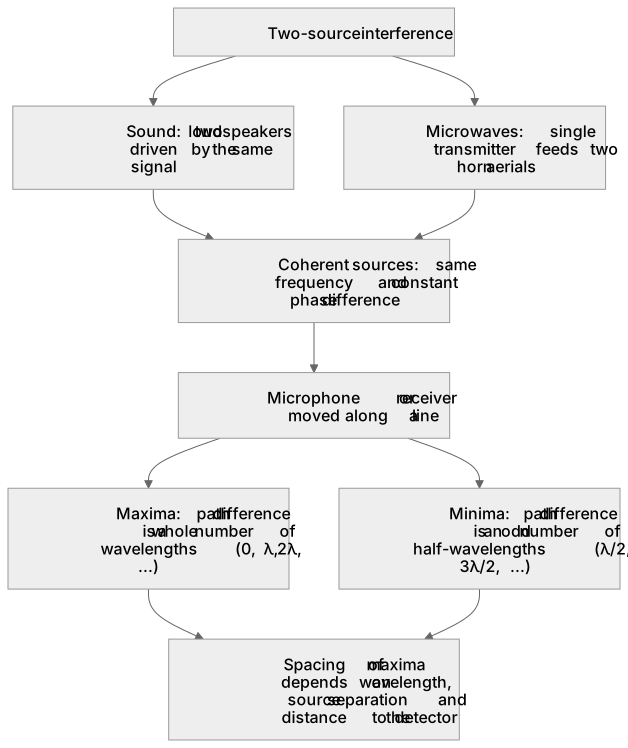
Two-source interference can be demonstrated with sound and microwaves. For sound, two loudspeakers driven by the same signal act as coherent sources; a microphone moved along a line parallel to the speakers detects alternating loud and quiet regions. For microwaves, a single transmitter feeds two horn aerials to produce coherent waves; a receiver moved along a line detects maxima and minima. In both cases, maxima occur where path difference is a whole number of wavelengths (0, λ, 2λ, ...) and minima where path difference is an odd number of half-wavelengths (λ/2, 3λ/2, ...). The fringe spacing or separation of maxima depends on wavelength, source separation and distance to the detector. Using microwaves of wavelength about 3 cm gives measurable spacings on a laboratory bench.
What earns the marks
- Two-source interference requires coherent sources: same frequency and constant phase difference.
- For sound, two loudspeakers connected to the same signal generator provide coherent sources; a microphone detects maxima and minima.
- For microwaves, a single transmitter split to two horn aerials provides coherent sources; a receiver detects maxima and minima.
- Maxima occur where path difference is a whole number of wavelengths; minima occur where path difference is an odd number of half-wavelengths.
- The spacing between adjacent maxima increases with wavelength and distance to the detector, and decreases with increasing source separation.
Common mistakes and how to put them right
Using two independent loudspeakers or transmitters without a common signal.
Put it right: The sources must be coherent, so they must be driven by the same oscillator or derived from the same transmitter.
Thinking that minima are points where no sound or microwave energy arrives.
Put it right: At minima the waves cancel at that point, but energy is redistributed to the maxima.
Assuming the interference pattern is the same for all wavelengths.
Put it right: Changing the wavelength changes the spacing of maxima and minima.
Confusing the condition for maxima and minima.
Put it right: Maxima correspond to path difference nλ, while minima correspond to (n + ½)λ.
Exam tips
- When describing an experiment, state how coherence is achieved, for example by connecting both loudspeakers to one signal generator.
- Use the wave equation v = fλ to find the wavelength from the frequency and speed of sound or microwaves before calculating path differences.
- For a given point, calculate the path difference from the source distances and compare it with λ to decide whether it is a maximum or minimum.
- Remember that the speed of sound in air is about 340 m/s and the speed of microwaves is the speed of light, 3.0 × 10⁸ m/s.
Try the lesson
The start of the Superposition: (e) two-source interference with sound and microwaves lesson, made from checked teaching notes for this specification point.
Listen
Two-source interference can be demonstrated with sound and microwaves. For sound, two loudspeakers driven by the same signal act as coherent sources; a microphone moved along a line parallel to the speakers detects alternating loud and quiet regions. For microwaves, a single transmitter feeds two horn aerials to produce coherent waves; a receiver moved along a line detects maxima and minima. In both cases, maxima occur where path difference is a whole number of wavelengths (0, λ, 2λ, ...) and minima where path difference is an odd number of half-wavelengths (λ/2, 3λ/2, ... The fringe spacing or separation of maxima depends on wavelength, source separation and distance to the detector. Using microwaves of wavelength about 3 cm gives measurable spacings on a laboratory bench. A strong answer earns marks for these points. Two-source interference requires coherent sources: same frequency and constant phase difference. For sound, two loudspeakers connected to the same signal generator provide coherent sources; a microphone detects maxima and minima. For microwaves, a single transmitter split to two horn aerials provides coherent sources; a receiver detects maxima and minima. Maxima occur where path difference is a whole number of wavelengths; minima occur where path difference is an odd number of half-wavelengths. A common slip: Using two independent loudspeakers or transmitters without a common signal. Instead, the sources must be coherent, so they must be driven by the same oscillator or derived from the same transmitter. Exam tip: When describing an experiment, state how coherence is achieved, for example by connecting both loudspeakers to one signal generator.
See it
Key words
Say what each word means before you turn the card.
Coherence
Try answering aloud or in your head before turning the card.
Interference of sound
Try answering aloud or in your head before turning the card.
Interference of microwaves
Try answering aloud or in your head before turning the card.
Path difference conditions
Try answering aloud or in your head before turning the card.
See every definition
- Coherence
- A property of sources having the same frequency and a constant phase difference.
- Interference of sound
- Two loudspeakers driven by the same signal act as coherent sources, and a microphone moved along a line parallel to the speakers detects alternating loud and quiet regions.
- Interference of microwaves
- A single transmitter feeds two horn aerials to produce coherent waves, and a receiver moved along a line detects maxima and minima.
- Path difference conditions
- Maxima occur where path difference is a whole number of wavelengths, and minima where path difference is an odd number of half-wavelengths.
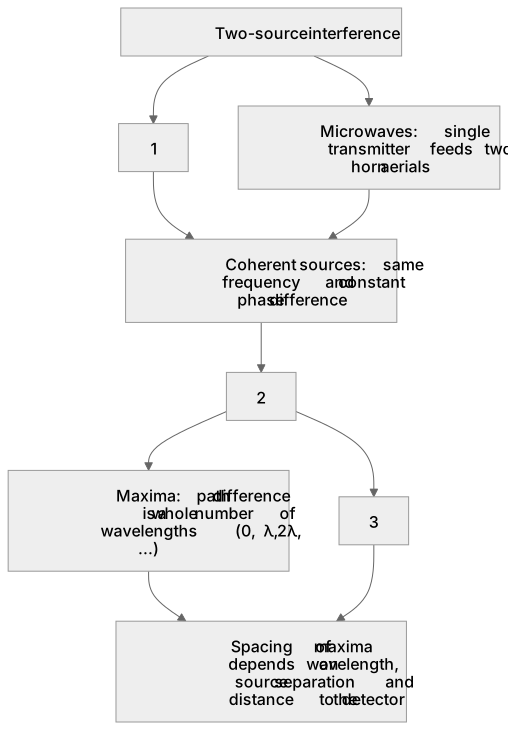
Label the diagram
Some boxes have lost their names. Pick the right name for each number.
1Box 1
2Box 2
3Box 3
There is more to this lesson
The full lesson goes on to check your understanding and help you earn the marks. Create a free account to carry on, with your progress saved.
A week of Premium from your first lesson · Then the free plan continues · No card, no charge
Test your understanding of Superposition: (e) two-source interference with sound and microwaves
Active recall beats re-reading. Take an instant quiz now to test what you’ve learned and lock it into long-term memory.
A week of Premium from your first lesson · Then the free plan continues · No card, no charge