OCR · A-Level · Physics
Course version: H556 · Version from Sept 2015
Superposition: (i) λ = ax/D for all waves where a ≪ D
This relationship links the wavelength λ of any wave to the geometry of a two-source interference pattern.
Checked against the OCR H556 specification (opens in a new tab) on .
- Point 7 of 10
Study notes
From the checked teaching notes for this specification point.
The idea
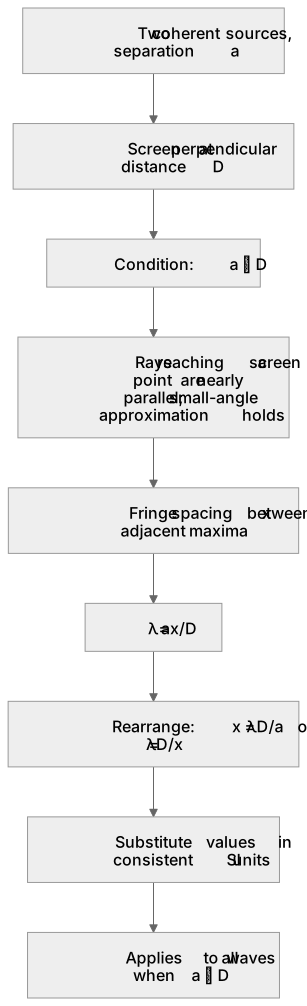
This relationship links the wavelength λ of any wave to the geometry of a two-source interference pattern. Here a is the separation of the two coherent sources, x is the fringe spacing measured between corresponding points on adjacent maxima, and D is the perpendicular distance from the source plane to the screen. The condition a ≪ D means the source separation is much smaller than the screen distance, so the rays reaching a point on the screen are nearly parallel and the small-angle approximation holds. Rearranged, λ = ax/D. For example, with a = 0.50 mm, x = 2.4 mm and D = 1.20 m, λ = (0.50 × 10⁻³ m × 2.4 × 10⁻³ m) / 1.20 m = 1.0 × 10⁻⁶ m. The equation applies to all waves, including sound and microwaves, provided the geometry condition is met.
What earns the marks
- States that λ = ax/D relates wavelength to source separation a, fringe spacing x and screen distance D.
- Identifies a as the separation of the two coherent sources and x as the spacing between adjacent maxima (or adjacent minima).
- Identifies D as the perpendicular distance from the sources to the screen, measured along the axis.
- Applies the condition a ≪ D, which justifies the small-angle approximation used to derive the equation.
- Rearranges correctly, for example x = λD/a or a = λD/x, and substitutes values with consistent SI units.
- Recognises that the equation applies to all waves, not only light, when the stated geometry condition is satisfied.
Common mistakes and how to put them right
Confusing a with the slit width.
Put it right by labelling a as source separation.
Measuring x across several fringes and forgetting to divide by the number of intervals.
Put it right: If n fringes span a distance, x equals that distance divided by n, not by n + 1.
Using D as the distance from one slit rather than from the source plane to the screen.
Put it right by measuring D perpendicular to the plane containing both sources.
Mixing units, such as millimetres for a and metres for D, without converting.
Put it right by converting every length to metres before substituting.
Exam tips
- Write the equation, rearrange it symbolically, then substitute values; this secures method credit even if the arithmetic slips.
- Check the a ≪ D condition in the question before using the equation; if it is not met, the small-angle derivation does not apply.
- Convert millimetres to metres by multiplying by 10⁻³, and quote the final wavelength with a sensible power of ten and unit.
- When a question gives the distance across several fringes, count the intervals between them, not the number of bright lines.
Try the lesson
The start of the Superposition: (i) λ = ax/D for all waves where a ≪ D lesson, made from checked teaching notes for this specification point.
Listen
This relationship links the wavelength λ of any wave to the geometry of a two-source interference pattern. Here a is the separation of the two coherent sources, x is the fringe spacing measured between corresponding points on adjacent maxima, and D is the perpendicular distance from the source plane to the screen. The condition a ≪ D means the source separation is much smaller than the screen distance, so the rays reaching a point on the screen are nearly parallel and the small-angle approximation holds. Rearranged, λ = ax/D. For example, with a = 0.50 mm, x = 2.4 mm and D = 1.20 m, λ = (0.50 × 10⁻³ m × 2.4 × 10⁻³ m) / 1.20 m = 1.0 × 10⁻⁶ m. The equation applies to all waves, including sound and microwaves, provided the geometry condition is met. A strong answer earns marks for these points. States that λ = ax/D relates wavelength to source separation a, fringe spacing x and screen distance D. Identifies a as the separation of the two coherent sources and x as the spacing between adjacent maxima (or adjacent minima). Identifies D as the perpendicular distance from the sources to the screen, measured along the axis. Applies the condition a ≪ D, which justifies the small-angle approximation used to derive the equation. A common slip: Confusing a with the slit width: a is the separation between the two sources, while slit width controls diffraction spreading. Instead, labelling a as source separation. Exam tip: Write the equation, rearrange it symbolically, then substitute values; this secures method credit even if the arithmetic slips.
See it
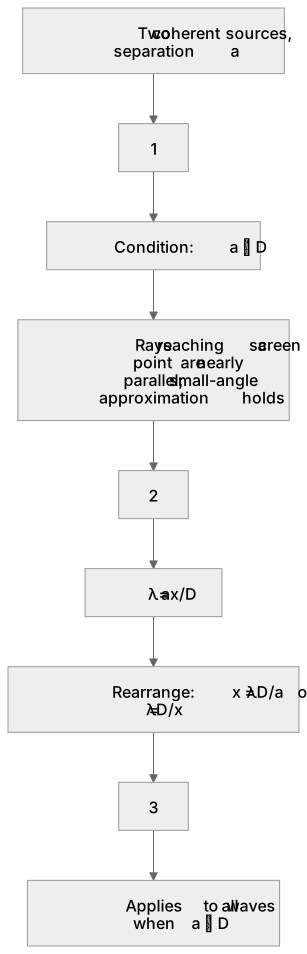
Label the diagram
Some boxes have lost their names. Pick the right name for each number.
1Box 1
2Box 2
3Box 3
There is more to this lesson
The full lesson goes on to check your understanding and help you earn the marks. Create a free account to carry on, with your progress saved.
A week of Premium from your first lesson · Then the free plan continues · No card, no charge
Test your understanding of Superposition: (i) λ = ax/D for all waves where a ≪ D
Active recall beats re-reading. Take an instant quiz now to test what you’ve learned and lock it into long-term memory.
A week of Premium from your first lesson · Then the free plan continues · No card, no charge