OCR · A-Level · Physics
Course version: H556 · Version from Sept 2015
Superposition: (f) Young double-slit experiment using visible light
Young's double-slit experiment demonstrates interference of visible light.
Checked against the OCR H556 specification (opens in a new tab) on .
- Point 6 of 10
Study notes
From the checked teaching notes for this specification point.
The idea
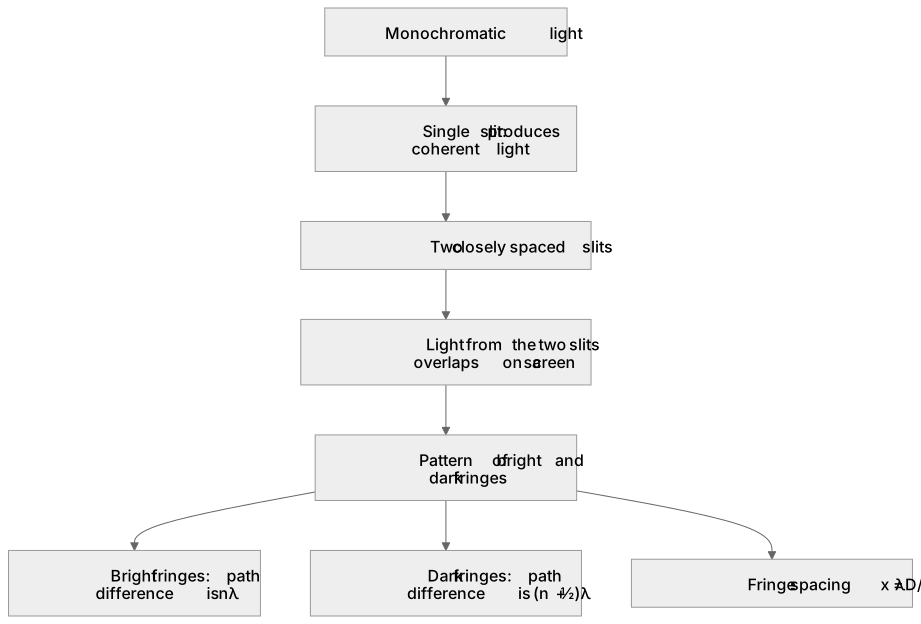
Young's double-slit experiment demonstrates interference of visible light. Monochromatic light passes through a single slit to produce coherent waves, which then illuminate two closely spaced slits. The light from the two slits overlaps on a screen, producing a pattern of bright and dark fringes. Bright fringes occur where path difference is a whole number of wavelengths (nλ), and dark fringes where path difference is an odd number of half-wavelengths ((n + ½)λ). The fringe spacing x is given by x = λD/a, where λ is wavelength, D is distance from slits to screen, and a is slit separation.
For example: With λ = 6.0 × 10⁻⁷ m, D = 2.0 m and a = 0.50 mm, x = (6.0 × 10⁻⁷ × 2.0) / (0.50 × 10⁻³) = 2.4 × 10⁻³ m = 2.4 mm.
What earns the marks
- Young's double-slit experiment uses a single slit to produce coherent light that then illuminates two slits.
- The two slits act as coherent sources because light diffracts from the single slit and reaches both slits with a constant phase difference.
- Bright fringes occur where path difference is nλ; dark fringes occur where path difference is (n + ½)λ.
- The fringe spacing is given by x = λD/a, where D is the distance from the slits to the screen and a is the slit separation.
- The fringe spacing increases with wavelength and distance to the screen, and decreases with increasing slit separation.
Common mistakes and how to put them right
Using two separate light sources instead of a single slit to illuminate the double slits.
Put it right: The single slit ensures coherence, which is necessary for a stable interference pattern.
Confusing the slit separation a with the distance D to the screen.
Put it right: A is the small distance between the two slits, while D is the much larger distance from the slits to the screen.
Forgetting to convert all lengths to metres before calculating.
Put it right: Convert millimetres to metres, for example 0.50 mm = 0.50 × 10⁻³ m.
Thinking that the central fringe is dark.
Put it right: The central fringe is bright because the path difference is zero, giving constructive interference.
Exam tips
- When using x = λD/a, identify which quantity is being asked for and rearrange the equation before substituting numbers.
- Keep units consistent: convert all lengths to metres, and express wavelength in metres.
- If the question gives the distance across several fringes, divide by the number of fringe spacings to find x.
- Remember that the fringe spacing is measured between the centres of adjacent bright fringes or adjacent dark fringes.
Try the lesson
The start of the Superposition: (f) Young double-slit experiment using visible light lesson, made from checked teaching notes for this specification point.
Listen
Young's double-slit experiment demonstrates interference of visible light. Monochromatic light passes through a single slit to produce coherent waves, which then illuminate two closely spaced slits. The light from the two slits overlaps on a screen, producing a pattern of bright and dark fringes. Bright fringes occur where path difference is a whole number of wavelengths (nλ), and dark fringes where path difference is an odd number of half-wavelengths ((n + ½)λ). The fringe spacing x is given by x = λD/a, where λ is wavelength, D is distance from slits to screen, and a is slit separation. For example, with λ = 6.0 × 10⁻⁷ m, D = 2.0 m and a = 0.50 mm, x = (6.0 × 10⁻⁷ × 2.0) / (0.50 × 10⁻³) = 2.4 × 10⁻³ m = 2.4 mm. A strong answer earns marks for these points. Young's double-slit experiment uses a single slit to produce coherent light that then illuminates two slits. The two slits act as coherent sources because light diffracts from the single slit and reaches both slits with a constant phase difference. Bright fringes occur where path difference is nλ; dark fringes occur where path difference is (n + ½)λ. The fringe spacing is given by x = λD/a, where D is the distance from the slits to the screen and a is the slit separation. A common slip: Using two separate light sources instead of a single slit to illuminate the double slits. Instead, the single slit ensures coherence, which is necessary for a stable interference pattern. Exam tip: When using x = λD/a, identify which quantity is being asked for and rearrange the equation before substituting numbers.
See it
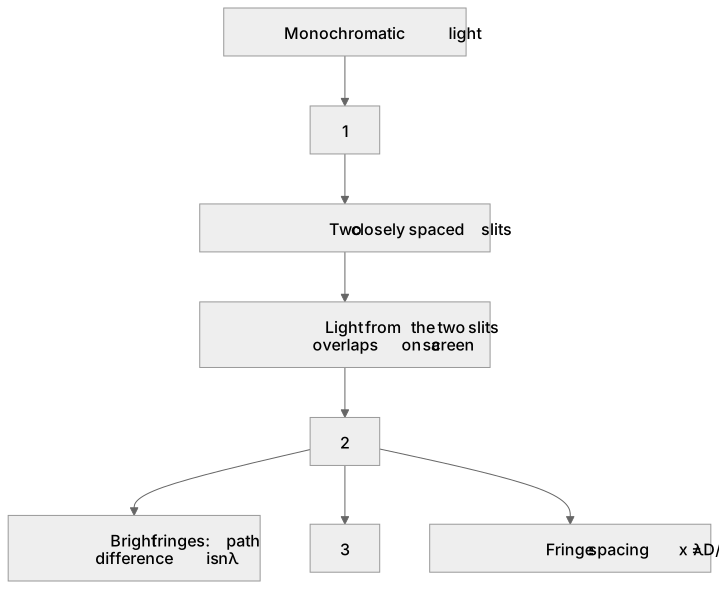
Label the diagram
Some boxes have lost their names. Pick the right name for each number.
1Box 1
2Box 2
3Box 3
There is more to this lesson
The full lesson goes on to check your understanding and help you earn the marks. Create a free account to carry on, with your progress saved.
A week of Premium from your first lesson · Then the free plan continues · No card, no charge
Test your understanding of Superposition: (f) Young double-slit experiment using visible light
Active recall beats re-reading. Take an instant quiz now to test what you’ve learned and lock it into long-term memory.
A week of Premium from your first lesson · Then the free plan continues · No card, no charge