OCR · A-Level · Physics
Course version: H556 · Version from Sept 2015
(c) Einstein’s photoelectric equation hf = φ + KEmax
Full specification wording
The photoelectric effect: (c) Einstein’s photoelectric equation hf = φ + KEmax
Einstein’s photoelectric equation is hf = φ + KEmax, where hf is the energy of one absorbed photon, φ is the work function of the metal surface and KEmax is the maximum kinetic energy of an…
Checked against the OCR H556 specification (opens in a new tab) on .
- Point 4 of 7
- 4 key terms
Study notes
From the checked teaching notes for this specification point.
The idea
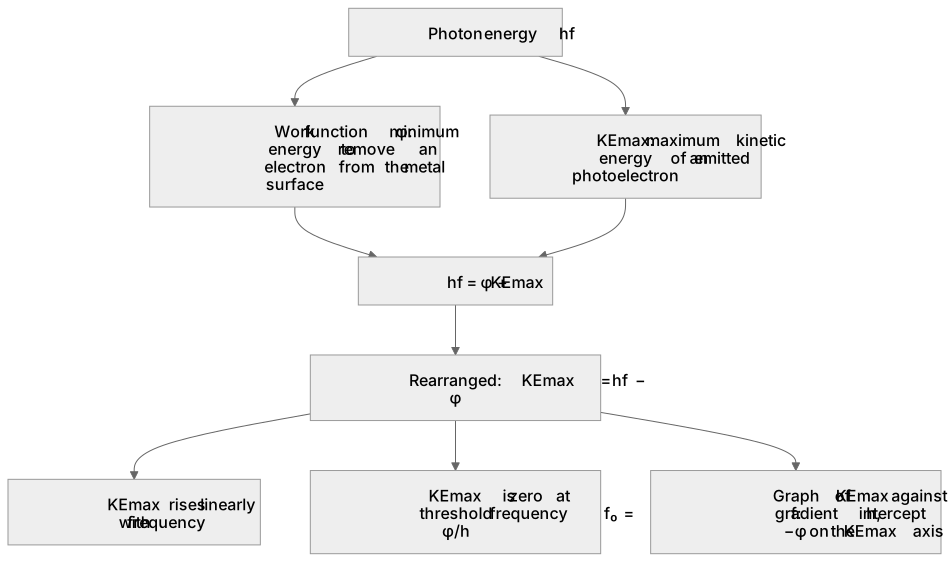
Einstein’s photoelectric equation is hf = φ + KEmax, where hf is the energy of one absorbed photon, φ is the work function of the metal surface and KEmax is the maximum kinetic energy of an emitted photoelectron. The equation is a statement of energy conservation for a single one-to-one photon-electron interaction: the photon energy is used partly to escape the surface and the remainder becomes kinetic energy. Rearranged, KEmax = hf − φ, so KEmax rises linearly with frequency and is zero at the threshold frequency f₀ = φ/h. Because φ is a property of the metal, different metals give different intercepts on a KEmax against f graph, while the gradient is h. Intensity does not appear in the equation, so it cannot change KEmax.
What earns the marks
- Hf is the energy of one photon, with h the Planck constant and f the frequency of the incident radiation.
- φ is the work function, the minimum energy needed to remove an electron from the metal surface.
- KEmax is the maximum kinetic energy of an emitted photoelectron, corresponding to electrons that lose no energy in escaping.
- The equation expresses conservation of energy for a single photon absorbed by a single electron.
- Rearranging gives KEmax = hf − φ, so KEmax increases with frequency and is zero at the threshold frequency f₀ = φ/h.
- A graph of KEmax against f has gradient h and intercept −φ on the KEmax axis.
Common mistakes and how to put them right
Writing the equation with the work function subtracted from kinetic energy, for example KEmax = φ − hf.
Put it right: The photon energy supplies the work function and the remainder is kinetic energy, so hf = φ + KEmax.
Treating φ as the energy of the photon.
Put it right: φ is a property of the metal surface, while hf depends on the radiation used.
Using the equation with intensity in place of frequency.
Put it right: Intensity controls the number of photons per second, not the energy of each photon.
Exam tips
- Quote the equation in the form hf = φ + KEmax before substituting values, so the energy balance is clear.
- Convert frequencies and work functions into consistent SI units, using joules or electronvolts throughout, before calculating KEmax.
- When reading a KEmax against f graph, identify the gradient as h and the intercept on the KEmax axis as −φ.
Try the lesson
The start of the The photoelectric effect: (c) Einstein’s photoelectric equation hf = φ + KEmax lesson, made from checked teaching notes for this specification point.
Listen
Einstein’s photoelectric equation is hf = φ + KEmax, where hf is the energy of one absorbed photon, φ is the work function of the metal surface and KEmax is the maximum kinetic energy of an emitted photoelectron. The equation is a statement of energy conservation for a single one-to-one photon-electron interaction: the photon energy is used partly to escape the surface and the remainder becomes kinetic energy. Rearranged, KEmax = hf − φ, so KEmax rises linearly with frequency and is zero at the threshold frequency f₀ = φ/h. Because φ is a property of the metal, different metals give different intercepts on a KEmax against f graph, while the gradient is h. Intensity does not appear in the equation, so it cannot change KEmax. A strong answer earns marks for these points. hf is the energy of one photon, with h the Planck constant and f the frequency of the incident radiation. φ is the work function, the minimum energy needed to remove an electron from the metal surface. KEmax is the maximum kinetic energy of an emitted photoelectron, corresponding to electrons that lose no energy in escaping. The equation expresses conservation of energy for a single photon absorbed by a single electron. A common slip: Writing the equation with the work function subtracted from kinetic energy, for example KEmax = φ − hf. Instead, the photon energy supplies the work function and the remainder is kinetic energy, so hf = φ + KEmax. Exam tip: Quote the equation in the form hf = φ + KEmax before substituting values, so the energy balance is clear.
See it
Key words
Say what each word means before you turn the card.
Work function
Try answering aloud or in your head before turning the card.
Maximum kinetic energy
Try answering aloud or in your head before turning the card.
Threshold frequency
Try answering aloud or in your head before turning the card.
Conservation of energy in photon absorption
Try answering aloud or in your head before turning the card.
See every definition
- Work function
- The minimum energy needed to remove an electron from the metal surface, and a property of the metal.
- Maximum kinetic energy
- The kinetic energy of an emitted photoelectron that loses no energy in escaping, given by KEmax = hf − φ.
- Threshold frequency
- The frequency at which KEmax is zero, given by f₀ = φ/h.
- Conservation of energy in photon absorption
- The photon energy is used partly to escape the surface and the remainder becomes kinetic energy, for a single one-to-one photon-electron interaction.
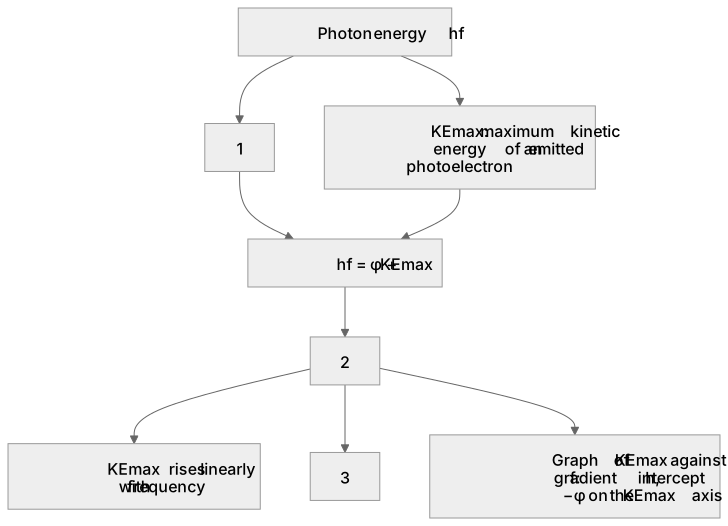
Label the diagram
Some boxes have lost their names. Pick the right name for each number.
1Box 1
2Box 2
3Box 3
There is more to this lesson
The full lesson goes on to check your understanding and help you earn the marks. Create a free account to carry on, with your progress saved.
A week of Premium from your first lesson · Then the free plan continues · No card, no charge
Test your understanding of The photoelectric effect: (c) Einstein’s photoelectric equation hf = φ + KEmax
Active recall beats re-reading. Take an instant quiz now to test what you’ve learned and lock it into long-term memory.
A week of Premium from your first lesson · Then the free plan continues · No card, no charge