OCR · A-Level · Physics
Course version: H556 · Version from Sept 2015
(f) the idea that rate of emission of photoelectrons above the threshold…
Full specification wording
The photoelectric effect: (f) the idea that rate of emission of photoelectrons above the threshold frequency is directly proportional to the intensity of the incident radiation.
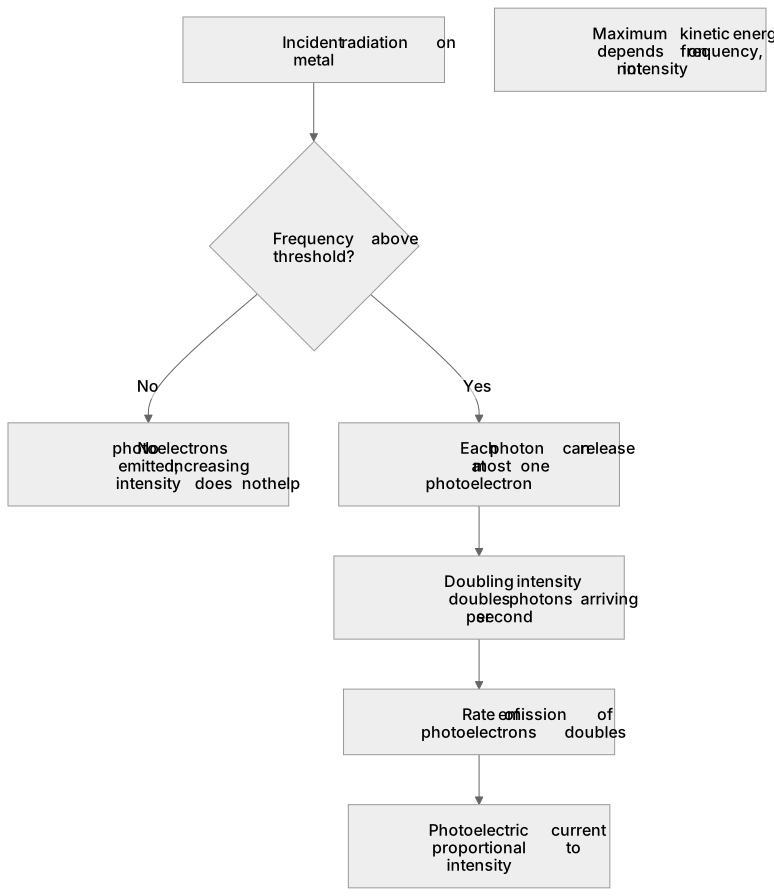
Above the threshold frequency, each incident photon has enough energy to release one photoelectron.
Checked against the OCR H556 specification (opens in a new tab) on .
- Point 7 of 7
- 4 key terms
Study notes
From the checked teaching notes for this specification point.
The idea
Above the threshold frequency, each incident photon has enough energy to release one photoelectron. Doubling the intensity of monochromatic radiation doubles the number of photons arriving per second, so the rate of emission of photoelectrons doubles. The photoelectric current is therefore directly proportional to intensity, provided the frequency is above the threshold and the metal surface is unchanged. Below the threshold frequency, increasing intensity does not cause emission because no single photon has sufficient energy. A useful check is to compare currents for two intensities at the same frequency: if the current doubles when intensity doubles, the proportionality is confirmed. This relationship is separate from the maximum kinetic energy of the emitted electrons, which depends on frequency, not intensity.
What earns the marks
- Above the threshold frequency, the rate of emission of photoelectrons is directly proportional to the intensity of the incident radiation.
- Intensity is the energy per unit area per unit time; for monochromatic light it is proportional to the number of photons incident per second.
- Each absorbed photon can release at most one photoelectron, so doubling the photon arrival rate doubles the emission rate.
- The photoelectric current is proportional to the rate of emission of photoelectrons, so current is proportional to intensity at constant frequency above threshold.
- Below the threshold frequency, increasing intensity does not produce photoelectrons because individual photons lack sufficient energy.
Common mistakes and how to put them right
Thinking that increasing intensity increases the maximum kinetic energy of the photoelectrons.
Put it right: Intensity changes the number of photoelectrons per second, while maximum kinetic energy depends on the frequency of the radiation.
Believing that any intensity will cause emission if it is large enough.
Put it right: Emission requires the frequency to be above the threshold frequency; below threshold, no emission occurs regardless of intensity.
Confusing intensity with frequency.
Put it right: Intensity relates to the number of photons per second per unit area, whereas frequency determines the energy of each photon.
Assuming the proportionality holds below the threshold frequency.
Put it right: The direct proportionality applies only above the threshold frequency.
Exam tips
- State clearly that the proportionality is between rate of emission and intensity, and that it applies only above the threshold frequency.
- When explaining, link intensity to the number of photons per second and then to the number of photoelectrons emitted per second.
- Use the term 'rate of emission' rather than vague phrases such as 'amount of electrons' to show precise understanding.
Try the lesson
The start of the The photoelectric effect: (f) the idea that rate of emission of photoelectrons above the threshold frequency is directly proportional to the intensity of the incident radiation. lesson, made from checked teaching notes for this specification point.
Listen
Above the threshold frequency, each incident photon has enough energy to release one photoelectron. Doubling the intensity of monochromatic radiation doubles the number of photons arriving per second, so the rate of emission of photoelectrons doubles. The photoelectric current is therefore directly proportional to intensity, provided the frequency is above the threshold and the metal surface is unchanged. Below the threshold frequency, increasing intensity does not cause emission because no single photon has sufficient energy. A useful check is to compare currents for two intensities at the same frequency: if the current doubles when intensity doubles, the proportionality is confirmed. This relationship is separate from the maximum kinetic energy of the emitted electrons, which depends on frequency, not intensity. A strong answer earns marks for these points. Above the threshold frequency, the rate of emission of photoelectrons is directly proportional to the intensity of the incident radiation. Intensity is the energy per unit area per unit time; for monochromatic light it is proportional to the number of photons incident per second. Each absorbed photon can release at most one photoelectron, so doubling the photon arrival rate doubles the emission rate. The photoelectric current is proportional to the rate of emission of photoelectrons, so current is proportional to intensity at constant frequency above threshold. A common slip: Thinking that increasing intensity increases the maximum kinetic energy of the photoelectrons. Instead, intensity changes the number of photoelectrons per second, while maximum kinetic energy depends on the frequency of the radiation. Exam tip: State clearly that the proportionality is between rate of emission and intensity, and that it applies only above the threshold frequency.
See it
Key words
Say what each word means before you turn the card.
Threshold frequency
Try answering aloud or in your head before turning the card.
Intensity
Try answering aloud or in your head before turning the card.
Photoelectric current
Try answering aloud or in your head before turning the card.
Rate of emission
Try answering aloud or in your head before turning the card.
See every definition
- Threshold frequency
- The frequency below which increasing intensity does not cause emission because no single photon has sufficient energy.
- Intensity
- The energy per unit area per unit time; for monochromatic light it is proportional to the number of photons incident per second.
- Photoelectric current
- A current proportional to the rate of emission of photoelectrons, so proportional to intensity at constant frequency above threshold.
- Rate of emission
- Above the threshold frequency, the number of photoelectrons released per second, directly proportional to the intensity of the incident radiation.
There is more to this lesson
The full lesson goes on to check your understanding and help you earn the marks. Create a free account to carry on, with your progress saved.
A week of Premium from your first lesson · Then the free plan continues · No card, no charge
Test your understanding of The photoelectric effect: (f) the idea that rate of emission of photoelectrons above the threshold frequency is directly proportional to the intensity of the incident radiation.
Active recall beats re-reading. Take an instant quiz now to test what you’ve learned and lock it into long-term memory.
A week of Premium from your first lesson · Then the free plan continues · No card, no charge