OCR · A-Level · Physics
Course version: H556 · Version from Sept 2015
(e) the idea that the maximum kinetic energy of the photoelectrons is…
Full specification wording
The photoelectric effect: (e) the idea that the maximum kinetic energy of the photoelectrons is independent of the intensity of the incident radiation
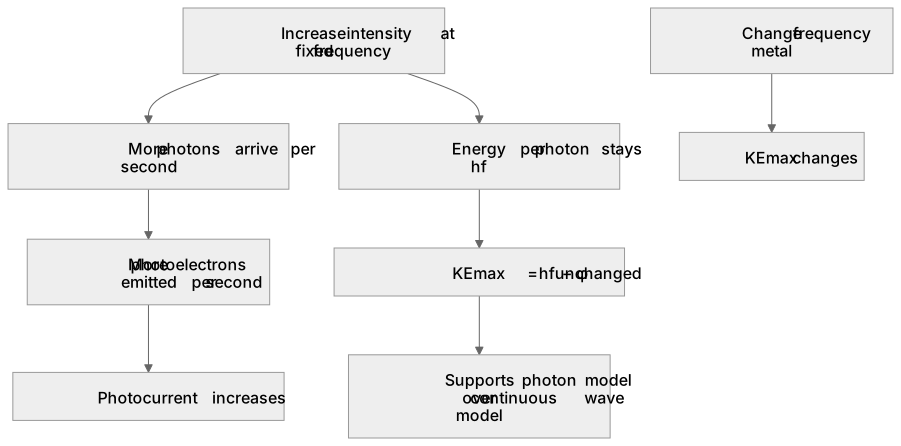
In the photon model, intensity is the energy arriving per unit area per unit time, so a more intense beam of fixed frequency delivers more photons per second.
Checked against the OCR H556 specification (opens in a new tab) on .
- Point 6 of 7
- 4 key terms
Study notes
From the checked teaching notes for this specification point.
The idea
In the photon model, intensity is the energy arriving per unit area per unit time, so a more intense beam of fixed frequency delivers more photons per second. Each photon still carries the same energy hf, so each emitted electron gains the same maximum kinetic energy KEmax = hf − φ. Increasing intensity therefore increases the number of photoelectrons emitted per second, which raises the photocurrent, but it does not change KEmax. To change KEmax you must change the frequency of the radiation or use a metal with a different work function. This independence of KEmax from intensity is a key piece of evidence for the photon model and cannot be explained by a continuous wave picture.
What earns the marks
- Intensity is the energy transferred per unit area per unit time, so for fixed frequency it is proportional to the number of photons arriving per second.
- Each photon has energy hf, so increasing intensity at fixed frequency does not increase the energy carried by an individual photon.
- KEmax = hf − φ depends only on the photon frequency and the work function of the metal, so it is independent of intensity.
- Increasing intensity increases the number of photoelectrons emitted per second and hence the photocurrent.
- Changing KEmax requires a change in frequency or a change in the metal used, not a change in intensity.
Common mistakes and how to put them right
Believing that a more intense beam gives photoelectrons more kinetic energy.
Put it right: Intensity increases the number of photons per second, so it increases the emission rate, while KEmax stays the same.
Thinking that intensity and frequency both affect KEmax equally.
Put it right: KEmax depends on frequency and work function through KEmax = hf − φ, and is independent of intensity.
Assuming a brighter beam can raise the maximum kinetic energy above hf − φ.
Put it right: No electron can gain more than one photon’s energy minus the work function in a one-to-one interaction.
Exam tips
- Separate the two effects clearly: intensity controls the number of electrons per second, while frequency controls the energy of each electron.
- Use KEmax = hf − φ to justify why KEmax is unchanged when only the intensity is altered.
- When describing evidence for photons, contrast the constant KEmax with the wave prediction that brighter light should give more energetic electrons.
Try the lesson
The start of the The photoelectric effect: (e) the idea that the maximum kinetic energy of the photoelectrons is independent of the intensity of the incident radiation lesson, made from checked teaching notes for this specification point.
Listen
In the photon model, intensity is the energy arriving per unit area per unit time, so a more intense beam of fixed frequency delivers more photons per second. Each photon still carries the same energy hf, so each emitted electron gains the same maximum kinetic energy KEmax = hf − φ. Increasing intensity therefore increases the number of photoelectrons emitted per second, which raises the photocurrent, but it does not change KEmax. To change KEmax you must change the frequency of the radiation or use a metal with a different work function. This independence of KEmax from intensity is a key piece of evidence for the photon model and cannot be explained by a continuous wave picture. A strong answer earns marks for these points. Intensity is the energy transferred per unit area per unit time, so for fixed frequency it is proportional to the number of photons arriving per second. Each photon has energy hf, so increasing intensity at fixed frequency does not increase the energy carried by an individual photon. KEmax = hf − φ depends only on the photon frequency and the work function of the metal, so it is independent of intensity. Increasing intensity increases the number of photoelectrons emitted per second and hence the photocurrent. A common slip: Believing that a more intense beam gives photoelectrons more kinetic energy. Instead, intensity increases the number of photons per second, so it increases the emission rate, while KEmax stays the same. Exam tip: Separate the two effects clearly: intensity controls the number of electrons per second, while frequency controls the energy of each electron.
See it
Key words
Say what each word means before you turn the card.
Intensity as photons per second
Try answering aloud or in your head before turning the card.
Independence of KEmax from intensity
Try answering aloud or in your head before turning the card.
Photocurrent and emission rate
Try answering aloud or in your head before turning the card.
Evidence for the photon model
Try answering aloud or in your head before turning the card.
See every definition
- Intensity as photons per second
- The energy transferred per unit area per unit time, so for fixed frequency it is proportional to the number of photons arriving per second.
- Independence of KEmax from intensity
- KEmax = hf − φ depends only on the photon frequency and the work function of the metal, so it is independent of intensity.
- Photocurrent and emission rate
- Increasing intensity increases the number of photoelectrons emitted per second and hence the photocurrent.
- Evidence for the photon model
- This independence supports the photon model over a continuous wave model of light.
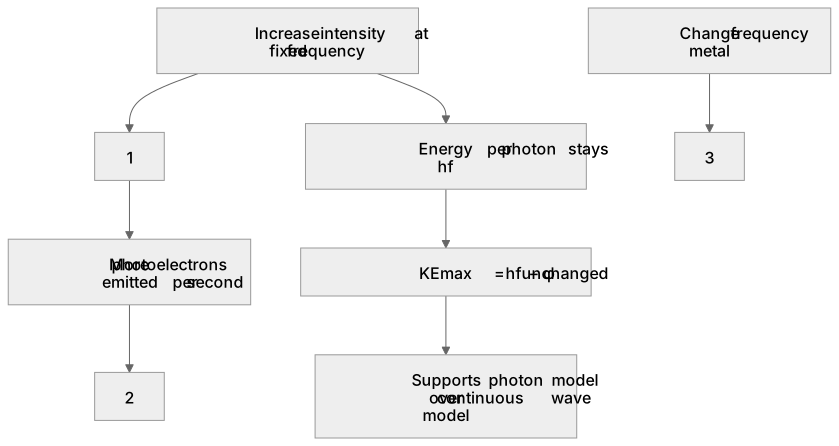
Label the diagram
Some boxes have lost their names. Pick the right name for each number.
1Box 1
2Box 2
3Box 3
There is more to this lesson
The full lesson goes on to check your understanding and help you earn the marks. Create a free account to carry on, with your progress saved.
A week of Premium from your first lesson · Then the free plan continues · No card, no charge
Test your understanding of The photoelectric effect: (e) the idea that the maximum kinetic energy of the photoelectrons is independent of the intensity of the incident radiation
Active recall beats re-reading. Take an instant quiz now to test what you’ve learned and lock it into long-term memory.
A week of Premium from your first lesson · Then the free plan continues · No card, no charge