OCR · A-Level · Physics
Course version: H556 · Version from Sept 2015
(acoustic) matching; special gel used in ultrasound scanning
Full specification wording
Using ultrasound: (acoustic) matching; special gel used in ultrasound scanning
Acoustic matching is the technique of choosing a coupling medium whose acoustic impedance is close to that of the skin, so that ultrasound passes efficiently from the transducer into the body.
Checked against the OCR H556 specification (opens in a new tab) on .
- Point 7 of 8
- 2 key terms
Study notes
From the checked teaching notes for this specification point.
The idea
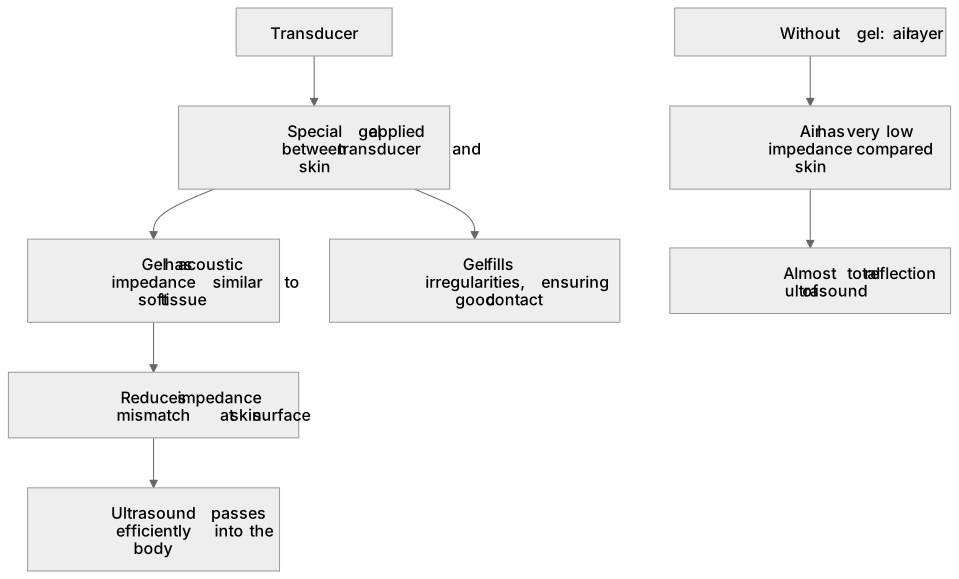
Acoustic matching is the technique of choosing a coupling medium whose acoustic impedance is close to that of the skin, so that ultrasound passes efficiently from the transducer into the body. In ultrasound scanning, a special gel is applied between the transducer and the skin. The gel has an acoustic impedance similar to that of soft tissue, so it reduces the impedance mismatch at the skin surface. Without the gel, an air layer would cause almost total reflection because air has a very low impedance compared with skin. The gel also fills any irregularities between the transducer and the skin, ensuring good contact.
What earns the marks
- State that acoustic matching aims to reduce the impedance mismatch between the transducer and the skin.
- Explain that the gel has an acoustic impedance similar to that of soft tissue.
- Explain that without the gel, an air layer causes almost total reflection of ultrasound.
- Describe how the gel improves transmission of ultrasound into the body.
- Recognise that the gel also ensures good acoustic contact by filling irregularities.
Common mistakes and how to put them right
Thinking the gel is used to clean the skin or to cool the transducer.
Put it right: Its main purpose is acoustic matching.
Believing the gel increases the speed of ultrasound in tissue.
Put it right: It does not change the speed in tissue, it reduces reflection at the surface.
Assuming the gel must have a very different impedance from skin to work.
Put it right: It must have a similar impedance.
Forgetting that air has very low acoustic impedance, which is why an air gap causes strong reflection.
Exam tips
- Link the gel to the equation for intensity reflection: a smaller difference in Z gives a smaller reflected fraction.
- Remember that the gel is not a medicine; it is a coupling medium.
- If asked why not use water, note that gel is more convenient and stays in place, but the key physics is impedance matching.
- In multiple-choice questions, choose the option that mentions impedance matching or reducing reflection at the skin surface.
Try the lesson
The start of the Using ultrasound: (acoustic) matching; special gel used in ultrasound scanning lesson, made from checked teaching notes for this specification point.
Listen
Acoustic matching is the technique of choosing a coupling medium whose acoustic impedance is close to that of the skin, so that ultrasound passes efficiently from the transducer into the body. In ultrasound scanning, a special gel is applied between the transducer and the skin. The gel has an acoustic impedance similar to that of soft tissue, so it reduces the impedance mismatch at the skin surface. Without the gel, an air layer would cause almost total reflection because air has a very low impedance compared with skin. The gel also fills any irregularities between the transducer and the skin, ensuring good contact. A strong answer earns marks for these points. State that acoustic matching aims to reduce the impedance mismatch between the transducer and the skin. Explain that the gel has an acoustic impedance similar to that of soft tissue. Explain that without the gel, an air layer causes almost total reflection of ultrasound. Describe how the gel improves transmission of ultrasound into the body. Exam tip: Link the gel to the equation for intensity reflection: a smaller difference in Z gives a smaller reflected fraction.
See it
Key words
Say what each word means before you turn the card.
Acoustic matching
Try answering aloud or in your head before turning the card.
Coupling gel in ultrasound scanning
Try answering aloud or in your head before turning the card.
See every definition
- Acoustic matching
- The technique of choosing a coupling medium whose acoustic impedance is close to that of the skin, so that ultrasound passes efficiently from the transducer into the body.
- Coupling gel in ultrasound scanning
- A special gel applied between the transducer and the skin that has an acoustic impedance similar to that of soft tissue, reducing the impedance mismatch at the skin surface.
Label the diagram
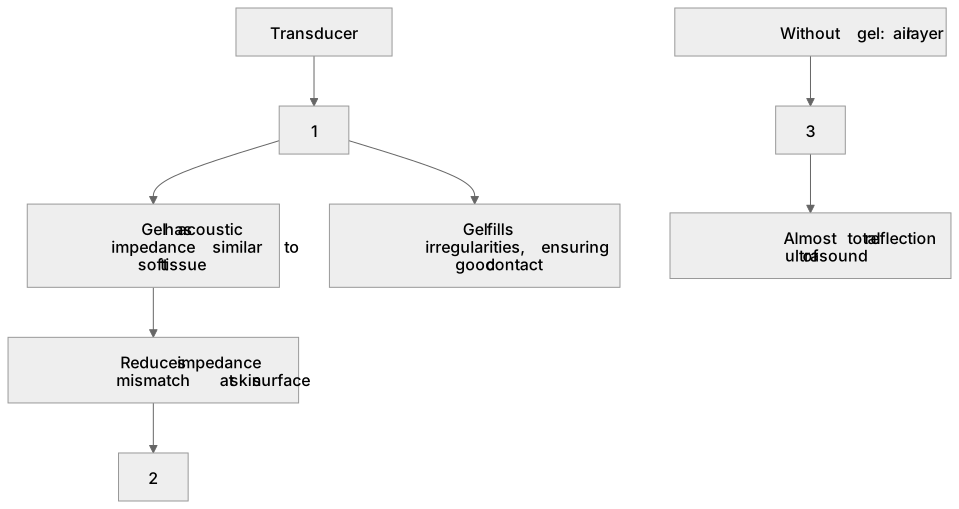
Some boxes have lost their names. Pick the right name for each number.
1Box 1
2Box 2
3Box 3
There is more to this lesson
The full lesson goes on to check your understanding and help you earn the marks. Create a free account to carry on, with your progress saved.
A week of Premium from your first lesson · Then the free plan continues · No card, no charge
Test your understanding of Using ultrasound: (acoustic) matching; special gel used in ultrasound scanning
Active recall beats re-reading. Take an instant quiz now to test what you’ve learned and lock it into long-term memory.
A week of Premium from your first lesson · Then the free plan continues · No card, no charge