OCR · GCSE · Physics
Course version: J249 · Version from Sept 2018
Explain the red-shift of light as seen from galaxies which are receding…
Full specification wording
Beyond Earth: explain the red-shift of light as seen from galaxies which are receding (qualitative only). The change with distance of each galaxy’s speed is evidence of an expanding universe (to include: understanding of changes in frequency and wavelength) (content found only in the physics separate science qualification)
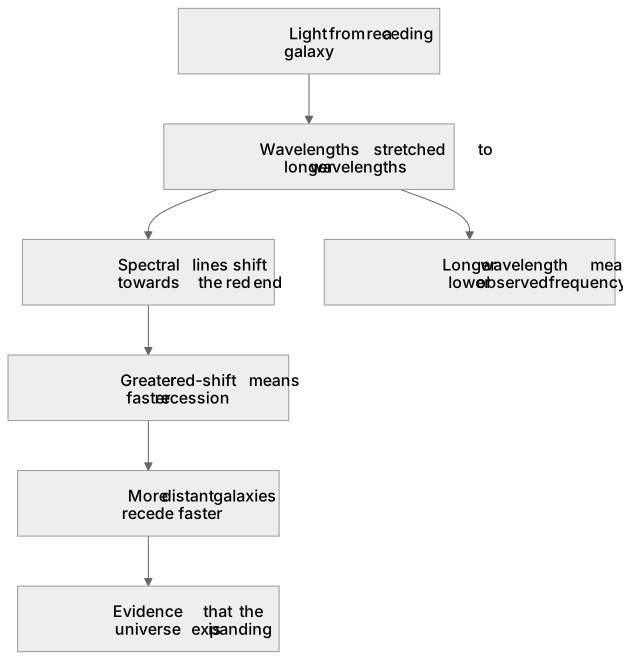
Light from a receding galaxy is stretched to longer wavelengths, so its spectral lines shift towards the red end.
Checked against the OCR J249 specification (opens in a new tab) on .
- Point 1 of 8
- 4 key terms
Study notes
From the checked teaching notes for this specification point.
The idea
Light from a receding galaxy is stretched to longer wavelengths, so its spectral lines shift towards the red end. Because wavelength and frequency are inversely related, a longer wavelength means a lower observed frequency than the same line measured in a laboratory source. The shift is described qualitatively: the faster the recession, the greater the red-shift. Comparing many galaxies shows that the more distant a galaxy is, the faster it recedes, and this pattern of speed increasing with distance is evidence that the universe is expanding. A useful method is to match a known line in a galaxy spectrum to its laboratory wavelength and note whether the galaxy line sits at a longer wavelength.
What earns the marks
- States that light from a receding galaxy is shifted to longer wavelengths, towards the red end of the spectrum.
- Explains that a longer observed wavelength corresponds to a lower observed frequency.
- Links the size of the red-shift to the speed of recession of the galaxy.
- Uses the pattern that more distant galaxies recede faster as evidence that the universe is expanding.
Common mistakes and how to put them right
Claims that red-shift means the galaxy is moving towards us.
Put it right by linking red-shift to recession, with light stretched to longer wavelengths.
Treats wavelength and frequency as increasing together.
Put it right by stating that a longer wavelength means a lower frequency.
Describes red-shift as the galaxy changing colour to red rather than spectral lines moving to longer wavelengths.
Put it right by referring to the shift of spectral lines.
Asserts that the universe is expanding because galaxies move through pre-existing space.
Put it right by treating the increasing separation of galaxies as the expansion itself.
Exam tips
- Name both quantities: wavelength increases and frequency decreases for a receding galaxy.
- Keep the explanation qualitative and avoid quoting a numerical value for the speed of light or a Hubble constant.
- When a question shows two spectra, compare the position of a named line with its laboratory position and state the direction of the shift.
Try the lesson
The start of the Beyond Earth: explain the red-shift of light as seen from galaxies which are receding (qualitative only). The change with distance of each galaxy’s speed is evidence of an expanding universe (to include: understanding of changes in frequency and wavelength) (content found only in the physics separate science qualification) lesson, made from checked teaching notes for this specification point.
Have a go first
Light from a distant galaxy is observed to be red-shifted. What does this tell us about the galaxy's motion relative to us?
Listen
Light from a receding galaxy is stretched to longer wavelengths, so its spectral lines shift towards the red end. Because wavelength and frequency are inversely related, a longer wavelength means a lower observed frequency than the same line measured in a laboratory source. The shift is described qualitatively: the faster the recession, the greater the red-shift. Comparing many galaxies shows that the more distant a galaxy is, the faster it recedes, and this pattern of speed increasing with distance is evidence that the universe is expanding. A useful method is to match a known line in a galaxy spectrum to its laboratory wavelength and note whether the galaxy line sits at a longer wavelength. A strong answer earns marks for these points. States that light from a receding galaxy is shifted to longer wavelengths, towards the red end of the spectrum. Explains that a longer observed wavelength corresponds to a lower observed frequency. Links the size of the red-shift to the speed of recession of the galaxy. Uses the pattern that more distant galaxies recede faster as evidence that the universe is expanding. A common slip: Claims that red-shift means the galaxy is moving towards us. Instead, linking red-shift to recession, with light stretched to longer wavelengths. Exam tip: Name both quantities: wavelength increases and frequency decreases for a receding galaxy.
See it
Key words
Say what each word means before you turn the card.
Red-shift of galactic light
Try answering aloud or in your head before turning the card.
Wavelength and frequency relationship
Try answering aloud or in your head before turning the card.
Speed of recession and distance
Try answering aloud or in your head before turning the card.
Evidence for an expanding universe
Try answering aloud or in your head before turning the card.
See every definition
- Red-shift of galactic light
- Light from a receding galaxy is stretched to longer wavelengths, so its spectral lines shift towards the red end.
- Wavelength and frequency relationship
- Wavelength and frequency are inversely related, so a longer wavelength means a lower observed frequency.
- Speed of recession and distance
- The more distant a galaxy is, the faster it recedes, and the faster the recession, the greater the red-shift.
- Evidence for an expanding universe
- The pattern of speed increasing with distance is evidence that the universe is expanding.
Label the diagram
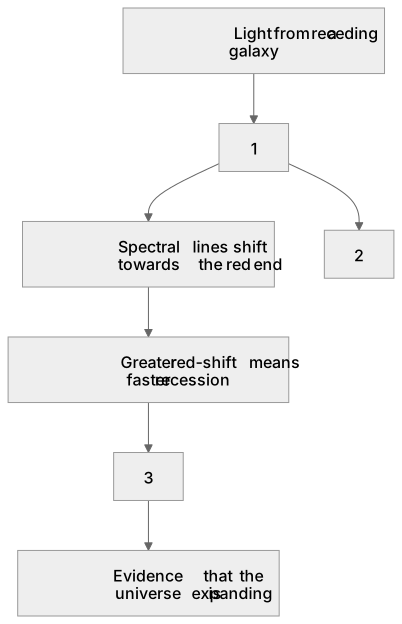
Some boxes have lost their names. Pick the right name for each number.
1Box 1
2Box 2
3Box 3
There is more to this lesson
The full lesson goes on to check your understanding and help you earn the marks. Create a free account to carry on, with your progress saved.
A week of Premium from your first lesson · Then the free plan continues · No card, no charge
Test your understanding of Beyond Earth: explain the red-shift of light as seen from galaxies which are receding (qualitative only). The change with distance of each galaxy’s speed is evidence of an expanding universe (to include: understanding of changes in frequency and wavelength) (content found only in the physics separate science qualification)
Active recall beats re-reading. Take an instant quiz now to test what you’ve learned and lock it into long-term memory.
A week of Premium from your first lesson · Then the free plan continues · No card, no charge