OCR · GCSE · Physics
Comets
This study guide covers comets within the OCR GCSE Physics specification, focusing on their highly elliptical orbits, velocity changes, and energy transformations. Understanding how comets differ from planets and applying gravitational principles to explain speed variations are critical for earning marks in both Foundation and Higher tier exams."
- 9 min read
- 4 worked examples
- 6 practice questions
Study Notes
Overview
Comets are among the most visually spectacular objects in our Solar System, yet they are also some of the most misunderstood by GCSE candidates. Within OCR Topic P8.5, examiners assess your understanding of orbital mechanics, gravitational forces, and energy conservation as applied to these icy wanderers. Unlike planets, which follow nearly circular orbits at constant speeds, comets trace highly elliptical paths around the Sun, with dramatic velocity changes at different orbital positions. This topic connects directly to broader themes in gravitational physics and requires precise application of energy principles. Typical exam questions ask candidates to sketch and label orbits, explain speed variations using force and energy concepts, and describe the behaviour of cometary tails. Marks are awarded for clear, causal reasoning that links distance, force, and energy transformations.
Key Concepts
Concept 1: Highly Elliptical Orbits
A comet's orbit is highly elliptical (oval-shaped), not circular. An ellipse has two focal points, and critically, the Sun is located at one focus, not at the geometric center. This is the single most common error in exam diagrams: candidates often place the Sun in the middle of the orbit, which loses marks immediately. The correct positioning means the comet's distance from the Sun varies enormously throughout its orbit.
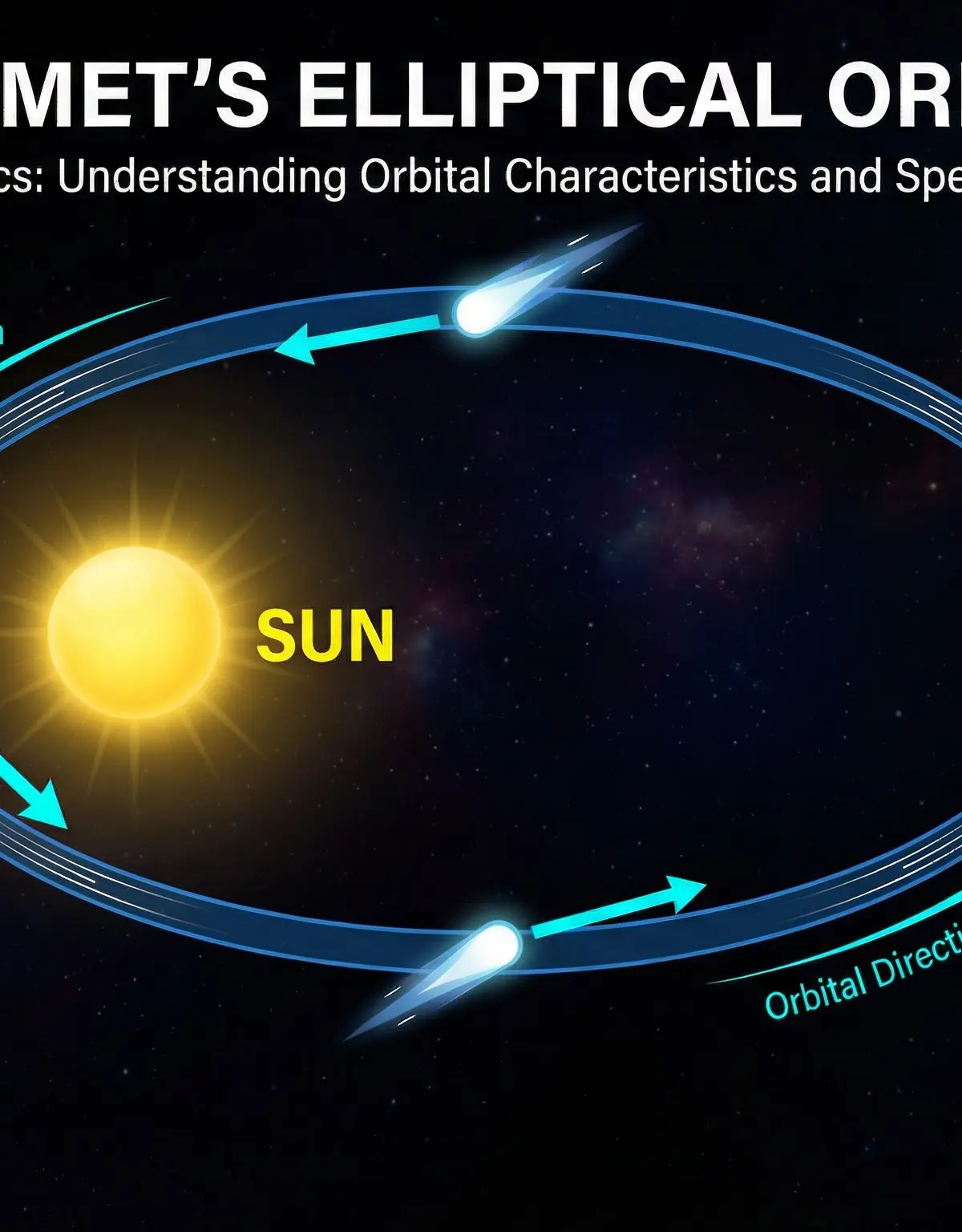
The point of closest approach to the Sun is called perihelion, and the farthest point is aphelion. At perihelion, the comet may be extremely close to the Sun (within the orbit of Mercury for some comets), while at aphelion it may be far beyond the orbit of Neptune. This vast range in distance is what drives the dramatic changes in speed and energy that examiners test.
Example: Halley's Comet has a perihelion distance of approximately 0.6 AU (astronomical units) and an aphelion distance of about 35 AU. This means the comet is nearly 60 times farther from the Sun at aphelion than at perihelion, resulting in enormous speed variations.
Concept 2: Velocity Changes and Gravitational Force
As a comet moves along its elliptical orbit, its speed is not constant. At aphelion (farthest from the Sun), the comet moves slowly. As it falls inward towards the Sun, it accelerates, reaching maximum speed at perihelion (closest to the Sun). After passing perihelion, it begins to slow down again as it climbs back out towards aphelion.
Why does this happen? The gravitational force between the Sun and the comet depends on the distance between them, following the inverse square law: as distance decreases, gravitational force increases. When the comet is closer to the Sun, the stronger gravitational pull accelerates it, increasing its kinetic energy. When the comet is farther away, the weaker gravitational force means less acceleration, and the comet slows down.
Example: If a comet is moving at 1 km/s at aphelion, it might accelerate to 50 km/s or more at perihelion due to the Sun's intense gravitational pull at close range.
Concept 3: Energy Conservation in Cometary Orbits
The principle of conservation of energy is fundamental to understanding cometary motion. The total mechanical energy of the comet (the sum of its gravitational potential energy, GPE, and kinetic energy, KE) remains constant throughout the orbit, assuming no external forces act on it.
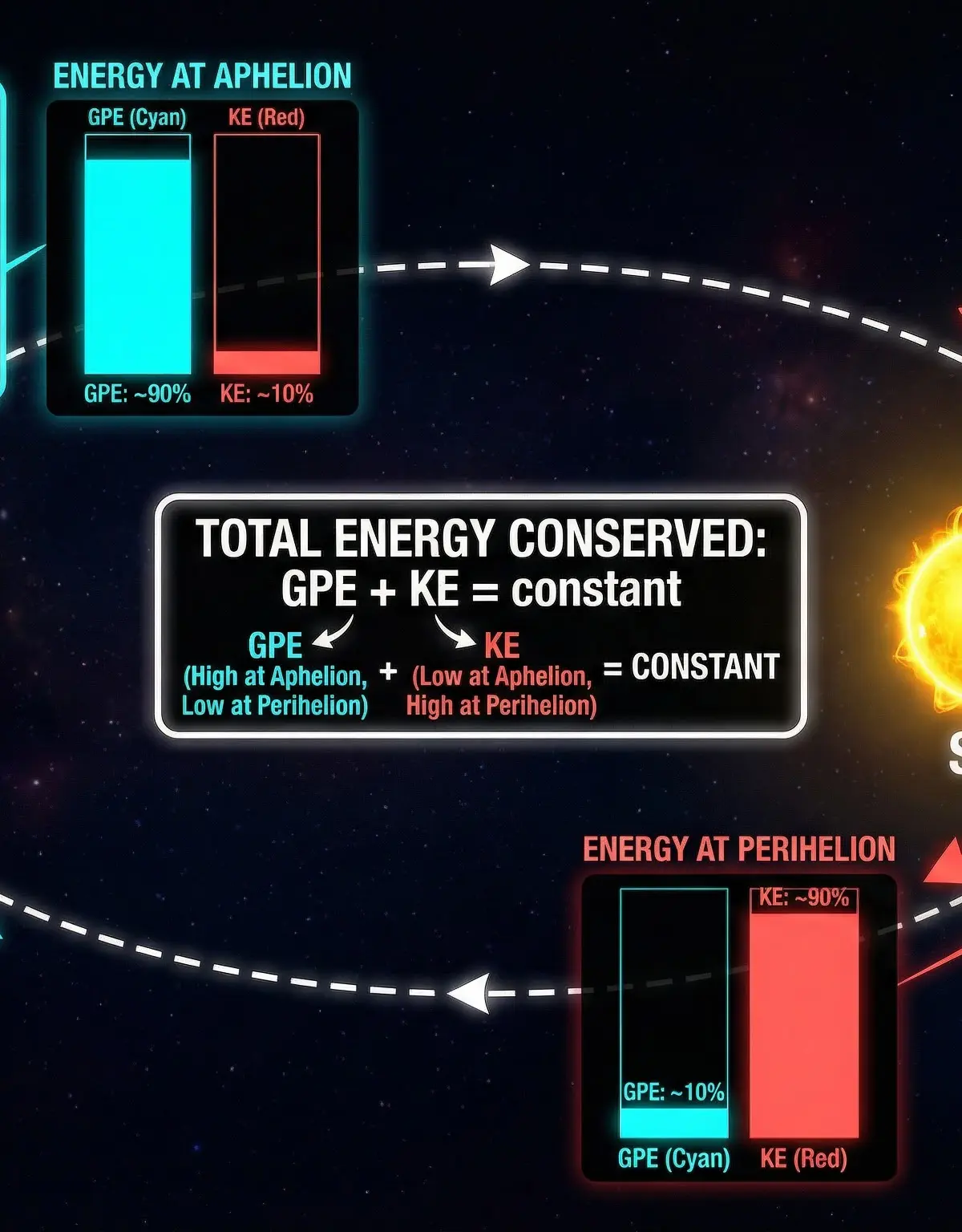
At aphelion, the comet is far from the Sun, so it has:
- High gravitational potential energy (GPE is less negative, or higher, when farther from the gravitational source)
- Low kinetic energy (moving slowly)
As the comet falls towards the Sun, GPE decreases (becomes more negative) and is converted into KE. At perihelion, the comet has:
- Low gravitational potential energy (GPE is more negative when closer to the Sun)
- High kinetic energy (moving very fast)
The equation is: Total Energy = GPE + KE = constantThis energy transformation is reversible: as the comet moves away from perihelion back towards aphelion, KE decreases and GPE increases, slowing the comet down again.
Example: If a comet has a total energy of -10 MJ (negative because it is gravitationally bound), at aphelion it might have GPE = -2 MJ and KE = -8 MJ. At perihelion, GPE might be -50 MJ and KE = +40 MJ, but the total remains -10 MJ.
Concept 4: Cometary Tails and Solar Wind
One of the most distinctive features of a comet is its glowing tail, which can stretch for millions of kilometres. However, many candidates incorrectly assume the tail trails behind the comet like exhaust from a rocket. This is wrong and will lose marks.
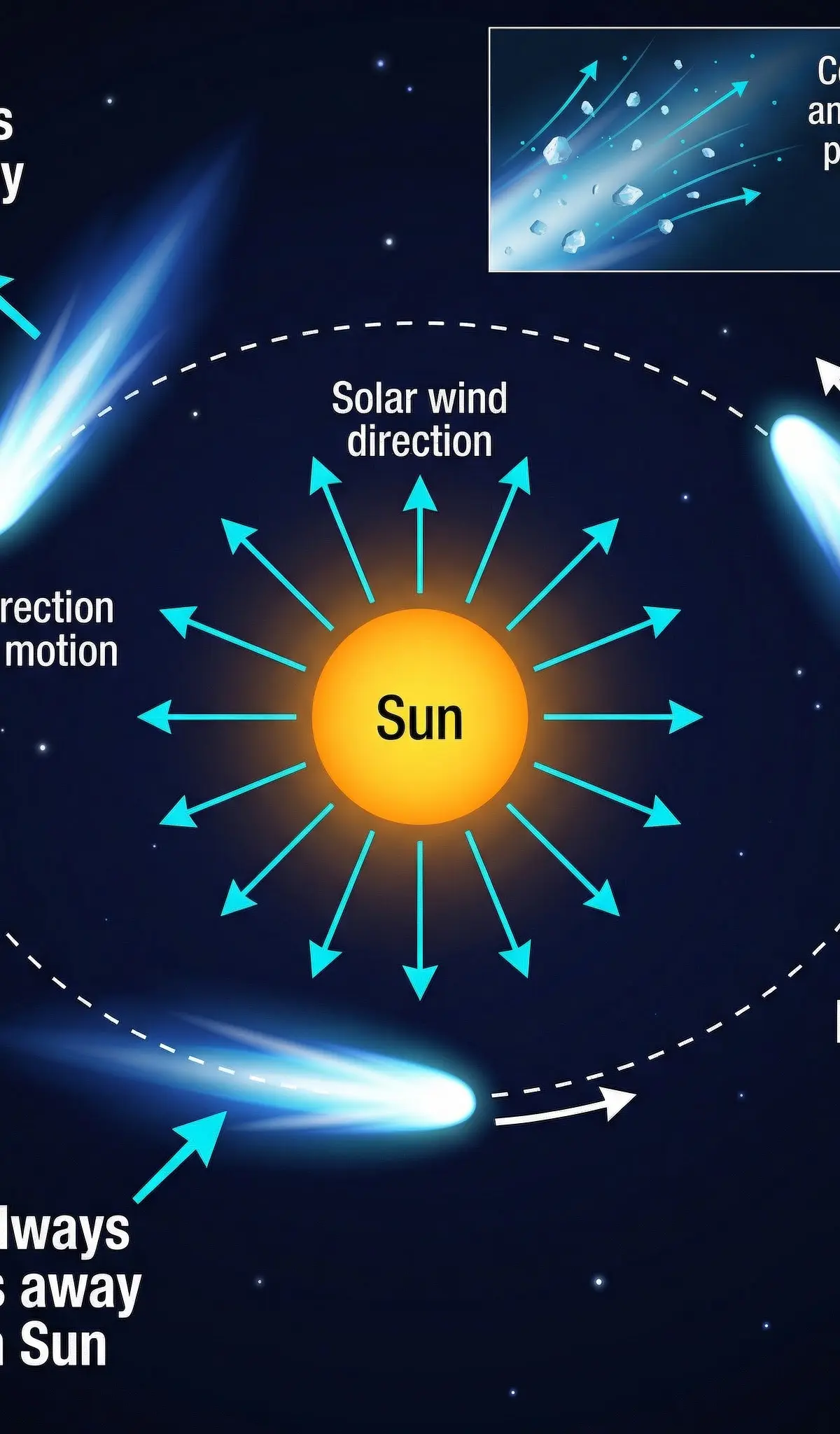
The tail always points away from the Sun, regardless of the comet's direction of motion. This occurs because the Sun emits a stream of charged particles called the solar wind, along with intense electromagnetic radiation. When the comet approaches the Sun, the ice in its nucleus sublimates (turns directly from solid to gas), releasing dust and gas particles. The solar wind and radiation pressure push these particles away from the comet's nucleus, forming a tail that points radially outward from the Sun.
There are actually two types of tails:
- Ion tail (bluish, straight): composed of ionized gas pushed by the solar wind
- Dust tail (yellowish, curved): composed of dust particles pushed by radiation pressure
For GCSE purposes, you simply need to know that the tail points away from the Sun due to solar wind and radiation pressure.
Example: When a comet is moving towards the Sun, the tail points behind it (away from the Sun). When the comet is moving away from the Sun after perihelion, the tail actually points ahead of the comet's motion, still pointing away from the Sun.
Concept 5: Comparing Comets and Planets
Examiners frequently ask candidates to compare comets and planets. The key distinctions are:
| Feature | Planets | Comets |
|---|---|---|
| Orbit shape | Nearly circular | Highly elliptical |
| Orbital speed | Approximately constant | Varies dramatically (slow at aphelion, fast at perihelion) |
| Composition | Rocky (inner planets) or gaseous (outer planets) | Ice, dust, and rock ("dirty snowballs") |
| Tail | None | Visible tail when near the Sun, pointing away from it |
| Sun's position | Near the center of the orbit | At one focus of the ellipse |
Understanding these differences is essential for scoring marks on comparison questions.
Mathematical/Scientific Relationships
While OCR GCSE Physics does not require complex calculations for cometary orbits, candidates should understand the following qualitative relationships:
Gravitational Force and Distance: The gravitational force between two objects is inversely proportional to the square of the distance between them. This means:
- When distance decreases, gravitational force increases
- When distance increases, gravitational force decreasesThis is why the comet experiences a much stronger pull from the Sun at perihelion than at aphelion.
Energy Conservation:
- Total Energy = Gravitational Potential Energy (GPE) + Kinetic Energy (KE) = constant
- As GPE decreases (comet falls towards Sun), KE increases (comet speeds up)
- As GPE increases (comet moves away from Sun), KE decreases (comet slows down)
These relationships must be stated clearly in explain-style questions to earn full marks.
Practical Applications
Comets are not just theoretical objects; they have real scientific significance:
1. Solar System Formation: Comets are thought to be remnants from the early Solar System, containing pristine material that has remained largely unchanged for 4.6 billion years. Studying comets helps scientists understand the conditions and composition of the early Solar System.
2. Water on Earth: Some scientists hypothesize that comets may have delivered significant amounts of water and organic molecules to Earth during the planet's early history, potentially contributing to the origin of life.
3. Space Missions: Missions such as ESA's Rosetta mission (which landed a probe on Comet 67P/Churyumov-Gerasimenko in 2014) have provided detailed data on cometary composition, structure, and behaviour.
4. Impact Hazards: While rare, comets can pose an impact threat to Earth. Understanding their orbits helps astronomers track potentially hazardous objects.
Podcast: GCSE Physics Essentials - Comets

Listen to this 10-minute podcast episode for a comprehensive audio review of comets, including core concepts, exam tips, and a quick-fire recall quiz. Perfect for revision on the go!
Tier-Specific Content
This topic is assessed at both Foundation and Higher tiers. However, Higher tier candidates may be expected to:
- Provide more detailed explanations linking gravitational force to acceleration and kinetic energy
- Apply energy conservation principles more explicitly
- Interpret or sketch more complex orbital diagrams
Foundation tier questions tend to focus on:
- Describing the shape of the orbit
- Stating where the Sun is located
- Identifying that speed increases near the Sun
- Describing the direction of the tail"
Worked Examples
4 worked examples — open one to explore the question and available guidance.
Practice Questions
Test your understanding — click to reveal model answers
State two ways in which the orbit of a comet differs from the orbit of a planet.
Hint: Think about the shape of the orbit and how the speed changes.
A comet is at perihelion. Explain what happens to the comet's speed and kinetic energy as it moves away from the Sun towards aphelion.
Hint: Consider how distance affects gravitational force, and how that affects the comet's motion and energy.
Describe the composition of a comet and explain why comets develop a visible tail when they approach the Sun.
Hint: Think about what comets are made of and what happens to ice when it gets hot.
A student draws a diagram of a comet's orbit with the Sun at the center of an ellipse. Explain what is wrong with this diagram and how it should be corrected.
Hint: Think about where the Sun should be positioned in an elliptical orbit.
Compare the gravitational potential energy and kinetic energy of a comet at perihelion and at aphelion. Explain how the total energy changes.
Hint: Consider both types of energy at both positions, and think about conservation of energy.
A comet takes 76 years to complete one orbit around the Sun. Suggest why the orbital period of a comet is much longer than the orbital period of Earth (1 year).
Hint: Think about the size and shape of the comet's orbit compared to Earth's orbit.