OCR · GCSE · Physics
Course version: J249 · Version from Sept 2018
Describe examples in which forces cause rotation (to include: location of…
Full specification wording
Forces in action: describe examples in which forces cause rotation (to include: location of pivot points and whether a resultant turning force will be in a clockwise or anticlockwise direction) (content found only in the physics separate science qualification)
A force applied away from a pivot can make an object turn.
Checked against the OCR J249 specification (opens in a new tab) on .
- Point 17 of 21
- 4 key terms
Study notes
From the checked teaching notes for this specification point.
The idea
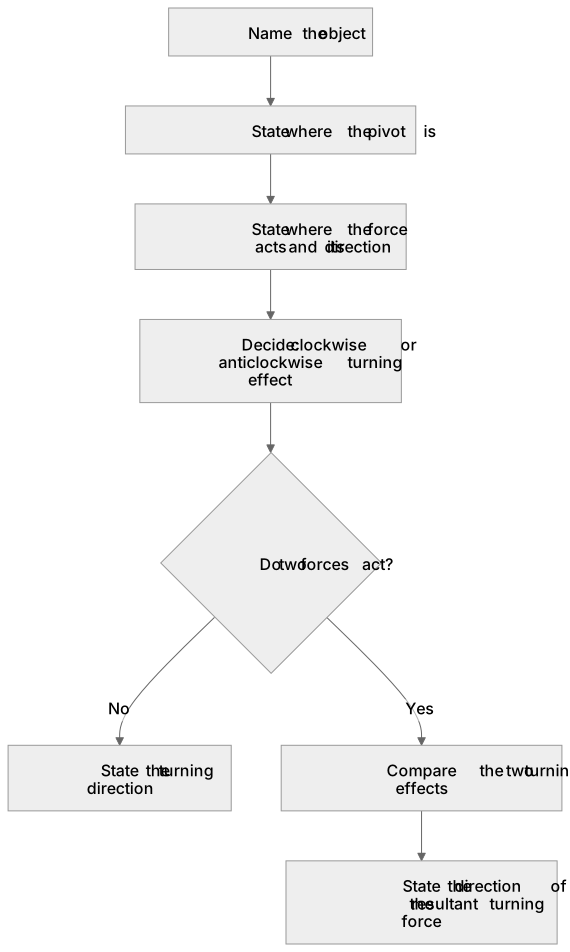
A force applied away from a pivot can make an object turn. To describe such an example, name the object, state where the pivot is, state where the force acts and in which direction, then decide whether the turning effect is clockwise or anticlockwise. For a door, the pivot is at the hinge line; a push on the handle away from the hinge turns the door one way, and a push on the same handle from the other side turns it the opposite way. For a spanner on a nut, the pivot is the nut; pushing the end of the handle one way gives a clockwise turn and pushing the other way gives an anticlockwise turn. If two forces act, compare their turning effects to decide the resultant direction.
What earns the marks
- Names a concrete object and identifies the pivot point, such as the hinge of a door or the nut on a spanner.
- States where the force is applied relative to the pivot and the direction in which it acts.
- Decides whether the resulting turning effect is clockwise or anticlockwise and justifies the choice from the geometry.
- Compares two opposing turning effects to state the direction of the resultant turning force.
Common mistakes and how to put them right
Places the pivot at the point where the force is applied.
Put it right: Identify the fixed point about which the object actually turns.
Describes a turning direction without stating where the force acts.
Put it right: Give the force's position and direction so the direction of rotation follows.
Assumes a larger force always wins without considering distance from the pivot.
Put it right: Compare both force and perpendicular distance.
Exam tips
- Sketch the object, mark the pivot with a dot and draw the force arrow before deciding the direction of rotation.
- Use the words clockwise and anticlockwise explicitly in your answer rather than vague terms such as 'round'.
- When two forces act, state which turning effect is larger and therefore which way the object turns.
Try the lesson
The start of the Forces in action: describe examples in which forces cause rotation (to include: location of pivot points and whether a resultant turning force will be in a clockwise or anticlockwise direction) (content found only in the physics separate science qualification) lesson, made from checked teaching notes for this specification point.
Have a go first
A door is hinged along its left edge. A person pushes the door on its right-hand side, pushing away from themselves so the door swings inward. About which point does the door rotate, and in which direction is the turning effect?
Listen
A force applied away from a pivot can make an object turn. To describe such an example, name the object, state where the pivot is, state where the force acts and in which direction, then decide whether the turning effect is clockwise or anticlockwise. For a door, the pivot is at the hinge line; a push on the handle away from the hinge turns the door one way, and a push on the same handle from the other side turns it the opposite way. For a spanner on a nut, the pivot is the nut; pushing the end of the handle one way gives a clockwise turn and pushing the other way gives an anticlockwise turn. If two forces act, compare their turning effects to decide the resultant direction. A strong answer earns marks for these points. Names a concrete object and identifies the pivot point, such as the hinge of a door or the nut on a spanner. States where the force is applied relative to the pivot and the direction in which it acts. Decides whether the resulting turning effect is clockwise or anticlockwise and justifies the choice from the geometry. Compares two opposing turning effects to state the direction of the resultant turning force. Exam tip: Sketch the object, mark the pivot with a dot and draw the force arrow before deciding the direction of rotation.
See it
Key words
Say what each word means before you turn the card.
Pivot location
Try answering aloud or in your head before turning the card.
Turning effect direction
Try answering aloud or in your head before turning the card.
Clockwise and anticlockwise rotation
Try answering aloud or in your head before turning the card.
Resultant turning force
Try answering aloud or in your head before turning the card.
See every definition
- Pivot location
- The fixed point about which an object actually turns, such as the hinge of a door or the nut on a spanner.
- Turning effect direction
- Whether the turning effect is clockwise or anticlockwise, decided from where the force acts and the direction in which it acts.
- Clockwise and anticlockwise rotation
- The two ways an object can turn; pushing the end of a spanner handle one way gives a clockwise turn and pushing the other way gives an anticlockwise turn.
- Resultant turning force
- When two forces act, their turning effects are compared to decide the resultant direction.
There is more to this lesson
The full lesson goes on to check your understanding and help you earn the marks. Create a free account to carry on, with your progress saved.
A week of Premium from your first lesson · Then the free plan continues · No card, no charge
Test your understanding of Forces in action: describe examples in which forces cause rotation (to include: location of pivot points and whether a resultant turning force will be in a clockwise or anticlockwise direction) (content found only in the physics separate science qualification)
Active recall beats re-reading. Take an instant quiz now to test what you’ve learned and lock it into long-term memory.
A week of Premium from your first lesson · Then the free plan continues · No card, no charge