OCR · GCSE · Physics
Course version: J249 · Version from Sept 2018
Describe that all matter has a gravitational field that causes attraction,…
Full specification wording
Forces in action: describe that all matter has a gravitational field that causes attraction, and the field strength is much greater for massive objects
Every object with mass has a gravitational field, and that field always pulls other masses towards it rather than pushing them away.
Checked against the OCR J249 specification (opens in a new tab) on .
- Point 13 of 21
- 4 key terms
Study notes
From the checked teaching notes for this specification point.
The idea
Every object with mass has a gravitational field, and that field always pulls other masses towards it rather than pushing them away. The field is strongest close to the object and weakens with distance. Field strength depends on how much mass the object contains: a more massive object produces a stronger field, so the Moon's pull on you is far weaker than the Earth's pull on you, and the Earth's pull is far weaker than the Sun's. In a multiple-choice question you may be asked which statement about the direction of the pull, or about how field strength changes with mass, is correct. Read each option and reject any that says gravity repels, that only large objects have a field, or that a small mass has the stronger field.
What earns the marks
- Selects the option stating that gravitational fields always produce attraction between masses.
- Identifies that every object with mass has a gravitational field, not only planets or stars.
- Chooses the option in which the more massive object has the greater field strength.
- Rejects options claiming that gravitational fields can repel other masses.
- Recognises that field strength decreases as distance from the object increases.
Common mistakes and how to put them right
Selects an option saying gravity can push masses apart.
Put it right by remembering gravitational fields only attract.
Chooses an option claiming only very large objects have a gravitational field.
Put it right by noting all matter with mass has one.
Picks the option giving the smaller mass the stronger field.
Put it right by linking greater mass to greater field strength.
Exam tips
- Underline the words attraction, all matter and massive in the question before reading the options.
- Eliminate any option that describes repulsion, because gravitational fields never repel.
- Check the comparison in the option carefully: decide which object is more massive before judging field strength.
Try the lesson
The start of the Forces in action: describe that all matter has a gravitational field that causes attraction, and the field strength is much greater for massive objects lesson, made from checked teaching notes for this specification point.
Have a go first
What kind of force does the gravitational field of a book exert on a nearby pencil?
Listen
Every object with mass has a gravitational field, and that field always pulls other masses towards it rather than pushing them away. The field is strongest close to the object and weakens with distance. Field strength depends on how much mass the object contains: a more massive object produces a stronger field, so the Moon's pull on you is far weaker than the Earth's pull on you, and the Earth's pull is far weaker than the Sun's. In a multiple-choice question you may be asked which statement about the direction of the pull, or about how field strength changes with mass, is correct. Read each option and reject any that says gravity repels, that only large objects have a field, or that a small mass has the stronger field. A strong answer earns marks for these points. Selects the option stating that gravitational fields always produce attraction between masses. Identifies that every object with mass has a gravitational field, not only planets or stars. Chooses the option in which the more massive object has the greater field strength. Rejects options claiming that gravitational fields can repel other masses. A common slip: Selects an option saying gravity can push masses apart. Instead, remembering gravitational fields only attract. Exam tip: Underline the words attraction, all matter and massive in the question before reading the options.
See it
Key words
Say what each word means before you turn the card.
gravitational field
Try answering aloud or in your head before turning the card.
attraction
Try answering aloud or in your head before turning the card.
field strength
Try answering aloud or in your head before turning the card.
massive object
Try answering aloud or in your head before turning the card.
See every definition
- gravitational field
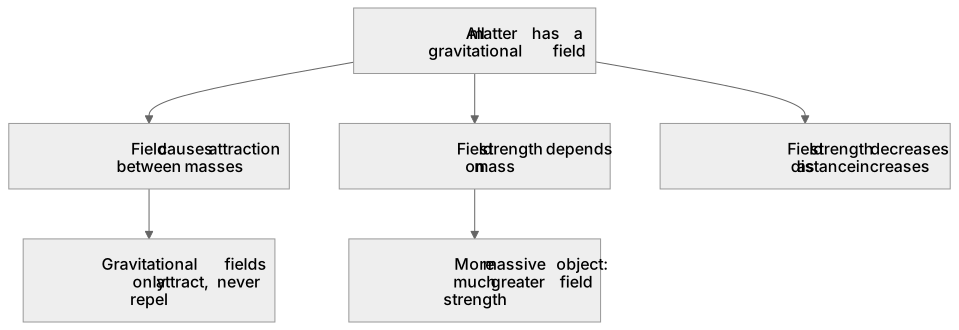
- All matter has one, and it causes attraction between masses rather than pushing them apart.
- attraction
- The pull that a gravitational field always produces between masses, never a push.
- field strength
- Much greater for massive objects, and it decreases as distance from the object increases.
- massive object
- One that produces a stronger gravitational field than a less massive object does.
Label the diagram
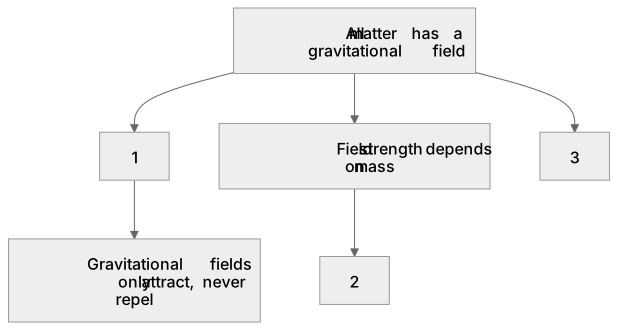
Some boxes have lost their names. Pick the right name for each number.
1Box 1
2Box 2
3Box 3
There is more to this lesson
The full lesson goes on to check your understanding and help you earn the marks. Create a free account to carry on, with your progress saved.
A week of Premium from your first lesson · Then the free plan continues · No card, no charge
Test your understanding of Forces in action: describe that all matter has a gravitational field that causes attraction, and the field strength is much greater for massive objects
Active recall beats re-reading. Take an instant quiz now to test what you’ve learned and lock it into long-term memory.
A week of Premium from your first lesson · Then the free plan continues · No card, no charge