OCR · GCSE · Physics
Course version: J249 · Version from Sept 2018
Describe the difference between elastic and plastic deformation…
Full specification wording
Forces in action: describe the difference between elastic and plastic deformation (distortions) caused by stretching forces
When a stretching force is removed, an object may return to its original shape or stay permanently changed.
Checked against the OCR J249 specification (opens in a new tab) on .
- Point 8 of 21
- 4 key terms
Study notes
From the checked teaching notes for this specification point.
The idea
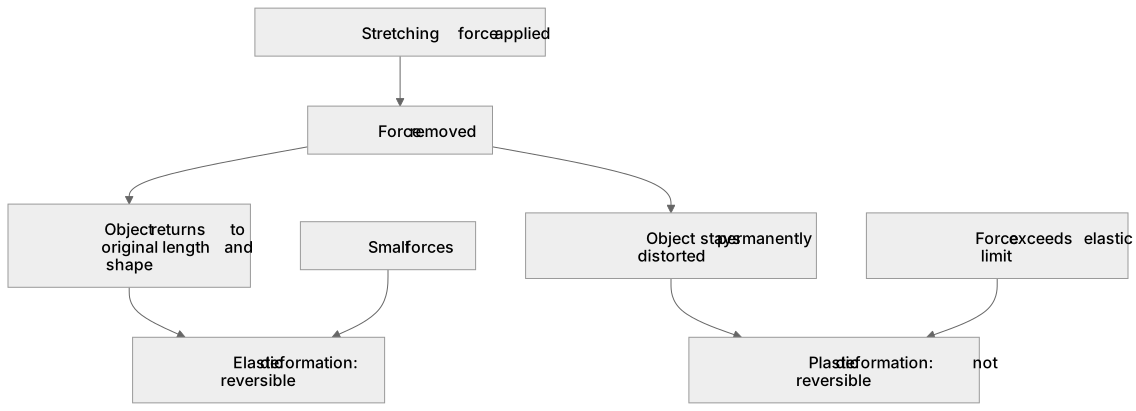
When a stretching force is removed, an object may return to its original shape or stay permanently changed. Elastic deformation occurs when the object returns to its original length and shape once the stretching force is removed; the material behaves elastically, as a rubber band or a spring does within its elastic limit. Plastic deformation occurs when the object is permanently distorted and does not return to its original shape after the force is removed; a metal paperclip bent too far or a piece of plastic stretched beyond its limit shows plastic behaviour. The key distinction is reversibility: elastic deformation is reversible, plastic deformation is not. A material may behave elastically for small forces and plastically once the force exceeds its elastic limit.
What earns the marks
- States that elastic deformation is reversible when the stretching force is removed.
- States that plastic deformation is permanent and the object does not return to its original shape.
- Contrasts the two by referring to whether the object regains its original length or shape.
- Applies the distinction to a named material or object such as a spring, rubber band or bent paperclip.
Common mistakes and how to put them right
Confuses elastic with plastic and claims elastic deformation is permanent.
Put it right by linking elastic to returning to the original shape.
Describes plastic deformation as temporary.
Put it right by stating that the distortion remains after the force is removed.
Omits the role of removing the force.
Put it right by explaining what happens once the stretching force is taken away.
Exam tips
- Use the words reversible and permanent to make the contrast explicit.
- Refer to what happens after the force is removed, since that is the defining test.
- Give a concrete example for each type to support your description.
Try the lesson
The start of the Forces in action: describe the difference between elastic and plastic deformation (distortions) caused by stretching forces lesson, made from checked teaching notes for this specification point.
Have a go first
A rubber band is stretched and then released, and it springs back to its original length. Which word describes this kind of deformation?
Listen
When a stretching force is removed, an object may return to its original shape or stay permanently changed. Elastic deformation occurs when the object returns to its original length and shape once the stretching force is removed; the material behaves elastically, as a rubber band or a spring does within its elastic limit. Plastic deformation occurs when the object is permanently distorted and does not return to its original shape after the force is removed; a metal paperclip bent too far or a piece of plastic stretched beyond its limit shows plastic behaviour. The key distinction is reversibility: elastic deformation is reversible, plastic deformation is not. A material may behave elastically for small forces and plastically once the force exceeds its elastic limit. A strong answer earns marks for these points. States that elastic deformation is reversible when the stretching force is removed. States that plastic deformation is permanent and the object does not return to its original shape. Contrasts the two by referring to whether the object regains its original length or shape. Applies the distinction to a named material or object such as a spring, rubber band or bent paperclip. A common slip: Confuses elastic with plastic and claims elastic deformation is permanent. Instead, linking elastic to returning to the original shape. Exam tip: Use the words reversible and permanent to make the contrast explicit.
See it
Key words
Say what each word means before you turn the card.
Elastic deformation
Try answering aloud or in your head before turning the card.
Plastic deformation
Try answering aloud or in your head before turning the card.
Reversibility of shape change
Try answering aloud or in your head before turning the card.
Elastic limit and material behaviour
Try answering aloud or in your head before turning the card.
See every definition
- Elastic deformation
- Occurs when the object returns to its original length and shape once the stretching force is removed, so the change is reversible.
- Plastic deformation
- Occurs when the object is permanently distorted and does not return to its original shape after the force is removed.
- Reversibility of shape change
- The key distinction is reversibility: elastic deformation is reversible, plastic deformation is not.
- Elastic limit and material behaviour
- A material may behave elastically for small forces and plastically once the force exceeds its elastic limit.
Label the diagram
Some boxes have lost their names. Pick the right name for each number.
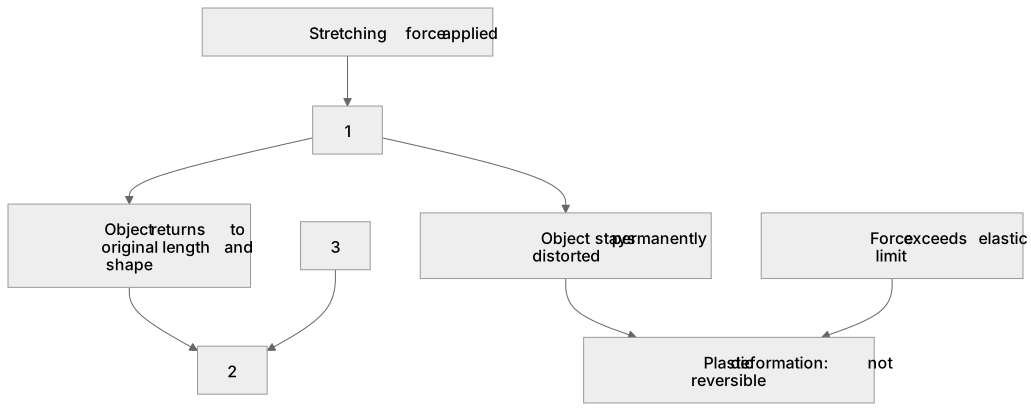
1Box 1
2Box 2
3Box 3
There is more to this lesson
The full lesson goes on to check your understanding and help you earn the marks. Create a free account to carry on, with your progress saved.
A week of Premium from your first lesson · Then the free plan continues · No card, no charge
Test your understanding of Forces in action: describe the difference between elastic and plastic deformation (distortions) caused by stretching forces
Active recall beats re-reading. Take an instant quiz now to test what you’ve learned and lock it into long-term memory.
A week of Premium from your first lesson · Then the free plan continues · No card, no charge