OCR · GCSE · Physics
Course version: J249 · Version from Sept 2018
Recall and apply: gravitational potential energy (J) = mass (kg) ×…
Full specification wording
Forces in action: recall and apply: gravitational potential energy (J) = mass (kg) × gravitational field strength (N/kg) × height (m)
Gravitational potential energy (GPE) is the energy stored when a mass is raised against gravity.
Checked against the OCR J249 specification (opens in a new tab) on .
- Point 4 of 21
- 4 key terms
Study notes
From the checked teaching notes for this specification point.
The idea
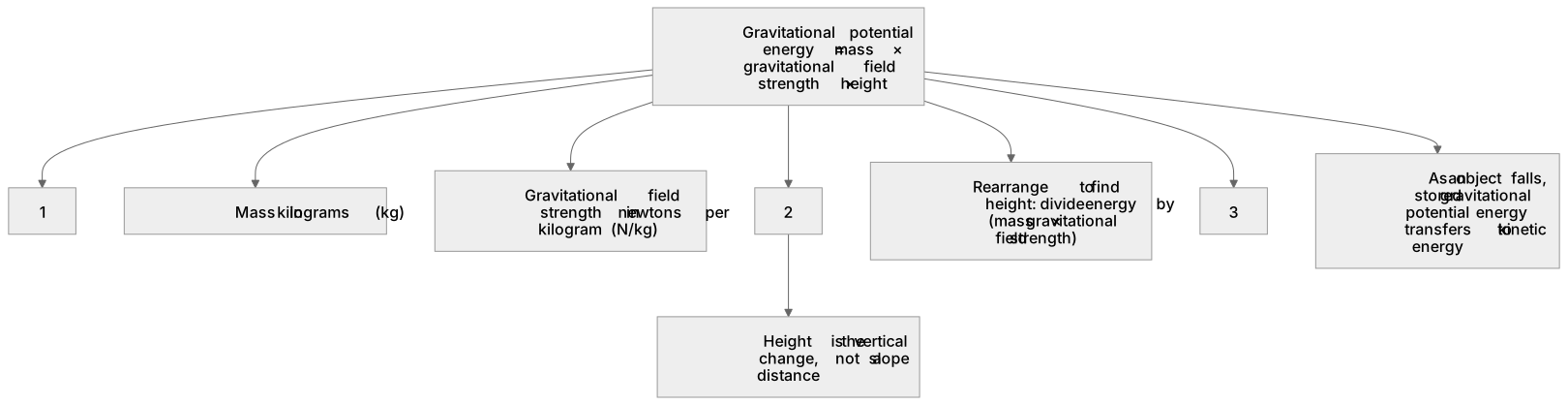
Gravitational potential energy (GPE) is the energy stored when a mass is raised against gravity. The equation is GPE = m × g × h, with energy in joules, mass in kilograms, gravitational field strength in newtons per kilogram and height in metres. Lifting a 2 kg book by 3 m on Earth stores 2 × 9.8 × 3 = 58.8 J. Height must be the vertical change, so a slope distance is not the height unless it is the vertical rise. To rearrange, divide GPE by (m × g) to find height, or by (g × h) to find mass. When an object falls, the stored GPE transfers to kinetic energy, so the same equation can find the energy released. Check units carefully: convert centimetres to metres and grams to kilograms before substituting.
What earns the marks
- Multiplies mass, gravitational field strength and height to obtain gravitational potential energy in joules.
- Uses height as the vertical change in metres rather than a distance along a slope.
- Rearranges the equation to find height by dividing energy by the product of mass and gravitational field strength.
- Recognises that gravitational potential energy transfers to kinetic energy as an object falls.
- Converts centimetres to metres and grams to kilograms before substituting into the equation.
Common mistakes and how to put them right
Uses a slope length as the height.
Put it right: Use the vertical rise in metres.
Leaves mass in grams.
Put it right: Convert to kilograms before multiplying.
Forgets to square nothing but misplaces a factor.
Put it right: Multiply all three quantities m, g and h together.
Omits the unit joule on an energy answer.
Put it right: Write J after the value.
Exam tips
- Write the equation, substitute values with units, then state the answer in joules.
- Identify the vertical height clearly before substituting.
- Check whether the question asks for energy, height or mass and rearrange first.
Try the lesson
The start of the Forces in action: recall and apply: gravitational potential energy (J) = mass (kg) × gravitational field strength (N/kg) × height (m) lesson, made from checked teaching notes for this specification point.
Have a go first
A 10 kg crate is lifted 2 m. Taking gravitational field strength as 10 N/kg, what gravitational potential energy does the crate gain?
Listen
Gravitational potential energy (GPE) is the energy stored when a mass is raised against gravity. The equation is GPE = m × g × h, with energy in joules, mass in kilograms, gravitational field strength in newtons per kilogram and height in metres. Lifting a 2 kg book by 3 m on Earth stores 2 × 9.8 × 3 = 58.8 J. Height must be the vertical change, so a slope distance is not the height unless it is the vertical rise. To rearrange, divide GPE by (m × g) to find height, or by (g × h) to find mass. When an object falls, the stored GPE transfers to kinetic energy, so the same equation can find the energy released. Check units carefully: convert centimetres to metres and grams to kilograms before substituting. A strong answer earns marks for these points. Multiplies mass, gravitational field strength and height to obtain gravitational potential energy in joules. Uses height as the vertical change in metres rather than a distance along a slope. Rearranges the equation to find height by dividing energy by the product of mass and gravitational field strength. Recognises that gravitational potential energy transfers to kinetic energy as an object falls. Exam tip: Write the equation, substitute values with units, then state the answer in joules.
See it

Key words
Say what each word means before you turn the card.
Gravitational potential energy
Try answering aloud or in your head before turning the card.
Energy stored by raising a mass
Try answering aloud or in your head before turning the card.
Transfer between GPE and kinetic energy
Try answering aloud or in your head before turning the card.
Rearranging and applying equations
Try answering aloud or in your head before turning the card.
See every definition
- Gravitational potential energy
- The energy stored when a mass is raised against gravity, measured in joules.
- Energy stored by raising a mass
- Energy stored when a mass is raised against gravity, calculated as mass times gravitational field strength times height.
- Transfer between GPE and kinetic energy
- When an object falls, the stored gravitational potential energy transfers to kinetic energy, so the same equation can find the energy released.
- Rearranging and applying equations
- Dividing gravitational potential energy by the product of mass and gravitational field strength finds height, or by the product of gravitational field strength and height finds mass.
Label the diagram
Some boxes have lost their names. Pick the right name for each number.
1Box 1
2Box 2
3Box 3
There is more to this lesson
The full lesson goes on to check your understanding and help you earn the marks. Create a free account to carry on, with your progress saved.
A week of Premium from your first lesson · Then the free plan continues · No card, no charge
Test your understanding of Forces in action: recall and apply: gravitational potential energy (J) = mass (kg) × gravitational field strength (N/kg) × height (m)
Active recall beats re-reading. Take an instant quiz now to test what you’ve learned and lock it into long-term memory.
A week of Premium from your first lesson · Then the free plan continues · No card, no charge