OCR · GCSE · Physics
Course version: J249 · Version from Sept 2018
Recall that the pressure in fluids (gases and liquids) causes a net force…
Full specification wording
Forces in action: recall that the pressure in fluids (gases and liquids) causes a net force at right angles to any surface (content found only in the physics separate science qualification)
A fluid is any substance that flows, so both gases and liquids count.
Checked against the OCR J249 specification (opens in a new tab) on .
- Point 20 of 21
- 4 key terms
Study notes
From the checked teaching notes for this specification point.
The idea
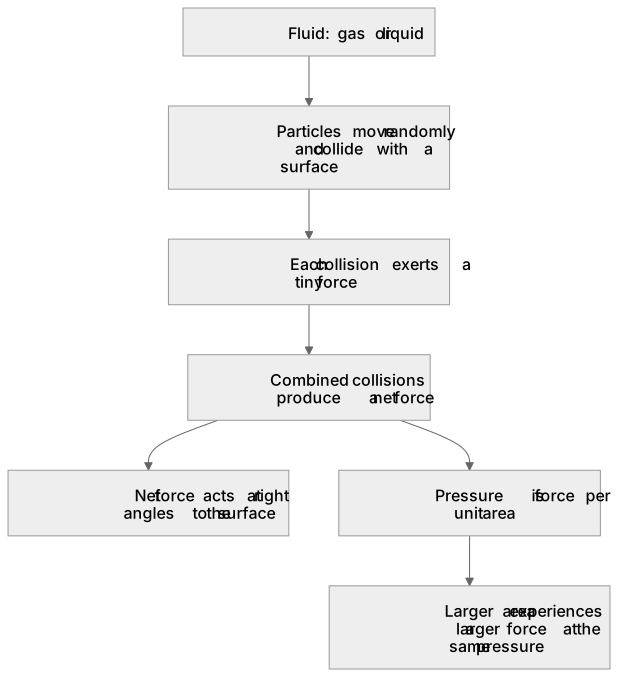
A fluid is any substance that flows, so both gases and liquids count. Particles in a fluid move randomly and collide with the walls of their container or with any surface placed in the fluid. Each collision exerts a tiny force on the surface, and the combined effect of many collisions is a net force. Because the collisions are equally likely from every direction along the surface, this net force acts at right angles (perpendicular) to the surface, not along it. Pressure is this force per unit area, so a given pressure produces a larger force on a larger area. The same rule applies whether the fluid is a gas in a sealed container or a liquid in a tank, and the force always pushes perpendicular to whichever surface the fluid touches.
What earns the marks
- States that a fluid is a gas or a liquid and that both exert pressure on surfaces.
- Explains that fluid particles collide with a surface and each collision exerts a small force.
- States that the combined collisions produce a net force on the surface.
- Identifies that the net force from fluid pressure acts at right angles to the surface.
- Relates pressure to force per unit area so a larger area experiences a larger force at the same pressure.
Common mistakes and how to put them right
Claims the pressure force acts along the surface.
Put it right: State that it acts at right angles to the surface.
Restricts fluids to liquids only.
Put it right: Include gases as fluids that also exert pressure.
Says pressure is a force.
Put it right: Distinguish pressure as force per unit area from the force itself.
Assumes the force depends only on the fluid and not the area.
Put it right: Note that force rises with area at constant pressure.
Exam tips
- Name both gases and liquids when the question asks about fluids.
- Use the phrase at right angles to the surface to describe the direction of the net force.
- Link particle collisions to the net force so the explanation shows the mechanism, not just the result.
Try the lesson
The start of the Forces in action: recall that the pressure in fluids (gases and liquids) causes a net force at right angles to any surface (content found only in the physics separate science qualification) lesson, made from checked teaching notes for this specification point.
Have a go first
A flat plate is held vertically inside a tank of water. What is the direction of the force that the water pressure exerts on the plate?
Listen
A fluid is any substance that flows, so both gases and liquids count. Particles in a fluid move randomly and collide with the walls of their container or with any surface placed in the fluid. Each collision exerts a tiny force on the surface, and the combined effect of many collisions is a net force. Because the collisions are equally likely from every direction along the surface, this net force acts at right angles (perpendicular) to the surface, not along it. Pressure is this force per unit area, so a given pressure produces a larger force on a larger area. The same rule applies whether the fluid is a gas in a sealed container or a liquid in a tank, and the force always pushes perpendicular to whichever surface the fluid touches. A strong answer earns marks for these points. States that a fluid is a gas or a liquid and that both exert pressure on surfaces. Explains that fluid particles collide with a surface and each collision exerts a small force. States that the combined collisions produce a net force on the surface. Identifies that the net force from fluid pressure acts at right angles to the surface. Exam tip: Name both gases and liquids when the question asks about fluids.
See it
Key words
Say what each word means before you turn the card.
Fluids as gases and liquids
Try answering aloud or in your head before turning the card.
Particle collisions producing force
Try answering aloud or in your head before turning the card.
Net force perpendicular to a surface
Try answering aloud or in your head before turning the card.
Pressure as force per unit area
Try answering aloud or in your head before turning the card.
See every definition
- Fluids as gases and liquids
- A fluid is any substance that flows, so both gases and liquids count.
- Particle collisions producing force
- Particles in a fluid move randomly and collide with surfaces, and each collision exerts a tiny force.
- Net force perpendicular to a surface
- The combined effect of many collisions is a net force acting at right angles to the surface.
- Pressure as force per unit area
- Pressure is this force per unit area, so a given pressure produces a larger force on a larger area.
Label the diagram
Some boxes have lost their names. Pick the right name for each number.
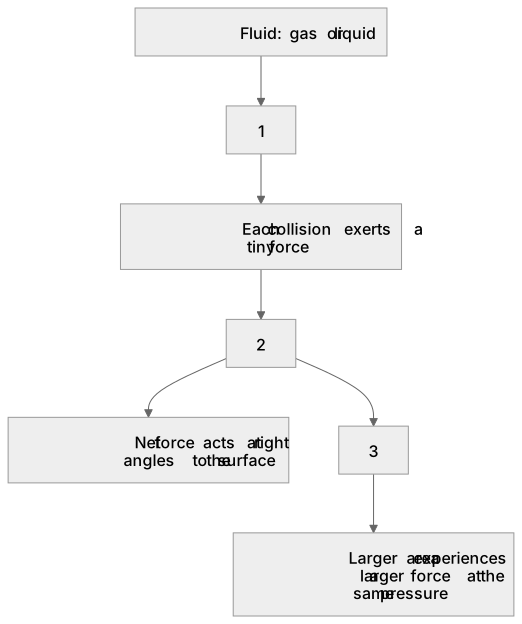
1Box 1
2Box 2
3Box 3
There is more to this lesson
The full lesson goes on to check your understanding and help you earn the marks. Create a free account to carry on, with your progress saved.
A week of Premium from your first lesson · Then the free plan continues · No card, no charge
Test your understanding of Forces in action: recall that the pressure in fluids (gases and liquids) causes a net force at right angles to any surface (content found only in the physics separate science qualification)
Active recall beats re-reading. Take an instant quiz now to test what you’ve learned and lock it into long-term memory.
A week of Premium from your first lesson · Then the free plan continues · No card, no charge