OCR · GCSE · Physics
Course version: J249 · Version from Sept 2018
Use of appropriate apparatus to measure and observe the effects of forces…
Full specification wording
Forces: Use of appropriate apparatus to measure and observe the effects of forces including the extension of springs.
This practical activity asks you to choose suitable apparatus and use it to measure and observe how forces change a spring.
Checked against the OCR J249 specification (opens in a new tab) on .
- Point 2 of 2
- 4 key terms
Study notes
From the checked teaching notes for this specification point.
The idea
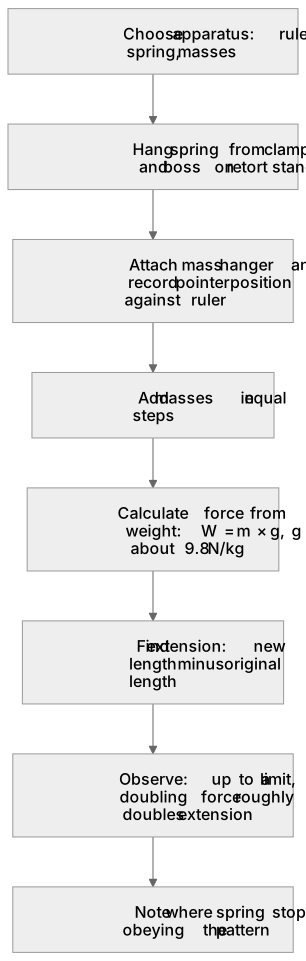
This practical activity asks you to choose suitable apparatus and use it to measure and observe how forces change a spring. A common method hangs a spring from a clamp and boss on a retort stand, attaches a mass hanger, and records the position of a pointer against a ruler before adding masses in equal steps. You calculate the force from the weight of each mass using W = m × g, where g is about 9.8 N/kg on Earth, and find the extension by subtracting the original length from the new length. You observe that, up to a limit, doubling the force roughly doubles the extension, and you note where the spring stops obeying this pattern. Choosing appropriate apparatus means selecting a ruler with a suitable resolution, a spring that does not permanently deform, and masses that give a measurable but safe range of forces.
What earns the marks
- Selects apparatus that can measure both the force applied and the resulting extension of the spring.
- Calculates the force on the spring from the hanging mass using W = m × g with g about 9.8 N/kg.
- Finds the extension by subtracting the original length of the spring from its stretched length.
- Records repeat readings and identifies the point at which the spring stops extending proportionally to the force.
Common mistakes and how to put them right
Confuses extension with total length.
Put it right: Subtract the original length to obtain the extension.
Treats the hanging mass in grams as the force in newtons.
Put it right: Convert to kilograms and multiply by g.
Assumes the spring obeys proportionality for every force.
Put it right: Identify the limit beyond which the pattern breaks down.
Exam tips
- State the apparatus by name and say what each item measures, for example a ruler for extension and a mass set for force.
- Show the calculation of force from mass with the value of g you use, keeping units consistent.
- Describe how you would check the reading is reliable, such as repeating and averaging or reading the pointer at eye level.
Try the lesson
The start of the Forces: Use of appropriate apparatus to measure and observe the effects of forces including the extension of springs. lesson, made from checked teaching notes for this specification point.
Have a go first
A student hangs a 2.0 N weight on a spring and measures how far the spring stretches. Which piece of apparatus is used to measure the extension of the spring directly?
Listen
This practical activity asks you to choose suitable apparatus and use it to measure and observe how forces change a spring. A common method hangs a spring from a clamp and boss on a retort stand, attaches a mass hanger, and records the position of a pointer against a ruler before adding masses in equal steps. You calculate the force from the weight of each mass using W = m × g, where g is about 9.8 N/kg on Earth, and find the extension by subtracting the original length from the new length. You observe that, up to a limit, doubling the force roughly doubles the extension, and you note where the spring stops obeying this pattern. Choosing appropriate apparatus means selecting a ruler with a suitable resolution, a spring that does not permanently deform, and masses that give a measurable but safe range of forces. A strong answer earns marks for these points. Selects apparatus that can measure both the force applied and the resulting extension of the spring. Calculates the force on the spring from the hanging mass using W = m × g with g about 9.8 N/kg. Finds the extension by subtracting the original length of the spring from its stretched length. Records repeat readings and identifies the point at which the spring stops extending proportionally to the force. Exam tip: State the apparatus by name and say what each item measures, for example a ruler for extension and a mass set for force.
See it
Put it in order
Put these steps in the order they happen.
- 1. Calculate force from weight: W = m × g, g about 9.8 N/kg
- 2. Note where spring stops obeying the pattern
- 3. Find extension: new length minus original length
- 4. Choose apparatus: ruler, spring, masses
- 5. Hang spring from clamp and boss on retort stand
- 6. Observe: up to a limit, doubling force roughly doubles extension
- 7. Attach mass hanger and record pointer position against ruler
- 8. Add masses in equal steps
Key words
Say what each word means before you turn the card.
Appropriate apparatus selection
Try answering aloud or in your head before turning the card.
Measuring force and extension
Try answering aloud or in your head before turning the card.
Hooke's law proportionality
Try answering aloud or in your head before turning the card.
Reliability and repeat readings
Try answering aloud or in your head before turning the card.
See every definition
- Appropriate apparatus selection
- Selecting a ruler with a suitable resolution, a spring that does not permanently deform, and masses that give a measurable but safe range of forces.
- Measuring force and extension
- Calculating the force from the weight of each mass using W = m × g, and finding the extension by subtracting the original length from the new length.
- Hooke's law proportionality
- Up to a limit, doubling the force roughly doubles the extension, and you note where the spring stops obeying this pattern.
- Reliability and repeat readings
- Recording repeat readings and identifying the point at which the spring stops extending proportionally to the force.
Label the diagram
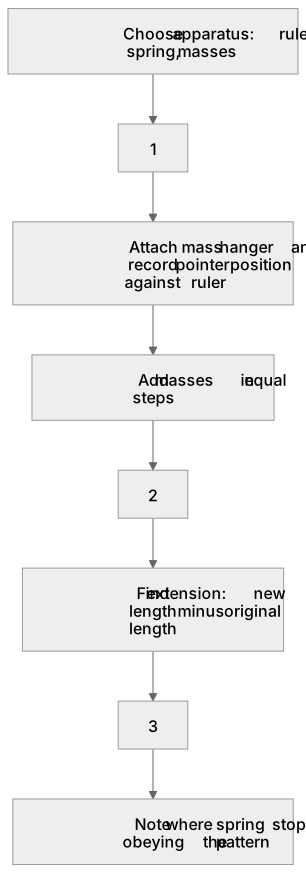
Some boxes have lost their names. Pick the right name for each number.
1Box 1
2Box 2
3Box 3
There is more to this lesson
The full lesson goes on to check your understanding and help you earn the marks. Create a free account to carry on, with your progress saved.
A week of Premium from your first lesson · Then the free plan continues · No card, no charge
Test your understanding of Forces: Use of appropriate apparatus to measure and observe the effects of forces including the extension of springs.
Active recall beats re-reading. Take an instant quiz now to test what you’ve learned and lock it into long-term memory.
A week of Premium from your first lesson · Then the free plan continues · No card, no charge