OCR · GCSE · Physics
Course version: J249 · Version from Sept 2018
Use of appropriate apparatus to make and record a range of measurements…
Full specification wording
Materials: Use of appropriate apparatus to make and record a range of measurements accurately, including length, area, mass, time, volume and temperature.
This practical apparatus criterion asks you to choose the right instrument for each quantity and to record readings accurately.
Checked against the OCR J249 specification (opens in a new tab) on .
- Point 1 of 2
- 4 key terms
Study notes
From the checked teaching notes for this specification point.
The idea
This practical apparatus criterion asks you to choose the right instrument for each quantity and to record readings accurately. Length is measured with a ruler or vernier calliper, choosing the scale that gives suitable resolution. Area is found by measuring lengths and calculating, for example length × width for a rectangle. Mass is measured with a balance, zeroed before use. Time is measured with a stopwatch, often timing several repeats to reduce random error. Volume of a liquid is read from a measuring cylinder at eye level, taking the bottom of the meniscus; volume of a regular solid is calculated from its dimensions. Temperature is measured with a thermometer or digital probe, allowing it to settle. A multiple-choice question tests whether you can match instrument to quantity and record with correct units and precision.
What earns the marks
- Selects a ruler, vernier calliper or micrometer for length according to the resolution needed.
- Calculates area from measured lengths rather than guessing, for example length × width for a rectangle.
- Chooses a balance for mass and zeroes it before taking the reading.
- Uses a stopwatch for time and repeats readings to reduce random error.
- Reads a measuring cylinder at eye level, taking the bottom of the meniscus, and records volume in cm³ or ml.
- Selects a thermometer or digital temperature probe and waits for the reading to settle before recording.
Common mistakes and how to put them right
Reads a measuring cylinder from above or below eye level.
Put it right by reading at eye level at the bottom of the meniscus.
Records a measurement without a unit.
Put it right by stating the unit, such as cm, g, s, cm³ or °C.
Uses a ruler to measure mass or a balance to measure volume.
Put it right by matching each instrument to the quantity it measures.
Takes a single timing and treats it as exact.
Put it right by repeating and averaging to reduce random error.
Exam tips
- Match the instrument to the quantity before looking at the options.
- Check that each recorded value carries the correct unit.
- Consider resolution: choose the instrument that can measure the smallest change required.
- Remember that area and the volume of a regular solid are calculated from measured lengths.
Try the lesson
The start of the Materials: Use of appropriate apparatus to make and record a range of measurements accurately, including length, area, mass, time, volume and temperature. lesson, made from checked teaching notes for this specification point.
Have a go first
Which piece of apparatus is most suitable for measuring 25.0 cm³ of water?
Listen
This practical apparatus criterion asks you to choose the right instrument for each quantity and to record readings accurately. Length is measured with a ruler or vernier calliper, choosing the scale that gives suitable resolution. Area is found by measuring lengths and calculating, for example length × width for a rectangle. Mass is measured with a balance, zeroed before use. Time is measured with a stopwatch, often timing several repeats to reduce random error. Volume of a liquid is read from a measuring cylinder at eye level, taking the bottom of the meniscus; volume of a regular solid is calculated from its dimensions. Temperature is measured with a thermometer or digital probe, allowing it to settle. A multiple-choice question tests whether you can match instrument to quantity and record with correct units and precision. A strong answer earns marks for these points. Selects a ruler, vernier calliper or micrometer for length according to the resolution needed. Calculates area from measured lengths rather than guessing, for example length × width for a rectangle. Chooses a balance for mass and zeroes it before taking the reading. Uses a stopwatch for time and repeats readings to reduce random error. A common slip: Reads a measuring cylinder from above or below eye level. Instead, reading at eye level at the bottom of the meniscus. Exam tip: Match the instrument to the quantity before looking at the options.
See it

Key words
Say what each word means before you turn the card.
Choosing appropriate apparatus
Try answering aloud or in your head before turning the card.
Accurate recording with units
Try answering aloud or in your head before turning the card.
Resolution and precision
Try answering aloud or in your head before turning the card.
Reducing random error by repeating
Try answering aloud or in your head before turning the card.
See every definition
- Choosing appropriate apparatus
- Matching each instrument to the quantity it measures, such as a balance for mass and a stopwatch for time.
- Accurate recording with units
- Always stating the unit with a measurement, such as cm, g, s, cm³ or °C.
- Resolution and precision
- Choosing the instrument that can measure the smallest change required, such as the scale that gives suitable resolution.
- Reducing random error by repeating
- Taking repeated readings, such as timing several repeats, and averaging to reduce random error.
Label the diagram
Some boxes have lost their names. Pick the right name for each number.
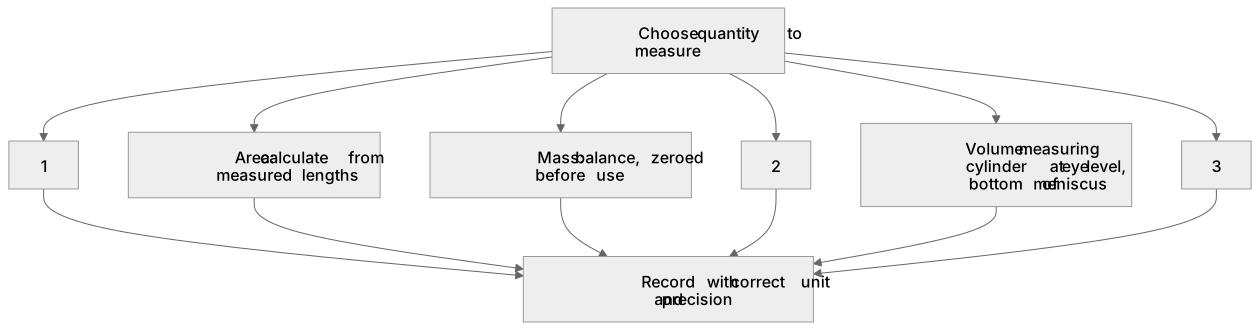
1Box 1
2Box 2
3Box 3
There is more to this lesson
The full lesson goes on to check your understanding and help you earn the marks. Create a free account to carry on, with your progress saved.
A week of Premium from your first lesson · Then the free plan continues · No card, no charge
Test your understanding of Materials: Use of appropriate apparatus to make and record a range of measurements accurately, including length, area, mass, time, volume and temperature.
Active recall beats re-reading. Take an instant quiz now to test what you’ve learned and lock it into long-term memory.
A week of Premium from your first lesson · Then the free plan continues · No card, no charge