OCR · GCSE · Physics
Course version: J249 · Version from Sept 2018
Use of appropriate apparatus to make and record a range of measurements…
Full specification wording
Measuring waves: Use of appropriate apparatus to make and record a range of measurements accurately, including length, area, mass, time, volume and temperature.
In wave practical work you must pick apparatus that measures each quantity to a sensible precision and record the results clearly.
Checked against the OCR J249 specification (opens in a new tab) on .
- Point 1 of 2
- 4 key terms
Study notes
From the checked teaching notes for this specification point.
The idea
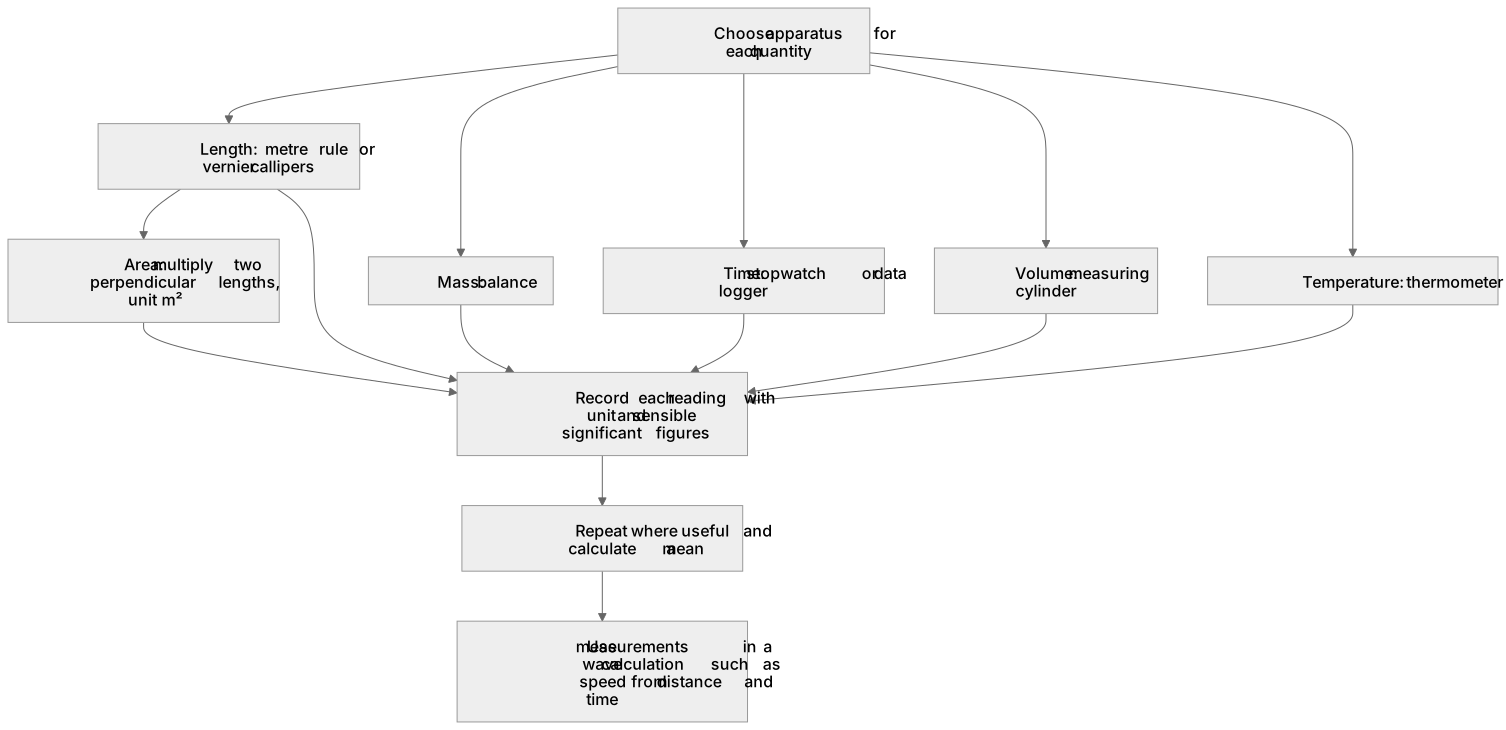
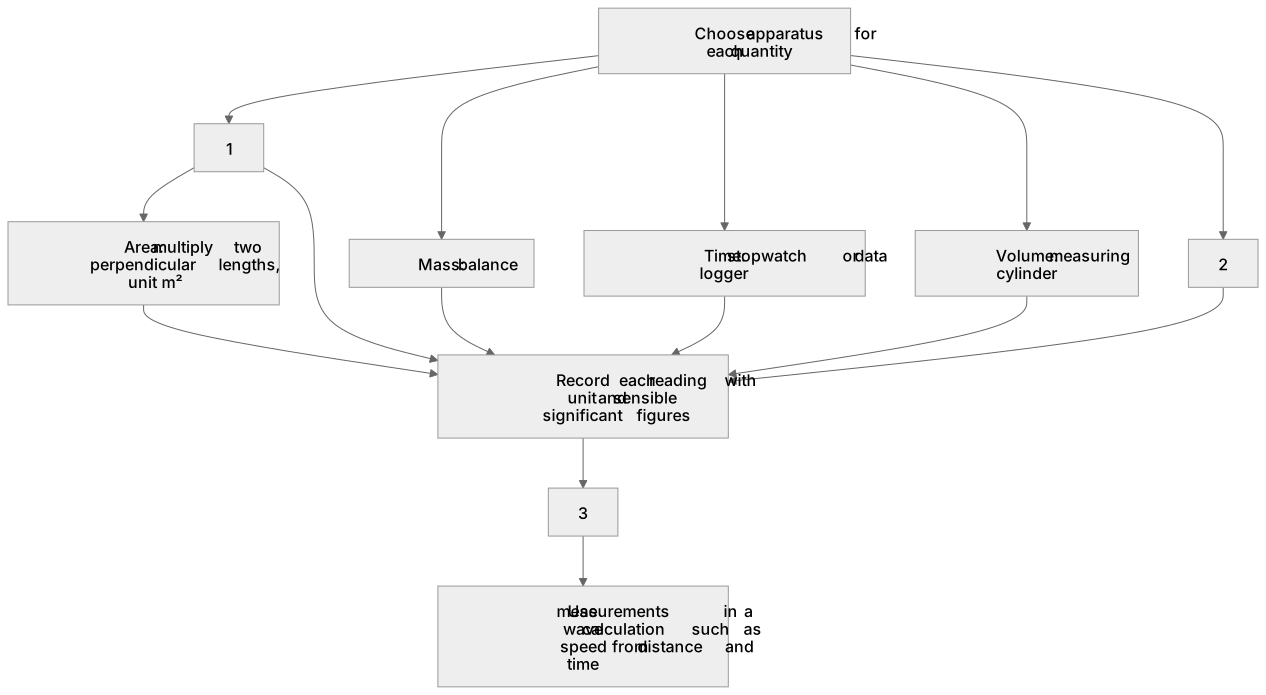
In wave practical work you must pick apparatus that measures each quantity to a sensible precision and record the results clearly. Measure length with a metre rule or vernier callipers, and find area by multiplying two measured lengths and giving the unit in m². Measure mass with a balance in kilograms or grams, time with a stopwatch or data logger in seconds, volume with a measuring cylinder in cm³ or ml, and temperature with a thermometer in °C. Record each reading with its unit and an appropriate number of significant figures, repeat where useful and calculate a mean. Accurate recording lets you then calculate wave speed from frequency and wavelength or from distance and time.
What earns the marks
- Selects apparatus matched to each quantity, such as a balance for mass, a measuring cylinder for volume and a thermometer for temperature.
- Measures length with a rule or callipers and calculates area by multiplying two perpendicular lengths, recording the result in m².
- Records each measurement with its correct unit and a sensible number of significant figures.
- Repeats readings where appropriate and calculates a mean to improve reliability.
- Uses the recorded measurements to support a wave calculation such as speed from distance and time.
Common mistakes and how to put them right
Records a number without a unit.
Put it right: State the unit, for example 25.0 cm³ or 20 °C.
Calculates area by adding lengths.
Put it right: Multiply the two perpendicular lengths instead.
Reads a measuring cylinder at the top of the meniscus.
Put it right: Read at eye level at the bottom of the meniscus for water.
Gives more significant figures than the apparatus can support.
Put it right: Match the precision to the smallest scale division.
Exam tips
- Name the apparatus and the quantity it measures in the same sentence to show the link.
- Write every reading with its unit before doing any calculation.
- State how repeats or a mean improve the reliability of the recorded data.
Try the lesson
The start of the Measuring waves: Use of appropriate apparatus to make and record a range of measurements accurately, including length, area, mass, time, volume and temperature. lesson, made from checked teaching notes for this specification point.
Have a go first
A student needs to find the mass of a small metal block before using it in a wave experiment. Which apparatus is most suitable?
Listen
In wave practical work you must pick apparatus that measures each quantity to a sensible precision and record the results clearly. Measure length with a metre rule or vernier callipers, and find area by multiplying two measured lengths and giving the unit in m². Measure mass with a balance in kilograms or grams, time with a stopwatch or data logger in seconds, volume with a measuring cylinder in cm³ or ml, and temperature with a thermometer in °C. Record each reading with its unit and an appropriate number of significant figures, repeat where useful and calculate a mean. Accurate recording lets you then calculate wave speed from frequency and wavelength or from distance and time. A strong answer earns marks for these points. Selects apparatus matched to each quantity, such as a balance for mass, a measuring cylinder for volume and a thermometer for temperature. Measures length with a rule or callipers and calculates area by multiplying two perpendicular lengths, recording the result in m². Records each measurement with its correct unit and a sensible number of significant figures. Repeats readings where appropriate and calculates a mean to improve reliability. Exam tip: Name the apparatus and the quantity it measures in the same sentence to show the link.
See it
Key words
Say what each word means before you turn the card.
Matching apparatus to the quantity measured
Try answering aloud or in your head before turning the card.
Measuring length and calculating area
Try answering aloud or in your head before turning the card.
Recording mass, time, volume and temperature with units
Try answering aloud or in your head before turning the card.
Improving reliability through repeats and means
Try answering aloud or in your head before turning the card.
See every definition
- Matching apparatus to the quantity measured
- Picking apparatus that measures each quantity to a sensible precision, such as a balance for mass, a measuring cylinder for volume and a thermometer for temperature.
- Measuring length and calculating area
- Measuring length with a metre rule or vernier callipers, then finding area by multiplying two perpendicular lengths and giving the unit in m².
- Recording mass, time, volume and temperature with units
- Recording each reading with its correct unit and an appropriate number of significant figures, matching the precision to the smallest scale division.
- Improving reliability through repeats and means
- Repeating readings where appropriate and calculating a mean to improve the reliability of the recorded data.
Label the diagram
Some boxes have lost their names. Pick the right name for each number.
1Box 1
2Box 2
3Box 3
There is more to this lesson
The full lesson goes on to check your understanding and help you earn the marks. Create a free account to carry on, with your progress saved.
A week of Premium from your first lesson · Then the free plan continues · No card, no charge
Test your understanding of Measuring waves: Use of appropriate apparatus to make and record a range of measurements accurately, including length, area, mass, time, volume and temperature.
Active recall beats re-reading. Take an instant quiz now to test what you’ve learned and lock it into long-term memory.
A week of Premium from your first lesson · Then the free plan continues · No card, no charge