OCR · GCSE · Physics
Course version: J249 · Version from Sept 2018
Apply formulae relating distance, time and speed, for uniform motion, and…
Full specification wording
Motion: apply formulae relating distance, time and speed, for uniform motion, and for motion with uniform acceleration
This criterion asks you to select and use the right relationship for two different kinds of motion.
Checked against the OCR J249 specification (opens in a new tab) on .
- Point 12 of 14
- 4 key terms
Study notes
From the checked teaching notes for this specification point.
The idea
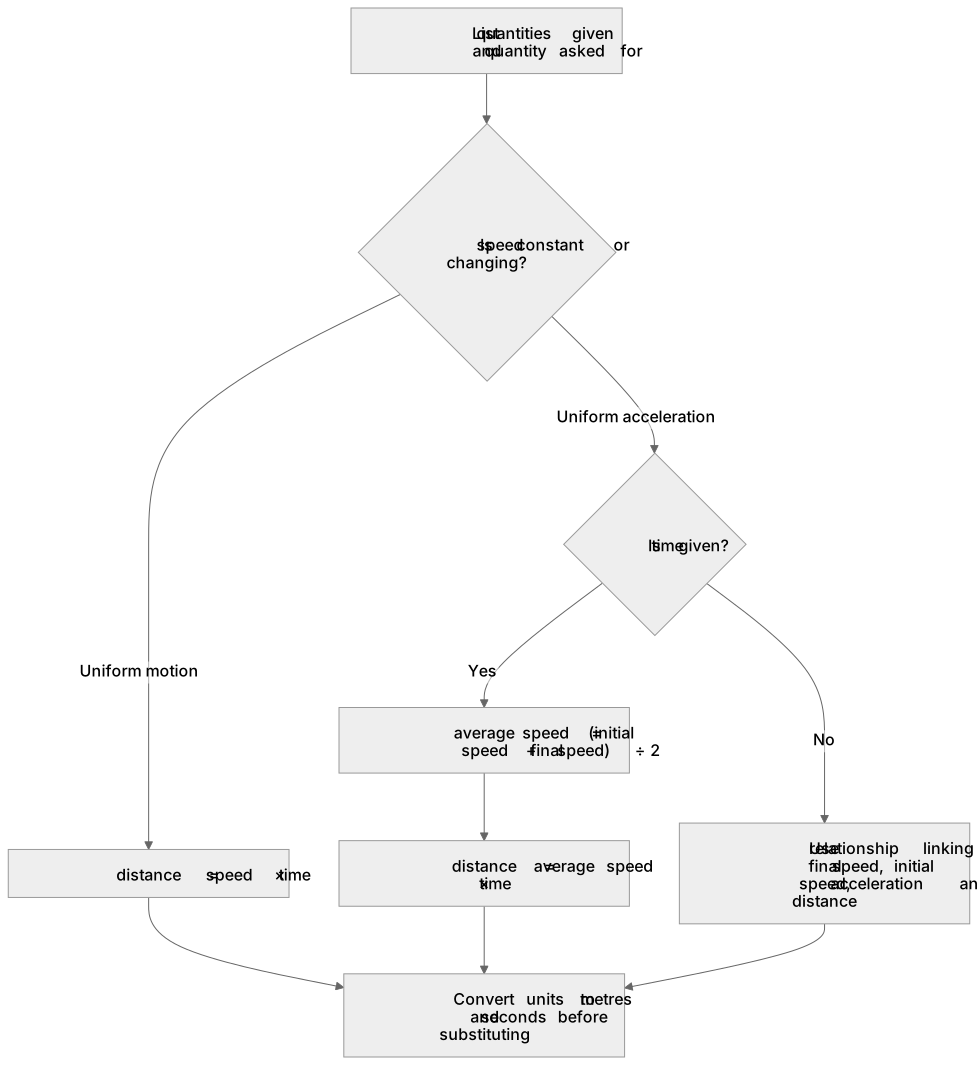
This criterion asks you to select and use the right relationship for two different kinds of motion. For uniform motion, speed stays constant, so distance = speed × time, rearranged as speed = distance ÷ time or time = distance ÷ speed. For motion with uniform acceleration, speed changes at a steady rate, so distance = average speed × time, where average speed = (initial speed + final speed) ÷ 2. You also use acceleration = change in speed ÷ time and the combined relationship linking final speed, initial speed, acceleration and distance. In a multiple-choice question, read which quantities are given, decide whether speed is constant or changing, then pick the formula that uses exactly those quantities. Check units: convert minutes to seconds and kilometres to metres before substituting.
What earns the marks
- Selects distance = speed × time when the object moves at constant speed.
- Uses distance = average speed × time with average speed = (initial speed + final speed) ÷ 2 for uniform acceleration.
- Applies acceleration = change in speed ÷ time to find the time taken to change speed.
- Chooses the relationship linking final speed, initial speed, acceleration and distance when time is not given.
- Converts units such as minutes to seconds and kilometres to metres before substituting into a formula.
Common mistakes and how to put them right
Uses distance = speed × time with the final speed during acceleration.
Put it right: Use the average of initial and final speed instead.
Forgets to halve the sum of initial and final speed when finding average speed.
Put it right: Divide the sum by 2.
Substitutes time in minutes into a formula expecting seconds.
Put it right: Convert to seconds first.
Mixes kilometres and metres in one calculation.
Put it right: Convert all distances to the same unit.
Exam tips
- List the quantities given and the quantity asked for before looking at the options.
- Decide first whether the motion is uniform or uniformly accelerated, because that choice fixes the formula.
- Convert all units to metres and seconds before substituting, then check the answer's size is sensible.
Try the lesson
The start of the Motion: apply formulae relating distance, time and speed, for uniform motion, and for motion with uniform acceleration lesson, made from checked teaching notes for this specification point.
Have a go first
A cyclist travels at a steady speed of 6 m/s for 20 s. What distance does the cyclist cover?
Listen
This criterion asks you to select and use the right relationship for two different kinds of motion. For uniform motion, speed stays constant, so distance = speed × time, rearranged as speed = distance ÷ time or time = distance ÷ speed. For motion with uniform acceleration, speed changes at a steady rate, so distance = average speed × time, where average speed = (initial speed + final speed) ÷ 2. You also use acceleration = change in speed ÷ time and the combined relationship linking final speed, initial speed, acceleration and distance. In a multiple-choice question, read which quantities are given, decide whether speed is constant or changing, then pick the formula that uses exactly those quantities. Check units: convert minutes to seconds and kilometres to metres before substituting. A strong answer earns marks for these points. Selects distance = speed × time when the object moves at constant speed. Uses distance = average speed × time with average speed = (initial speed + final speed) ÷ 2 for uniform acceleration. Applies acceleration = change in speed ÷ time to find the time taken to change speed. Chooses the relationship linking final speed, initial speed, acceleration and distance when time is not given. Exam tip: List the quantities given and the quantity asked for before looking at the options.
See it
Key words
Say what each word means before you turn the card.
Uniform motion
Try answering aloud or in your head before turning the card.
Uniform acceleration
Try answering aloud or in your head before turning the card.
Acceleration
Try answering aloud or in your head before turning the card.
Unit conversion
Try answering aloud or in your head before turning the card.
See every definition
- Uniform motion
- Motion in which speed stays constant, so distance = speed × time, rearranged as speed = distance ÷ time or time = distance ÷ speed.
- Uniform acceleration
- Motion in which speed changes at a steady rate, so distance = average speed × time, where average speed = (initial speed + final speed) ÷ 2.
- Acceleration
- Change in speed ÷ time, used to find the time taken to change speed.
- Unit conversion
- Converting units such as minutes to seconds and kilometres to metres before substituting into a formula.
There is more to this lesson
The full lesson goes on to check your understanding and help you earn the marks. Create a free account to carry on, with your progress saved.
A week of Premium from your first lesson · Then the free plan continues · No card, no charge
Test your understanding of Motion: apply formulae relating distance, time and speed, for uniform motion, and for motion with uniform acceleration
Active recall beats re-reading. Take an instant quiz now to test what you’ve learned and lock it into long-term memory.
A week of Premium from your first lesson · Then the free plan continues · No card, no charge