OCR · GCSE · Physics
Course version: J249 · Version from Sept 2018
Apply Newton’s first law to explain the motion of an object moving with…
Full specification wording
Newton's laws: apply Newton’s first law to explain the motion of an object moving with uniform velocity and also an object where the speed and/or direction change (to include: looking at forces on one body and resultant forces and their effects (qualitative only))
Newton's first law says an object keeps a constant velocity unless a resultant force acts on it.
Checked against the OCR J249 specification (opens in a new tab) on .
- Point 8 of 20
- 4 key terms
Study notes
From the checked teaching notes for this specification point.
The idea
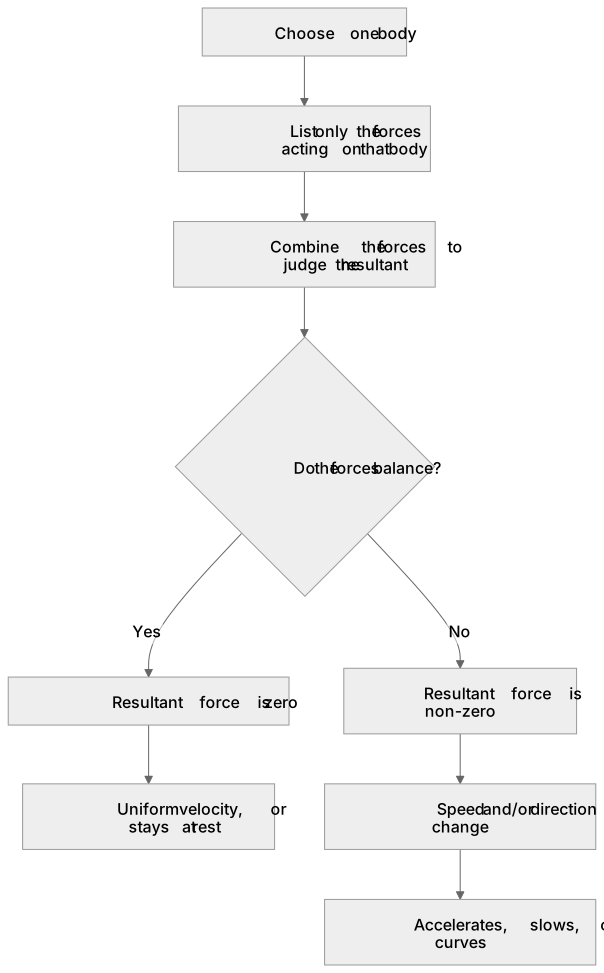
Newton's first law says an object keeps a constant velocity unless a resultant force acts on it. To apply it, isolate one body, list the forces on that body only, then combine them to judge the resultant. If the forces balance, the resultant is zero and the object continues at uniform velocity, or stays at rest. If they do not balance, a resultant force exists and the speed and/or direction change: the object accelerates, slows, or curves. For example, a car cruising at a steady 20 m/s on a straight road has driving force balanced by friction and drag, so its velocity is constant. When the driver brakes, friction exceeds the driving force, a backward resultant acts, and the car slows. Reasoning stays qualitative: name the forces, state whether they balance, and link that to the motion.
What earns the marks
- Identifies the single body under consideration and lists only the forces acting on that body.
- Combines the forces on the body to decide whether the resultant is zero or non-zero.
- States that zero resultant force means uniform velocity or rest, in line with Newton's first law.
- Explains that a non-zero resultant force changes the speed and/or the direction of motion.
- Describes the direction of the resultant force and links it to speeding up, slowing down or curving.
- Keeps the reasoning qualitative by naming forces and balance rather than calculating values.
Common mistakes and how to put them right
Lists forces the body exerts on other objects.
Put it right: Keep only the forces acting on the chosen body.
Treats a moving object as necessarily having a resultant force.
Put it right: Recognise that steady motion needs zero resultant.
Assumes a constant speed always means zero resultant force.
Put it right: Check whether the direction changes, as in circular motion.
Adds forces in the same direction when they oppose.
Put it right: Subtract opposing forces to find the resultant.
Exam tips
- Name the body first, then list each force on it with its direction before judging balance.
- State explicitly whether the resultant is zero or non-zero, then link that to the described motion.
- Use the words uniform velocity, resultant force and balanced to match the command of the criterion.
Try the lesson
The start of the Newton's laws: apply Newton’s first law to explain the motion of an object moving with uniform velocity and also an object where the speed and/or direction change (to include: looking at forces on one body and resultant forces and their effects (qualitative only)) lesson, made from checked teaching notes for this specification point.
Have a go first
A book rests on a horizontal table and does not move. The weight of the book is 8 N downwards. What is the size and direction of the force the table exerts on the book?
Listen
Newton's first law says an object keeps a constant velocity unless a resultant force acts on it. To apply it, isolate one body, list the forces on that body only, then combine them to judge the resultant. If the forces balance, the resultant is zero and the object continues at uniform velocity, or stays at rest. If they do not balance, a resultant force exists and the speed and/or direction change: the object accelerates, slows, or curves. For example, a car cruising at a steady 20 m/s on a straight road has driving force balanced by friction and drag, so its velocity is constant. When the driver brakes, friction exceeds the driving force, a backward resultant acts, and the car slows. Reasoning stays qualitative: name the forces, state whether they balance, and link that to the motion. A strong answer earns marks for these points. Identifies the single body under consideration and lists only the forces acting on that body. Combines the forces on the body to decide whether the resultant is zero or non-zero. States that zero resultant force means uniform velocity or rest, in line with Newton's first law. Explains that a non-zero resultant force changes the speed and/or the direction of motion. Exam tip: Name the body first, then list each force on it with its direction before judging balance.
See it
Key words
Say what each word means before you turn the card.
Newton's first law
Try answering aloud or in your head before turning the card.
Resultant force on a single body
Try answering aloud or in your head before turning the card.
Uniform velocity and balanced forces
Try answering aloud or in your head before turning the card.
Changing speed or direction from an unbalanced force
Try answering aloud or in your head before turning the card.
See every definition
- Newton's first law
- An object keeps a constant velocity unless a resultant force acts on it.
- Resultant force on a single body
- The forces on one body only are combined to judge the resultant.
- Uniform velocity and balanced forces
- If the forces balance, the resultant is zero and the object continues at uniform velocity, or stays at rest.
- Changing speed or direction from an unbalanced force
- If the forces do not balance, a resultant force exists and the speed and/or direction change.
Label the diagram
Some boxes have lost their names. Pick the right name for each number.
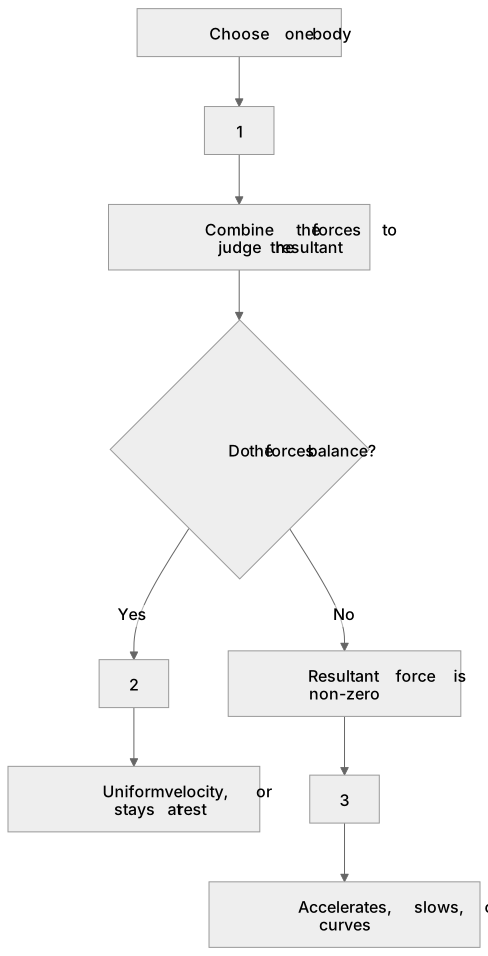
1Box 1
2Box 2
3Box 3
There is more to this lesson
The full lesson goes on to check your understanding and help you earn the marks. Create a free account to carry on, with your progress saved.
A week of Premium from your first lesson · Then the free plan continues · No card, no charge
Test your understanding of Newton's laws: apply Newton’s first law to explain the motion of an object moving with uniform velocity and also an object where the speed and/or direction change (to include: looking at forces on one body and resultant forces and their effects (qualitative only))
Active recall beats re-reading. Take an instant quiz now to test what you’ve learned and lock it into long-term memory.
A week of Premium from your first lesson · Then the free plan continues · No card, no charge