OCR · GCSE · Physics
Course version: J249 · Version from Sept 2018
Apply Newton’s second law in calculations relating forces, masses and…
Full specification wording
Newton's laws: apply Newton’s second law in calculations relating forces, masses and accelerations
Newton's second law links resultant force F, mass m and acceleration a by the equation F = m × a.
Checked against the OCR J249 specification (opens in a new tab) on .
- Point 12 of 20
- 4 key terms
Study notes
From the checked teaching notes for this specification point.
The idea
Newton's second law links resultant force F, mass m and acceleration a by the equation F = m × a. Force is measured in newtons (N), mass in kilograms (kg) and acceleration in metres per second squared (m/s²). A resultant force of 12 N on a 3 kg trolley gives a = F ÷ m = 12 N ÷ 3 kg = 4 m/s². Rearranging gives m = F ÷ a and a = F ÷ m, so any one quantity can be found from the other two. Always use the resultant force, not a single applied force, when several forces act: subtract opposing forces first. Convert grams to kilograms by dividing by 1000, for example 500 g = 0.5 kg. Check units before substituting, then state the unit with the answer. A larger resultant force on the same mass gives a larger acceleration, and a larger mass under the same force gives a smaller acceleration.
What earns the marks
- Selects the equation F = m × a and substitutes the given values correctly.
- Rearranges the equation to find acceleration as force divided by mass.
- Rearranges the equation to find mass as force divided by acceleration.
- Uses the resultant force by combining opposing forces before substituting.
- Converts mass in grams to kilograms by dividing by 1000.
- States the answer with the correct unit: newtons, kilograms or metres per second squared.
- Explains that a greater resultant force on the same mass produces a greater acceleration.
Common mistakes and how to put them right
Substitutes a single applied force when two opposing forces act.
Put it right: Calculate the resultant force first.
Uses mass in grams directly in the equation.
Put it right: Convert to kilograms by dividing by 1000.
Multiplies force by mass when finding acceleration.
Put it right: Divide force by mass instead.
Omits the unit or gives the wrong unit with the answer.
Put it right: State N, kg or m/s² as appropriate.
Treats acceleration as a force.
Put it right: Recognise that acceleration is the effect produced by a resultant force.
Exam tips
- Write the equation, then rearrange it before substituting numbers to reduce errors.
- Convert all masses to kilograms and check every unit before calculating.
- Show the substitution line so the method is visible even if the arithmetic slips.
- Sanity-check the answer: doubling the force on the same mass should double the acceleration.
Try the lesson
The start of the Newton's laws: apply Newton’s second law in calculations relating forces, masses and accelerations lesson, made from checked teaching notes for this specification point.
Have a go first
A box of mass 5 kg experiences a resultant force of 20 N. What is its acceleration?
Listen
Newton's second law links resultant force F, mass m and acceleration a by the equation F = m × a. Force is measured in newtons (N), mass in kilograms (kg) and acceleration in metres per second squared (m/s²). A resultant force of 12 N on a 3 kg trolley gives a = F ÷ m = 12 N ÷ 3 kg = 4 m/s². Rearranging gives m = F ÷ a and a = F ÷ m, so any one quantity can be found from the other two. Always use the resultant force, not a single applied force, when several forces act: subtract opposing forces first. Convert grams to kilograms by dividing by 1000, for example 500 g = 0.5 kg. Check units before substituting, then state the unit with the answer. A larger resultant force on the same mass gives a larger acceleration, and a larger mass under the same force gives a smaller acceleration. A strong answer earns marks for these points. Selects the equation F = m × a and substitutes the given values correctly. Rearranges the equation to find acceleration as force divided by mass. Rearranges the equation to find mass as force divided by acceleration. Uses the resultant force by combining opposing forces before substituting. Exam tip: Write the equation, then rearrange it before substituting numbers to reduce errors.
See it
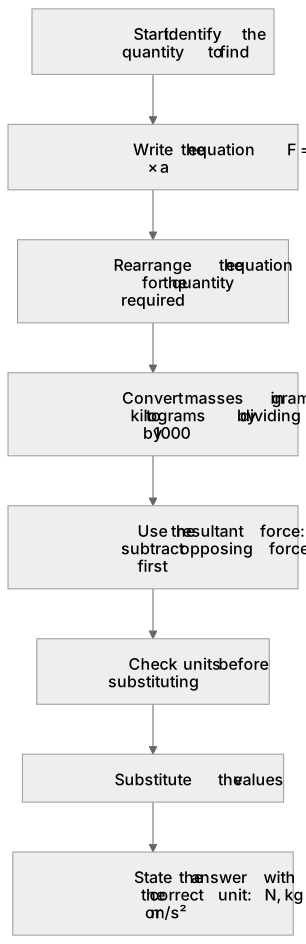
Put it in order
Put these steps in the order they happen.
- 1. Use the resultant force: subtract opposing forces first
- 2. State the answer with the correct unit: N, kg or m/s²
- 3. Check units before substituting
- 4. Start: identify the quantity to find
- 5. Write the equation F = m × a
- 6. Substitute the values
- 7. Rearrange the equation for the quantity required
- 8. Convert masses in grams to kilograms by dividing by 1000
Key words
Say what each word means before you turn the card.
Newton's second law
Try answering aloud or in your head before turning the card.
Resultant force
Try answering aloud or in your head before turning the card.
Force, mass and acceleration
Try answering aloud or in your head before turning the card.
Rearranging equations
Try answering aloud or in your head before turning the card.
See every definition
- Newton's second law
- Links resultant force F, mass m and acceleration a by the equation F = m × a.
- Resultant force
- The force to use when several forces act, found by subtracting opposing forces first.
- Force, mass and acceleration
- Measured in newtons (N), kilograms (kg) and metres per second squared (m/s²) respectively.
- Rearranging equations
- Gives m = F ÷ a and a = F ÷ m, so any one quantity can be found from the other two.
Label the diagram
Some boxes have lost their names. Pick the right name for each number.
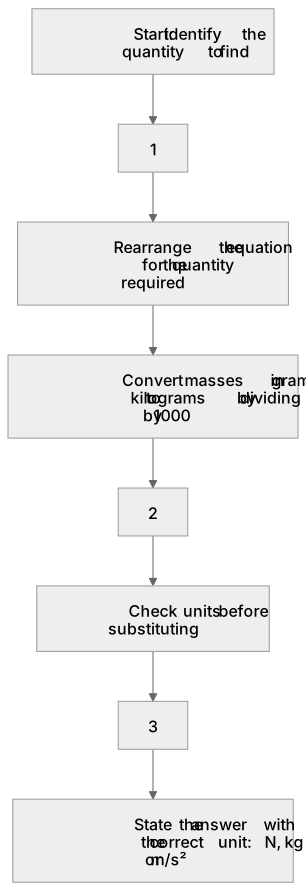
1Box 1
2Box 2
3Box 3
There is more to this lesson
The full lesson goes on to check your understanding and help you earn the marks. Create a free account to carry on, with your progress saved.
A week of Premium from your first lesson · Then the free plan continues · No card, no charge
Test your understanding of Newton's laws: apply Newton’s second law in calculations relating forces, masses and accelerations
Active recall beats re-reading. Take an instant quiz now to test what you’ve learned and lock it into long-term memory.
A week of Premium from your first lesson · Then the free plan continues · No card, no charge