OCR · GCSE · Physics
Course version: J249 · Version from Sept 2018
Describe, using free body diagrams, examples where two or more forces lead…
Full specification wording
Newton's laws: describe, using free body diagrams, examples where two or more forces lead to a resultant force on an object (Higher tier only)
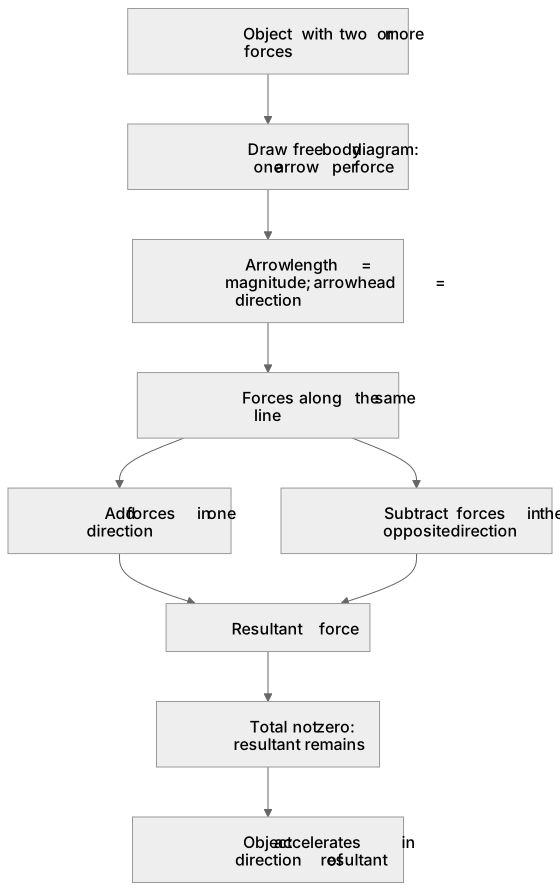
A free body diagram shows the object as a point or simple shape with one arrow for each force acting on it; arrow length represents magnitude and the arrowhead gives direction.
Checked against the OCR J249 specification (opens in a new tab) on .
- Point 10 of 20
- 4 key terms
Study notes
From the checked teaching notes for this specification point.
The idea
A free body diagram shows the object as a point or simple shape with one arrow for each force acting on it; arrow length represents magnitude and the arrowhead gives direction. When two or more forces act, combine them: forces along the same line add or subtract, so opposite forces partly cancel. If the total is not zero, a resultant force remains and the object accelerates in the direction of that resultant. For example, a box pushed with 30 N to the right while friction acts with 10 N to the left has a resultant of 20 N to the right. Read each diagram, resolve the arrows, and choose the option that correctly states the resultant's size and direction.
What earns the marks
- Identifies each force arrow on the free body diagram and states its direction relative to the object.
- Combines forces acting along the same line by adding those in one direction and subtracting those in the opposite direction.
- States the size and direction of the resultant force when the forces do not balance.
- Links a non-zero resultant force to acceleration of the object in the direction of that resultant.
Common mistakes and how to put them right
Adds all arrow lengths regardless of direction.
Put it right: Subtract opposing forces to find the resultant.
Assumes a diagram with several arrows must show balanced forces.
Put it right: Check whether the opposing forces are equal before deciding.
Gives the resultant's size but omits its direction.
Put it right: State both magnitude and direction.
Reads arrow length as the force's direction.
Put it right: Use the arrowhead for direction and the length for magnitude.
Exam tips
- Assign a positive direction first, then treat forces in the opposite direction as negative.
- Check whether the forces are equal and opposite before concluding the object is in equilibrium.
- Always give the resultant as a size with a stated direction.
Try the lesson
The start of the Newton's laws: describe, using free body diagrams, examples where two or more forces lead to a resultant force on an object (Higher tier only) lesson, made from checked teaching notes for this specification point.
Have a go first
A book rests on a table. Its weight is 6 N downwards and the table pushes up on it with 6 N. What is the resultant force on the book?
Listen
A free body diagram shows the object as a point or simple shape with one arrow for each force acting on it; arrow length represents magnitude and the arrowhead gives direction. When two or more forces act, combine them: forces along the same line add or subtract, so opposite forces partly cancel. If the total is not zero, a resultant force remains and the object accelerates in the direction of that resultant. For example, a box pushed with 30 N to the right while friction acts with 10 N to the left has a resultant of 20 N to the right. Read each diagram, resolve the arrows, and choose the option that correctly states the resultant's size and direction. A strong answer earns marks for these points. Identifies each force arrow on the free body diagram and states its direction relative to the object. Combines forces acting along the same line by adding those in one direction and subtracting those in the opposite direction. States the size and direction of the resultant force when the forces do not balance. Links a non-zero resultant force to acceleration of the object in the direction of that resultant. Exam tip: Assign a positive direction first, then treat forces in the opposite direction as negative.
See it
Key words
Say what each word means before you turn the card.
Free body diagrams
Try answering aloud or in your head before turning the card.
Resultant force
Try answering aloud or in your head before turning the card.
Balanced and unbalanced forces
Try answering aloud or in your head before turning the card.
Forces and acceleration
Try answering aloud or in your head before turning the card.
See every definition
- Free body diagrams
- A diagram showing the object as a point or simple shape with one arrow for each force acting on it.
- Resultant force
- The total remaining force when two or more forces acting along the same line are combined by adding or subtracting.
- Balanced and unbalanced forces
- Opposing forces that are equal are balanced, while forces that are not equal leave a resultant force.
- Forces and acceleration
- A non-zero resultant force causes the object to accelerate in the direction of that resultant.
Label the diagram
Some boxes have lost their names. Pick the right name for each number.
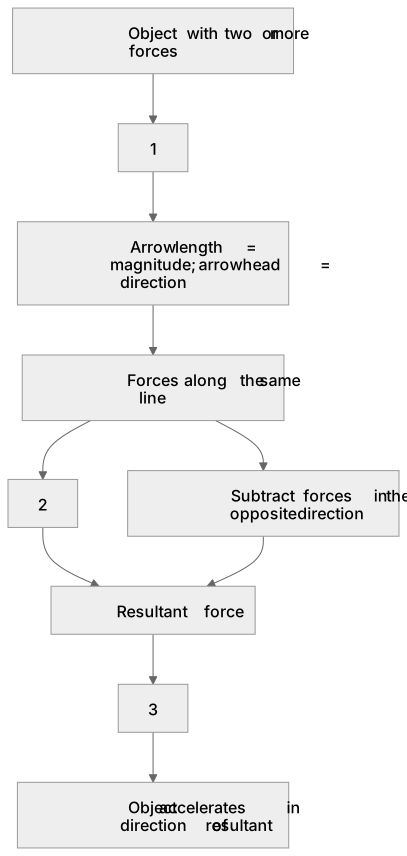
1Box 1
2Box 2
3Box 3
There is more to this lesson
The full lesson goes on to check your understanding and help you earn the marks. Create a free account to carry on, with your progress saved.
A week of Premium from your first lesson · Then the free plan continues · No card, no charge
Test your understanding of Newton's laws: describe, using free body diagrams, examples where two or more forces lead to a resultant force on an object (Higher tier only)
Active recall beats re-reading. Take an instant quiz now to test what you’ve learned and lock it into long-term memory.
A week of Premium from your first lesson · Then the free plan continues · No card, no charge