OCR · GCSE · Physics
Course version: J249 · Version from Sept 2018
Explain why an object moving in a circle with a constant speed has a…
Full specification wording
Newton's laws: explain why an object moving in a circle with a constant speed has a changing velocity (qualitative only) (Higher tier only)
Velocity is a vector: it has both a magnitude (the speed) and a direction.
Checked against the OCR J249 specification (opens in a new tab) on .
- Point 20 of 20
- 4 key terms
Study notes
From the checked teaching notes for this specification point.
The idea
Velocity is a vector: it has both a magnitude (the speed) and a direction. An object moving round a circle at constant speed keeps the same magnitude of velocity but its direction of motion changes continuously, because at each instant the motion is along the tangent to the circle. Since the direction changes, the velocity changes, even though the speed does not. A changing velocity means the object is accelerating, and that acceleration is directed towards the centre of the circle, produced by a resultant force acting towards the centre. This is a qualitative explanation only: no calculation of centripetal acceleration or force is required.
For example: A car going round a roundabout at a steady speed has a changing velocity because its heading keeps turning, so a resultant force towards the centre acts on it.
What earns the marks
- States that velocity is a vector quantity with both magnitude and direction.
- Explains that the direction of motion of the object changes continuously as it moves round the circle.
- Concludes that a changing direction with constant speed still gives a changing velocity.
- Links the changing velocity to an acceleration directed towards the centre of the circle, caused by a resultant force towards the centre.
Common mistakes and how to put them right
Says the velocity is constant because the speed is constant.
Put it right: State instead that the changing direction changes the velocity.
Treats speed and velocity as the same quantity.
Put it right: Distinguish instead that velocity includes direction while speed does not.
Claims a force pushes the object outwards from the circle.
Put it right: State instead that the resultant force acts towards the centre.
Exam tips
- Start by defining velocity as a vector, then explain the change of direction.
- Use the word 'direction' explicitly, since constant speed alone does not change velocity.
- Keep the explanation qualitative and link the changing velocity to an inward acceleration and resultant force.
Try the lesson
The start of the Newton's laws: explain why an object moving in a circle with a constant speed has a changing velocity (qualitative only) (Higher tier only) lesson, made from checked teaching notes for this specification point.
Have a go first
A cyclist rides round a velodrome bend at a steady 8 m/s. Why is the cyclist's velocity not constant?
Listen
Velocity is a vector: it has both a magnitude (the speed) and a direction. An object moving round a circle at constant speed keeps the same magnitude of velocity but its direction of motion changes continuously, because at each instant the motion is along the tangent to the circle. Since the direction changes, the velocity changes, even though the speed does not. A changing velocity means the object is accelerating, and that acceleration is directed towards the centre of the circle, produced by a resultant force acting towards the centre. This is a qualitative explanation only: no calculation of centripetal acceleration or force is required. For example, a car going round a roundabout at a steady speed has a changing velocity because its heading keeps turning, so a resultant force towards the centre acts on it. A strong answer earns marks for these points. States that velocity is a vector quantity with both magnitude and direction. Explains that the direction of motion of the object changes continuously as it moves round the circle. Concludes that a changing direction with constant speed still gives a changing velocity. Links the changing velocity to an acceleration directed towards the centre of the circle, caused by a resultant force towards the centre. Exam tip: Start by defining velocity as a vector, then explain the change of direction.
See it
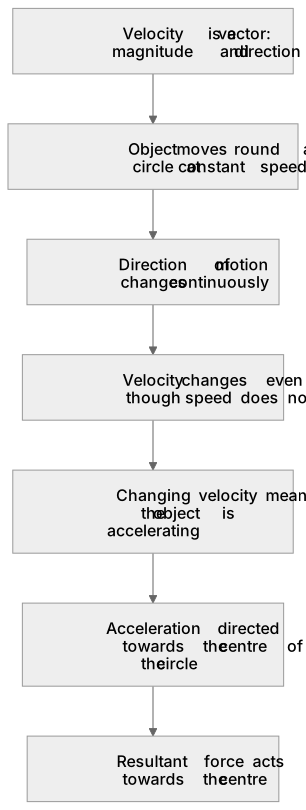
Put it in order
Put these steps in the order they happen.
- 1. Resultant force acts towards the centre
- 2. Acceleration directed towards the centre of the circle
- 3. Direction of motion changes continuously
- 4. Changing velocity means the object is accelerating
- 5. Velocity is a vector: magnitude and direction
- 6. Object moves round a circle at constant speed
- 7. Velocity changes even though speed does not
Key words
Say what each word means before you turn the card.
Velocity as a vector
Try answering aloud or in your head before turning the card.
Circular motion
Try answering aloud or in your head before turning the card.
Changing direction
Try answering aloud or in your head before turning the card.
Centripetal acceleration and force
Try answering aloud or in your head before turning the card.
See every definition
- Velocity as a vector
- A quantity that has both a magnitude, which is the speed, and a direction.
- Circular motion
- Motion round a circle at constant speed, where the direction of motion changes continuously along the tangent to the circle.
- Changing direction
- The direction of motion changing continuously, which means the velocity changes even though the speed does not.
- Centripetal acceleration and force
- An acceleration directed towards the centre of the circle, produced by a resultant force acting towards the centre.
Label the diagram
Some boxes have lost their names. Pick the right name for each number.
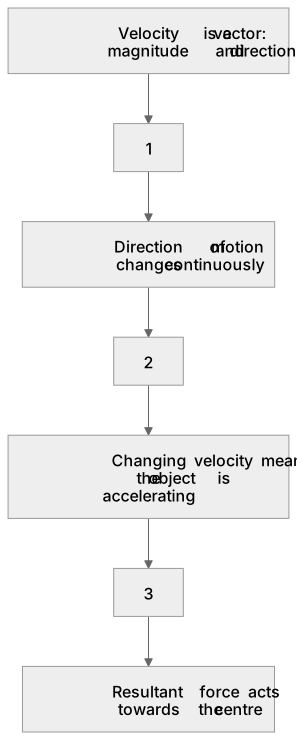
1Box 1
2Box 2
3Box 3
There is more to this lesson
The full lesson goes on to check your understanding and help you earn the marks. Create a free account to carry on, with your progress saved.
A week of Premium from your first lesson · Then the free plan continues · No card, no charge
Test your understanding of Newton's laws: explain why an object moving in a circle with a constant speed has a changing velocity (qualitative only) (Higher tier only)
Active recall beats re-reading. Take an instant quiz now to test what you’ve learned and lock it into long-term memory.
A week of Premium from your first lesson · Then the free plan continues · No card, no charge