OCR · GCSE · Physics
Course version: J249 · Version from Sept 2018
Recall examples of ways in which objects interact (to include:…
Full specification wording
Newton's laws: recall examples of ways in which objects interact (to include: electrostatics, gravity, magnetism and by contact (including normal contact force and friction))
Objects interact when a force acts between them, and the specification names five routes: electrostatics, gravity, magnetism, and contact through the normal contact force and through friction.
Checked against the OCR J249 specification (opens in a new tab) on .
- Point 5 of 20
- 4 key terms
Study notes
From the checked teaching notes for this specification point.
The idea
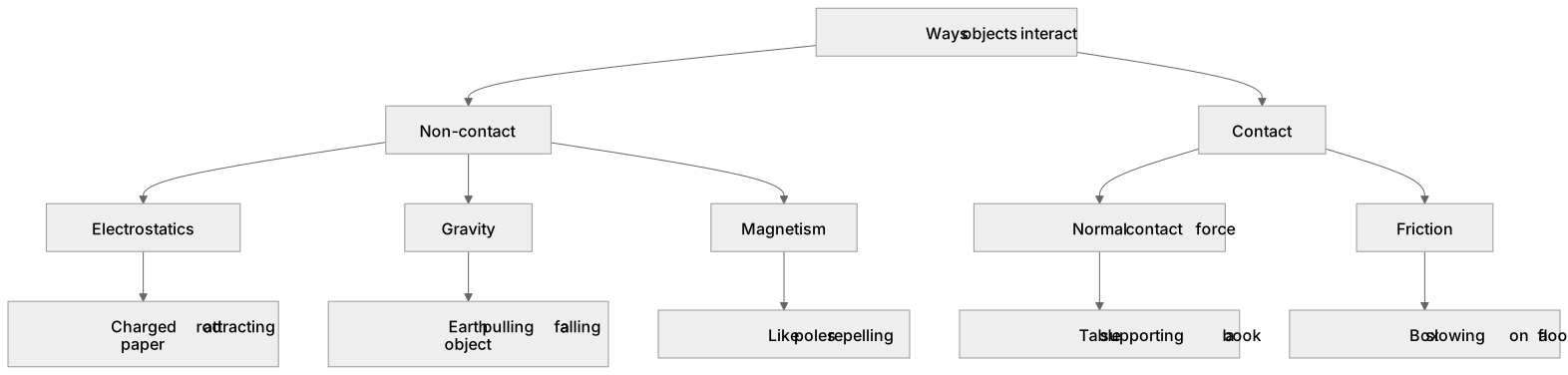
Objects interact when a force acts between them, and the specification names five routes: electrostatics, gravity, magnetism, and contact through the normal contact force and through friction. A charged balloon attracting small paper pieces is an electrostatic interaction acting at a distance. The Earth pulling a falling apple is a gravitational interaction. Two magnets repelling or attracting illustrate magnetism. A book resting on a table experiences a normal contact force pushing perpendicular to the surface, while a box sliding across a floor is slowed by friction acting along the surface. Non-contact interactions (electrostatics, gravity, magnetism) act without touching; contact interactions require surfaces to press or rub together.
What earns the marks
- Identifies electrostatics as an interaction between charged objects, such as a charged rod attracting small pieces of paper.
- Identifies gravity as an interaction between masses, such as the Earth pulling a falling object downwards.
- Identifies magnetism as an interaction between magnets or magnetic materials, such as two like poles repelling.
- Identifies the normal contact force as a push perpendicular to a surface, such as a table supporting a book.
- Identifies friction as a contact force opposing relative motion along surfaces, such as a box slowing on a floor.
- Distinguishes non-contact interactions (electrostatics, gravity, magnetism) from contact interactions (normal contact force, friction).
Common mistakes and how to put them right
Treats gravity as a contact force.
Put it right: Recognise gravity as a non-contact interaction between masses.
Describes the normal contact force as parallel to the surface.
Put it right: State that it acts perpendicular to the surface.
Confuses friction with the normal contact force.
Put it right: Keep friction along the surfaces opposing motion and the normal force perpendicular to them.
Omits one of the named interactions.
Put it right: Check that electrostatics, gravity, magnetism, normal contact force and friction are all covered.
Exam tips
- Match each named interaction to a concrete everyday example so the distinction between contact and non-contact is clear.
- Group the five interactions into non-contact (electrostatics, gravity, magnetism) and contact (normal contact force, friction) to avoid omissions.
- Read the question carefully to see whether it asks for a contact or non-contact example before choosing.
Try the lesson
The start of the Newton's laws: recall examples of ways in which objects interact (to include: electrostatics, gravity, magnetism and by contact (including normal contact force and friction)) lesson, made from checked teaching notes for this specification point.
Have a go first
A book rests on a table without moving. Which interaction holds the book up against the pull of gravity?
Listen
Objects interact when a force acts between them, and the specification names five routes: electrostatics, gravity, magnetism, and contact through the normal contact force and through friction. A charged balloon attracting small paper pieces is an electrostatic interaction acting at a distance. The Earth pulling a falling apple is a gravitational interaction. Two magnets repelling or attracting illustrate magnetism. A book resting on a table experiences a normal contact force pushing perpendicular to the surface, while a box sliding across a floor is slowed by friction acting along the surface. Non-contact interactions (electrostatics, gravity, magnetism) act without touching; contact interactions require surfaces to press or rub together. A strong answer earns marks for these points. Identifies electrostatics as an interaction between charged objects, such as a charged rod attracting small pieces of paper. Identifies gravity as an interaction between masses, such as the Earth pulling a falling object downwards. Identifies magnetism as an interaction between magnets or magnetic materials, such as two like poles repelling. Identifies the normal contact force as a push perpendicular to a surface, such as a table supporting a book. Exam tip: Match each named interaction to a concrete everyday example so the distinction between contact and non-contact is clear.
See it
Key words
Say what each word means before you turn the card.
Electrostatics
Try answering aloud or in your head before turning the card.
Gravity
Try answering aloud or in your head before turning the card.
Normal contact force
Try answering aloud or in your head before turning the card.
Friction
Try answering aloud or in your head before turning the card.
See every definition
- Electrostatics
- An interaction between charged objects, such as a charged rod attracting small pieces of paper.
- Gravity
- An interaction between masses, such as the Earth pulling a falling object downwards.
- Normal contact force
- A push perpendicular to a surface, such as a table supporting a book.
- Friction
- A contact force opposing relative motion along surfaces, such as a box slowing on a floor.
Label the diagram
Some boxes have lost their names. Pick the right name for each number.
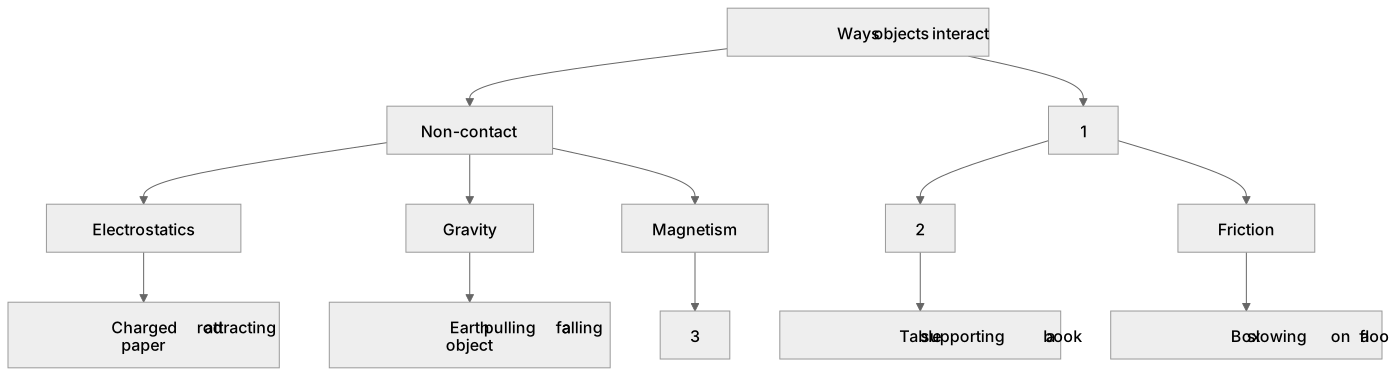
1Box 1
2Box 2
3Box 3
There is more to this lesson
The full lesson goes on to check your understanding and help you earn the marks. Create a free account to carry on, with your progress saved.
A week of Premium from your first lesson · Then the free plan continues · No card, no charge
Test your understanding of Newton's laws: recall examples of ways in which objects interact (to include: electrostatics, gravity, magnetism and by contact (including normal contact force and friction))
Active recall beats re-reading. Take an instant quiz now to test what you’ve learned and lock it into long-term memory.
A week of Premium from your first lesson · Then the free plan continues · No card, no charge