OCR · GCSE · Physics
Newton's Second Law
Unlock top marks in your OCR GCSE Physics exam by mastering Newton's Second Law (F=ma). This guide breaks down the core concepts, reveals common exam mistakes, and provides examiner-approved techniques to turn this crucial topic into your strength.
- 7 min read
- 3 worked examples
- 5 practice questions
- 6 key terms
Study Notes
Overview
Newton's Second Law of Motion is a cornerstone of classical physics and a topic that is guaranteed to feature prominently in your OCR GCSE exam. It provides the fundamental link between the forces acting on an object and the resulting change in its motion. In simple terms, it explains why things speed up or slow down. For an examiner, this topic is a gift because it allows them to test your understanding of mathematical relationships, your ability to handle units, and your interpretation of experimental data. A solid grasp of Newton's Second Law is not just about memorising an equation; it's about understanding the story of motion itself. This guide will equip you with the deep understanding and sharp exam technique needed to tackle any question on this topic, from straightforward calculations to complex analysis of the required practical. You'll see how it connects to concepts like energy, momentum, and Newton's other laws, forming a critical part of your synoptic understanding.
Key Concepts
Concept 1: The Resultant Force and Acceleration
At its heart, Newton's Second Law is about cause and effect. The 'cause' is a resultant force, and the 'effect' is acceleration. The law states that the acceleration of an object is directly proportional to the resultant force acting on it, and inversely proportional to its mass. The term 'resultant' is critical and a key area where marks are won or lost. It refers to the single, overall force that is left when you have accounted for all the individual forces acting on an object. For example, a car's engine provides a forward thrust, but air resistance and friction provide a backward drag. The resultant force is the difference between these. It is this resultant force, and only this force, that causes the car to accelerate.
Example: A rocket has an upward thrust of 50,000 N and a weight of 30,000 N. The resultant force is 50,000 N - 30,000 N = 20,000 N upwards. This is the value of 'F' you would use in any calculation.
Concept 2: Mass as Inertia (Higher Tier)
The 'mass' in Newton's Second Law is more formally known as inertial mass. This is a measure of how difficult it is to change an object's velocity. An object with a large inertial mass requires a very large force to make it accelerate. Think about pushing a car versus pushing a shopping trolley; the car has a much larger inertial mass, so the same push results in a much smaller acceleration. Examiners require a precise definition for this: Inertial mass is the ratio of force to acceleration (m = F/a). You must use the word 'ratio' to be awarded the mark. This concept explains why, for a constant applied force, a heavier object will always accelerate less than a lighter one.
Concept 3: The Distinction Between Mass and Weight
This is a fundamental concept that is frequently misunderstood by candidates. Mass is the amount of 'stuff' in an object, measured in kilograms (kg). It is an intrinsic property and is the same everywhere in the universe. Weight, however, is the force of gravity acting on that mass, measured in Newtons (N). It is calculated using the formula Weight = mass × gravitational field strength (W = mg). On Earth, 'g' is approximately 10 N/kg. An object's weight can change depending on the gravitational field it is in (it would weigh less on the Moon), but its mass remains constant. In F=ma problems, 'm' is always mass in kg. If a question uses weight as the force, you must use that value for 'F'.
Mathematical/Scientific Relationships
The core of this topic is the equation that defines Newton's Second Law:
Resultant Force (N) = mass (kg) × acceleration (m/s²)
F = ma
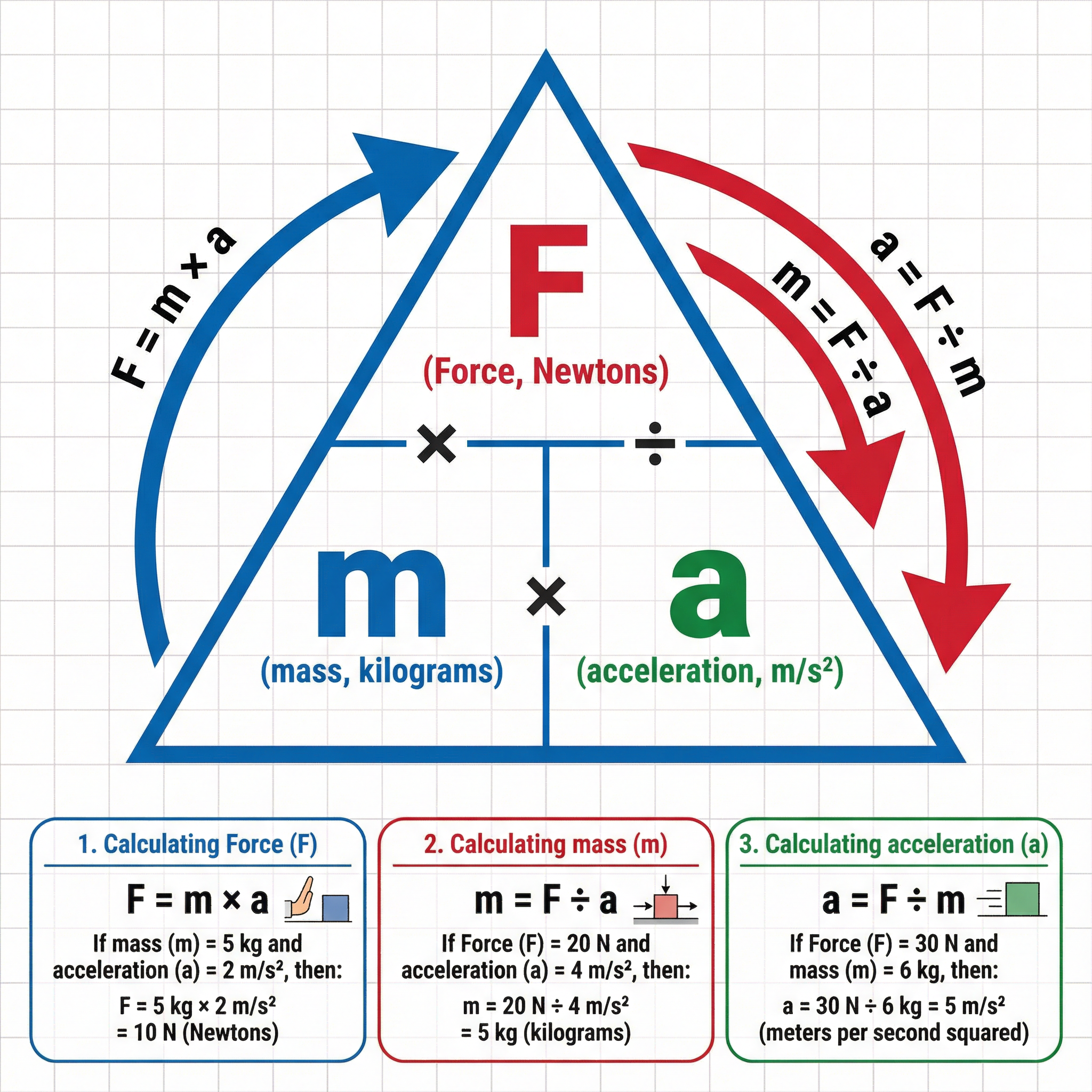
This formula is given on the formula sheet, but you must be able to rearrange it confidently to find any of the three variables. The formula triangle is an excellent tool for this.
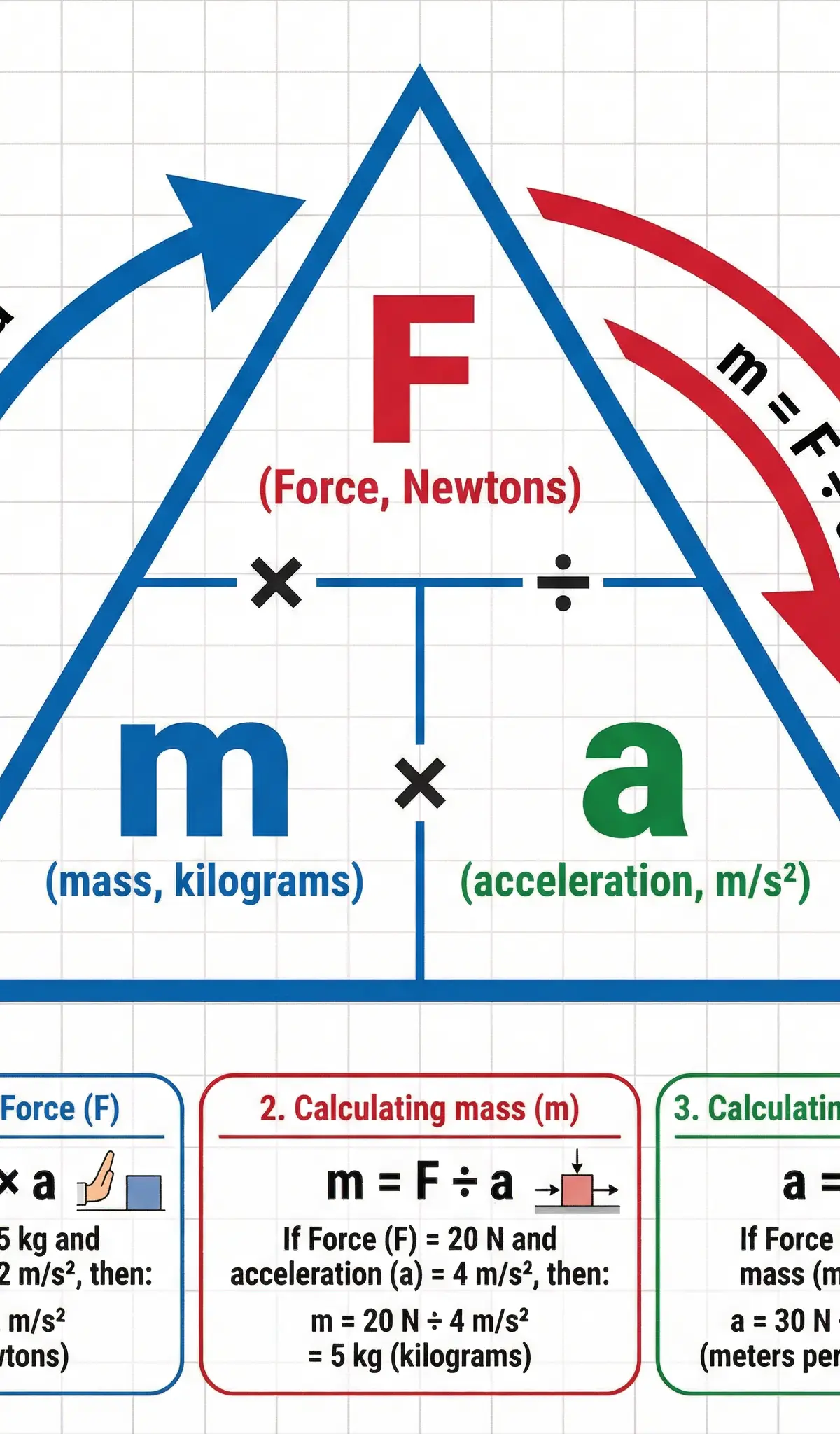
- To find Force (F):
F = m × a - To find mass (m):
m = F / a(Must memorise rearrangement) - To find acceleration (a):
a = F / m(Must memorise rearrangement)
Key Proportionality Relationships:
- Acceleration is directly proportional to resultant force (for a constant mass). If you double the force, you double the acceleration. A graph of 'a' against 'F' is a straight line through the origin.
- Acceleration is inversely proportional to mass (for a constant force). If you double the mass, you halve the acceleration. A graph of 'a' against 'm' is a curve (a hyperbola).
Required Practical: PAG P3 - Investigating Newton's Second Law
This is a classic experiment and a rich source of exam questions. The goal is to investigate the relationship between force, mass, and acceleration.
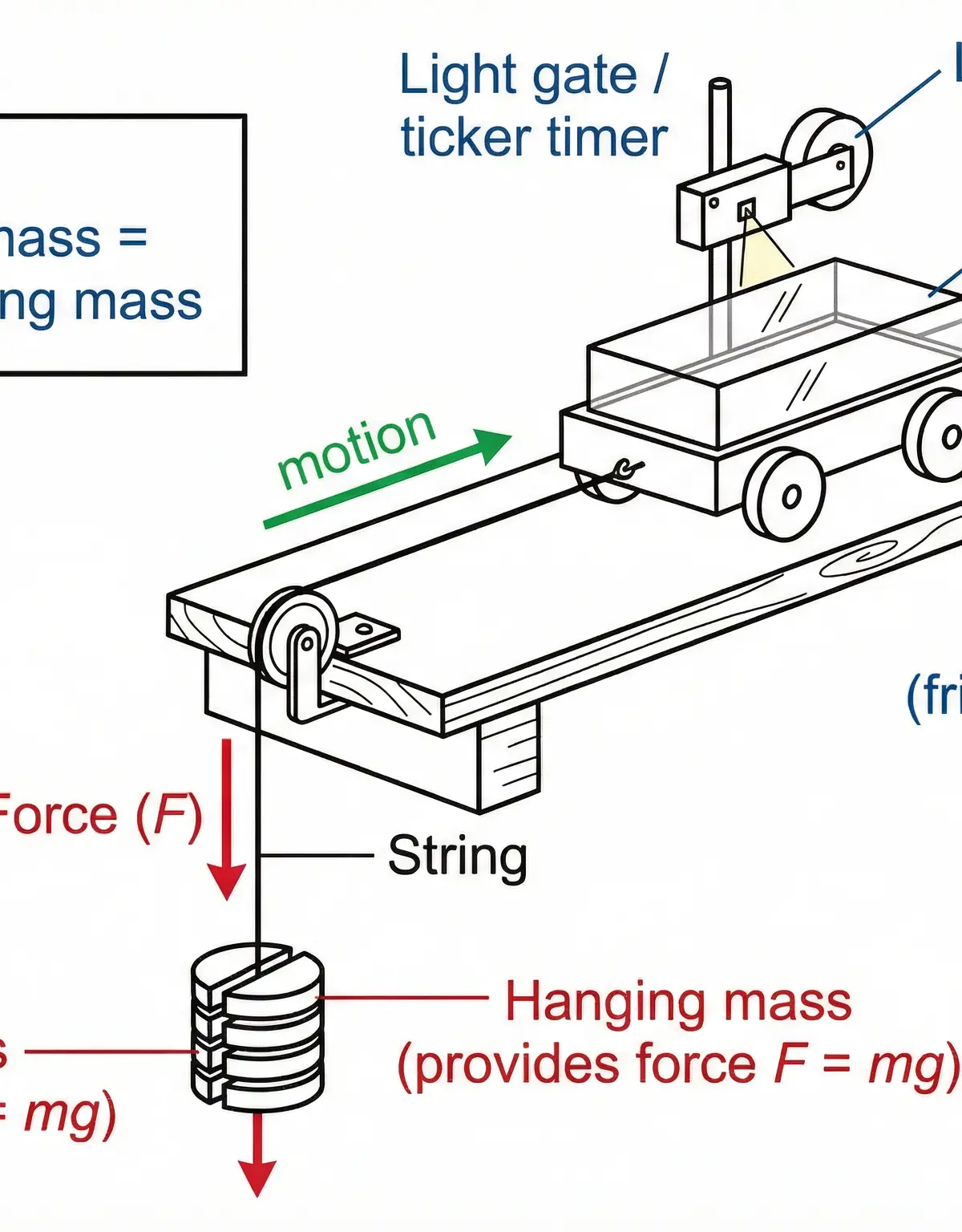
Apparatus:
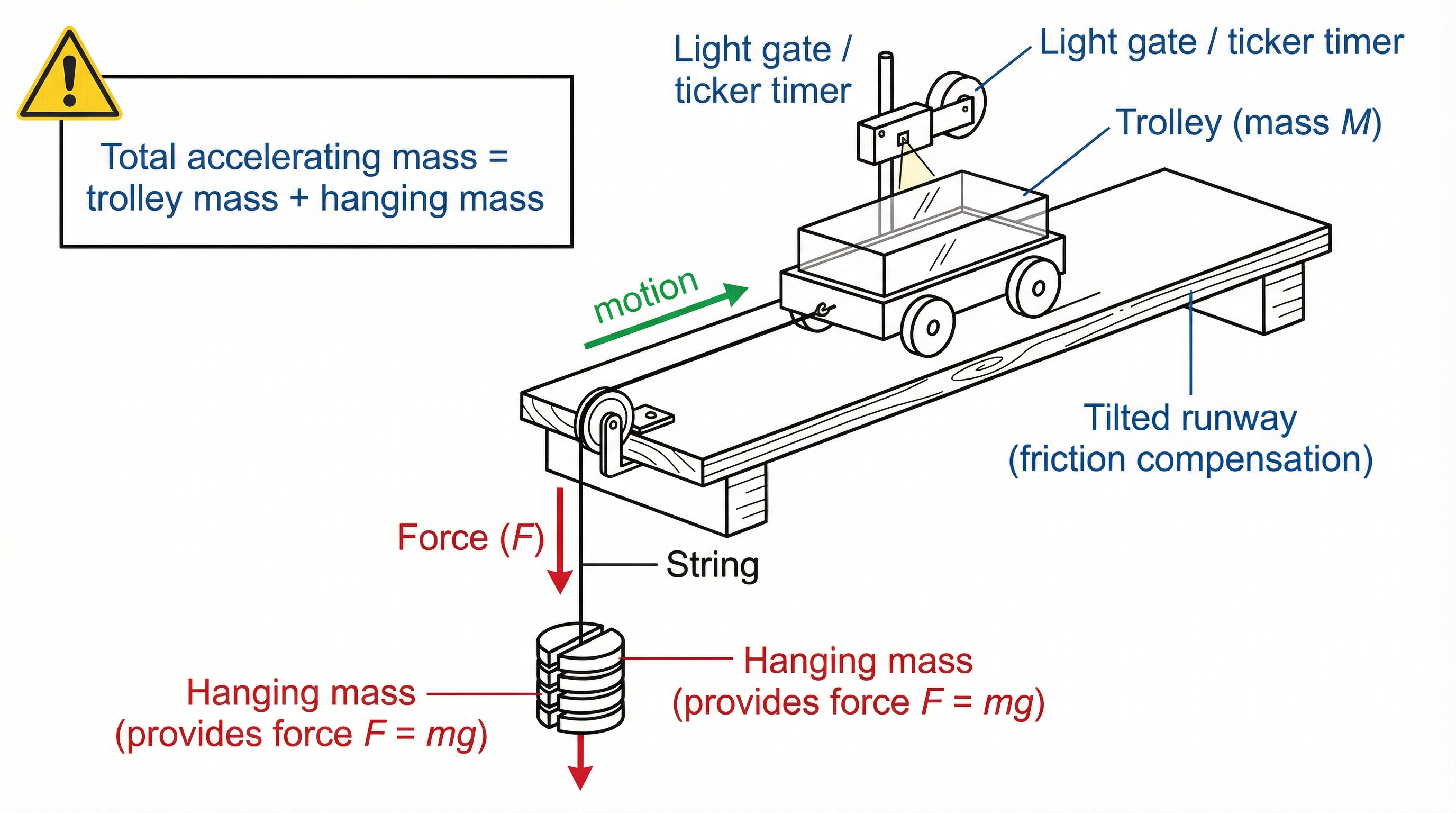
- Dynamics trolley
- Runway
- String and pulley
- Set of masses (for the trolley) and a mass hanger
- Light gate(s) connected to a data logger, or a ticker-tape timer
- Metre rule
Method to investigate a ∝ F (mass constant):
- Set up the apparatus as shown. Crucially, tilt the runway slightly until the trolley, when given a gentle push, rolls at a constant velocity. This compensates for friction.
- The total mass of the system (M_total) is the mass of the trolley plus all the masses on it and the mass on the hanger. This must be kept constant.
- Start with a small mass on the hanger (e.g., 10g) and the rest of the masses on the trolley.
- Release the trolley from a fixed starting point and record the acceleration using the light gate or ticker tape.
- Move one mass from the trolley to the hanger. This increases the accelerating force (F = weight of hanger) but keeps the total mass of the system constant.
- Repeat for a range of forces.
**Expected Results & Analysis:**A graph of acceleration (y-axis) against force (x-axis) should be a straight line passing through the origin, confirming that acceleration is directly proportional to the resultant force.
Common Errors & Examiner Traps:
- Forgetting to compensate for friction: This will lead to a smaller measured acceleration and a graph that does not go through the origin. Credit is given for stating that the runway should be tilted.
- Confusing the accelerating mass: The total mass being accelerated is
m_trolley + m_hanger. A very common mistake is to only use the mass of the trolley in calculations. The force is only the weight of the hanging mass,F = m_hanger × g. - Changing total mass: When moving masses from the trolley to the hanger, you are correctly keeping the total mass constant. If you just add masses to the hanger, you are changing both the force AND the total mass, which invalidates the experiment for investigating a ∝ F.
Visual Resources
4 diagrams and illustrations
Interactive Diagrams
2 interactive diagrams to visualise key concepts
Conceptual Flow Outline
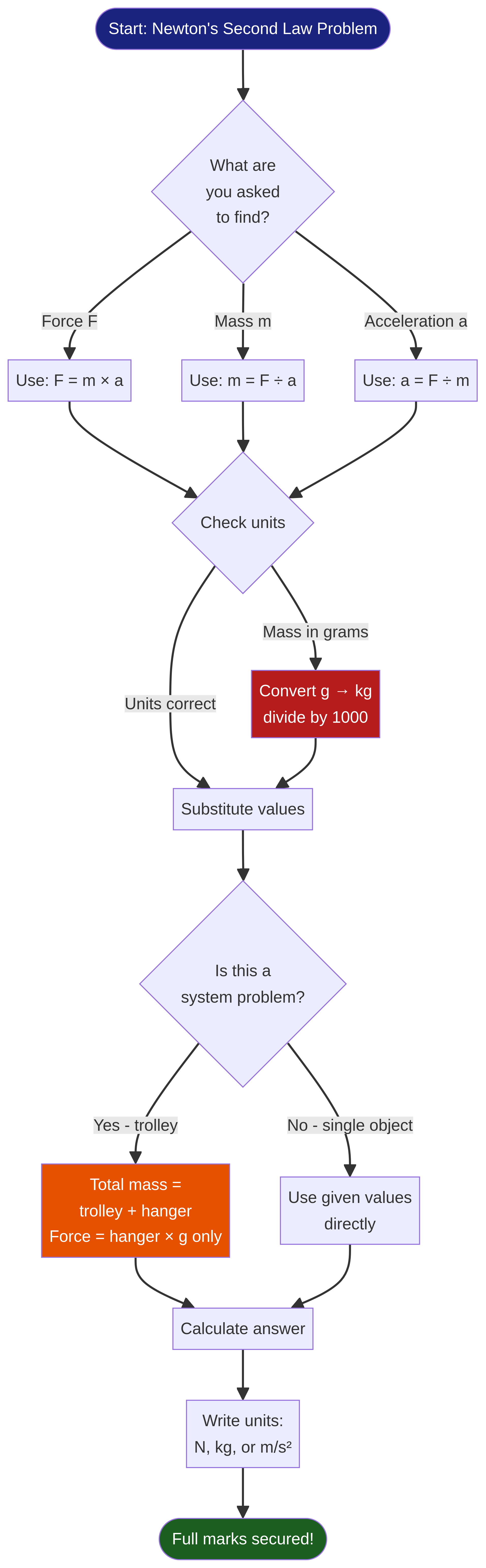
A flowchart showing the step-by-step thinking process for solving any F=ma exam question, including key checks for units and system problems.
Conceptual Flow Outline
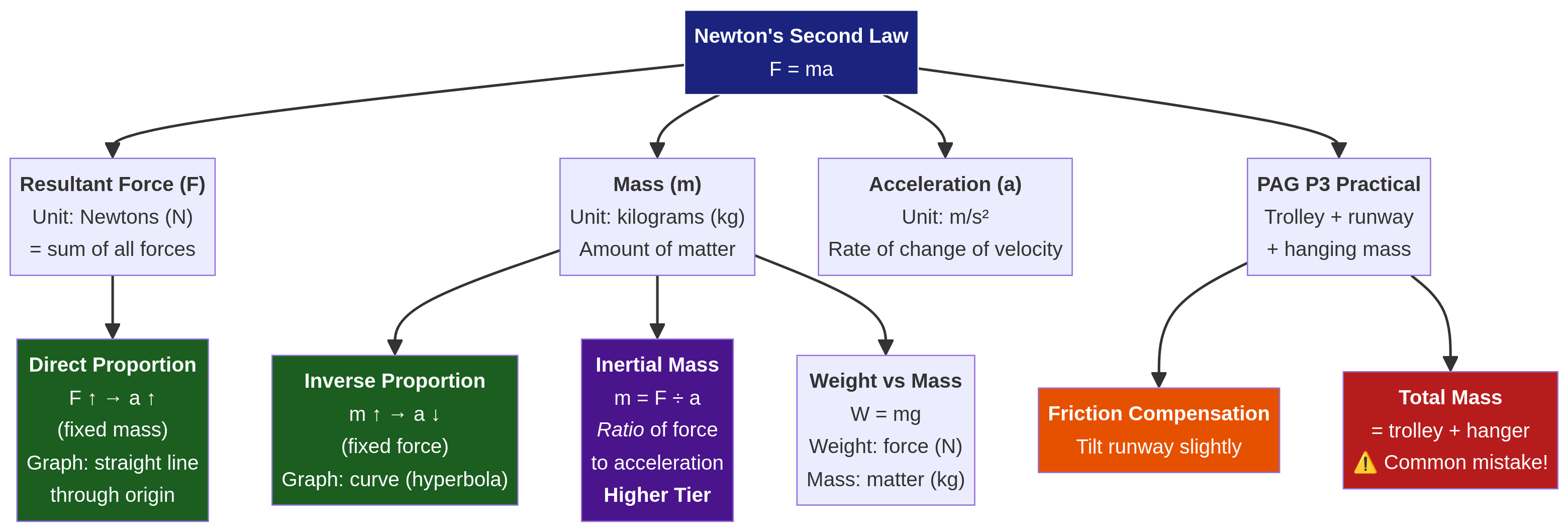
A concept map linking all the key ideas within Newton's Second Law, from the core equation to practical applications and common misconceptions.
Worked Examples
3 worked examples — open one to explore the question and available guidance.
Practice Questions
Test your understanding — click to reveal model answers
A ball of mass 250 g is kicked with a resultant force of 50 N. Calculate the initial acceleration of the ball.
Hint: Remember the first rule of F=ma calculations: what must you do with the mass before you calculate?
A skydiver of mass 70 kg has a weight of 700 N. At a certain point during her fall, the air resistance is 560 N. Describe and explain her motion at this point.
Hint: First, calculate the resultant force. Then, use this to determine if she is accelerating, decelerating, or at a constant velocity.
A student claims: 'If you double the force on an object, you will always double its acceleration.' Evaluate this statement.
Hint: Think about the full relationship: a = F/m. Is the statement *always* true? What condition must be met?
Explain the difference between mass and weight.
Hint: Think about what they measure, their units, and whether they can change.
In an experiment to investigate Newton's Second Law, a student forgets to tilt the runway to compensate for friction. State and explain what effect this will have on their results.
Hint: How does friction affect the resultant force? How will this, in turn, affect the acceleration?
Test your understanding of Newton's Second Law
Active recall beats re-reading. Take an instant quiz now to test what you’ve learned and lock it into long-term memory.
7 days Premium · Then free forever · No card, no charge