OCR · GCSE · Physics
Newton's Third Law
This guide provides a rigorous, exam-focused breakdown of Newton's Third Law for OCR GCSE Physics. It moves beyond the simple 'action-reaction' phrase to give you the precise language and analytical skills needed to distinguish interaction pairs from balanced forces, a key area where candidates lose marks.
- 6 min read
- 3 worked examples
- 5 practice questions
- 6 key terms
Study Notes
Overview
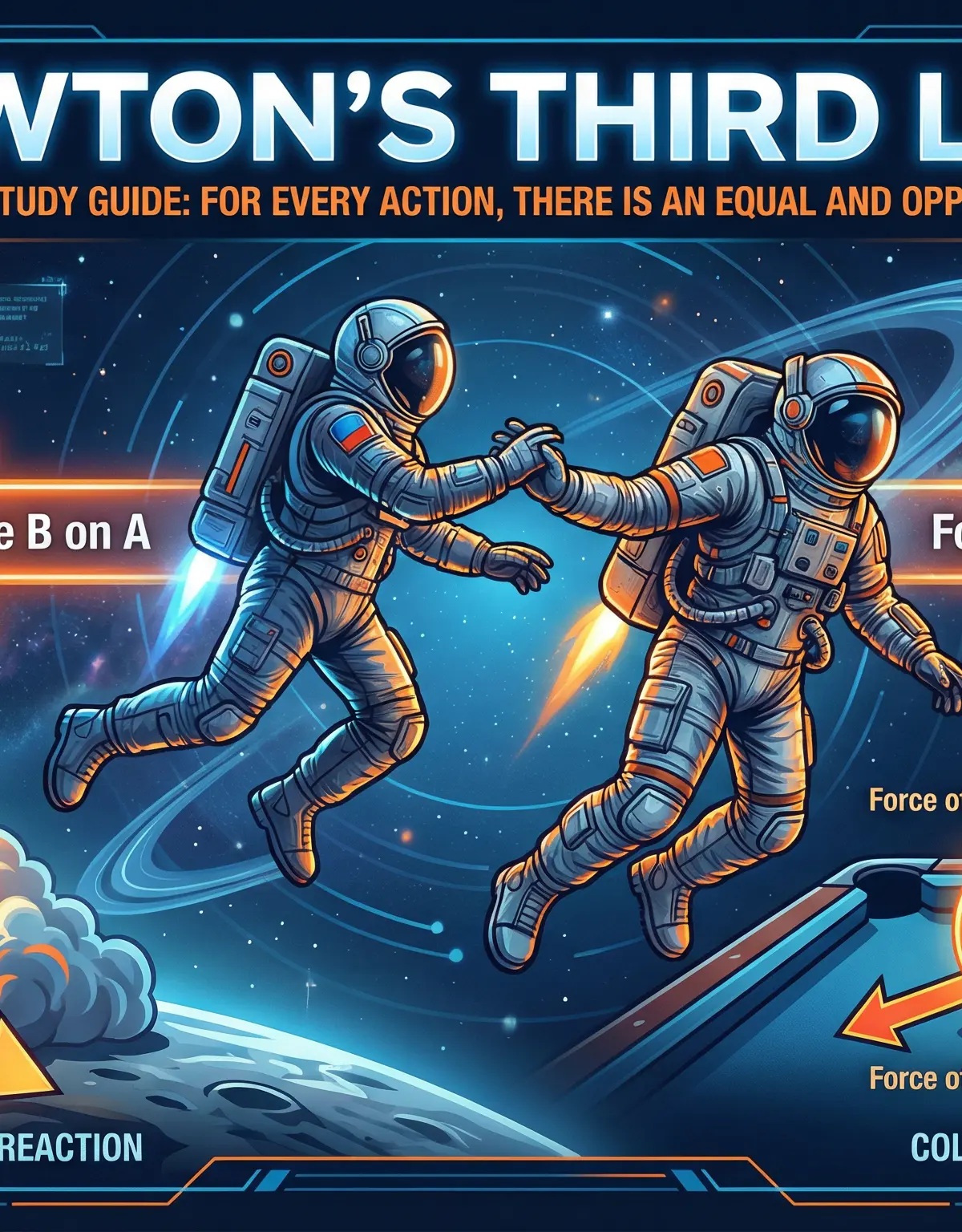
Newton's Third Law of Motion is a fundamental principle in physics, but it is also one of the most frequently misunderstood concepts at the GCSE level. While many candidates can recite the phrase "for every action, there is an equal and opposite reaction," very few can apply it with the precision required by OCR examiners. This guide will equip you with the framework to deconstruct any scenario, correctly identify Newton's Third Law interaction pairs, and articulate your reasoning in a way that secures maximum marks. The law is not merely an abstract idea; it is the principle that governs rocket propulsion, collisions, and even the simple act of walking. Examiners often test this topic by presenting scenarios and asking candidates to identify and describe the forces at play, specifically probing the common confusion between Third Law pairs and balanced forces in equilibrium.
Key Concepts
Concept 1: The Four Pillars of a Newton's Third Law Pair
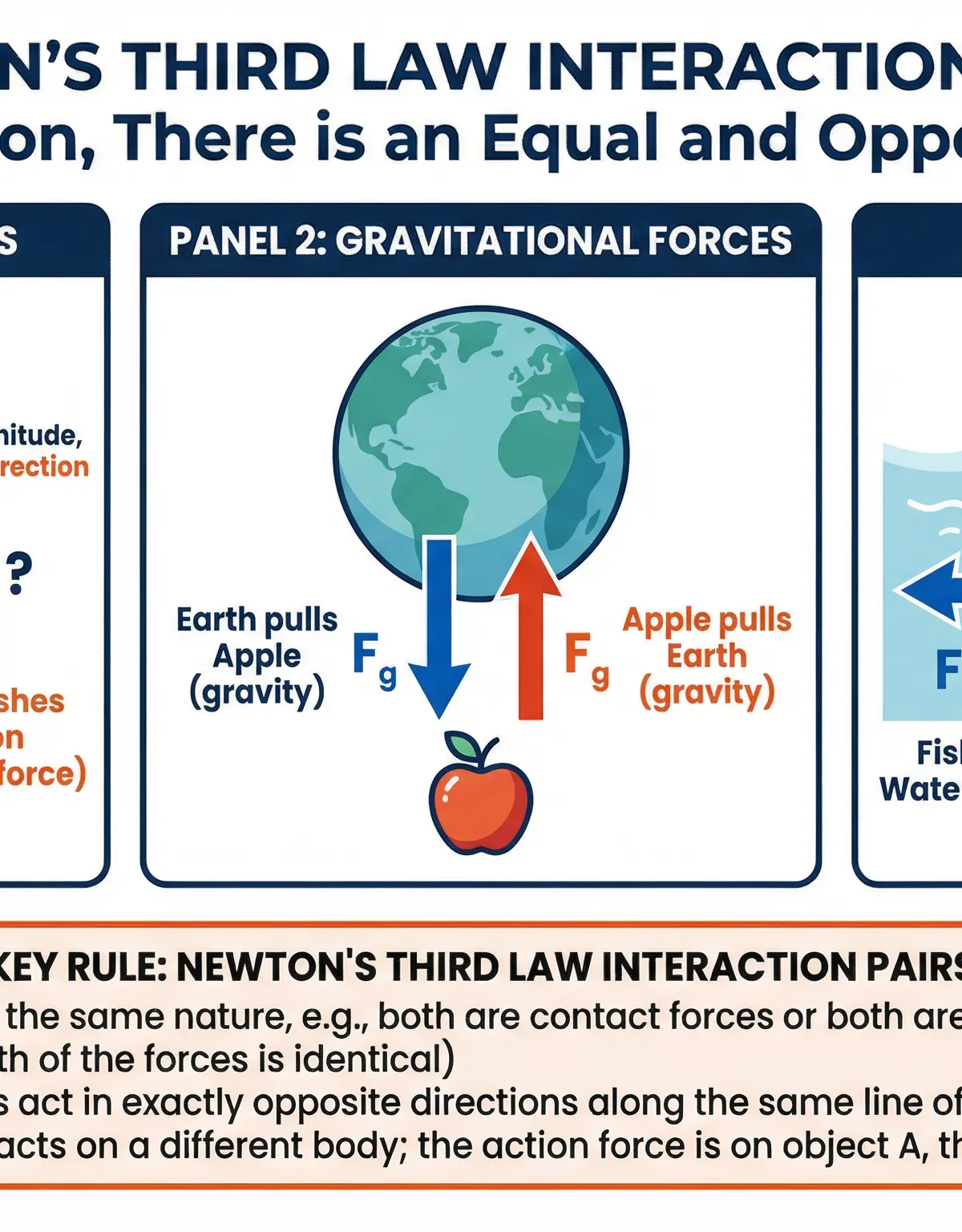
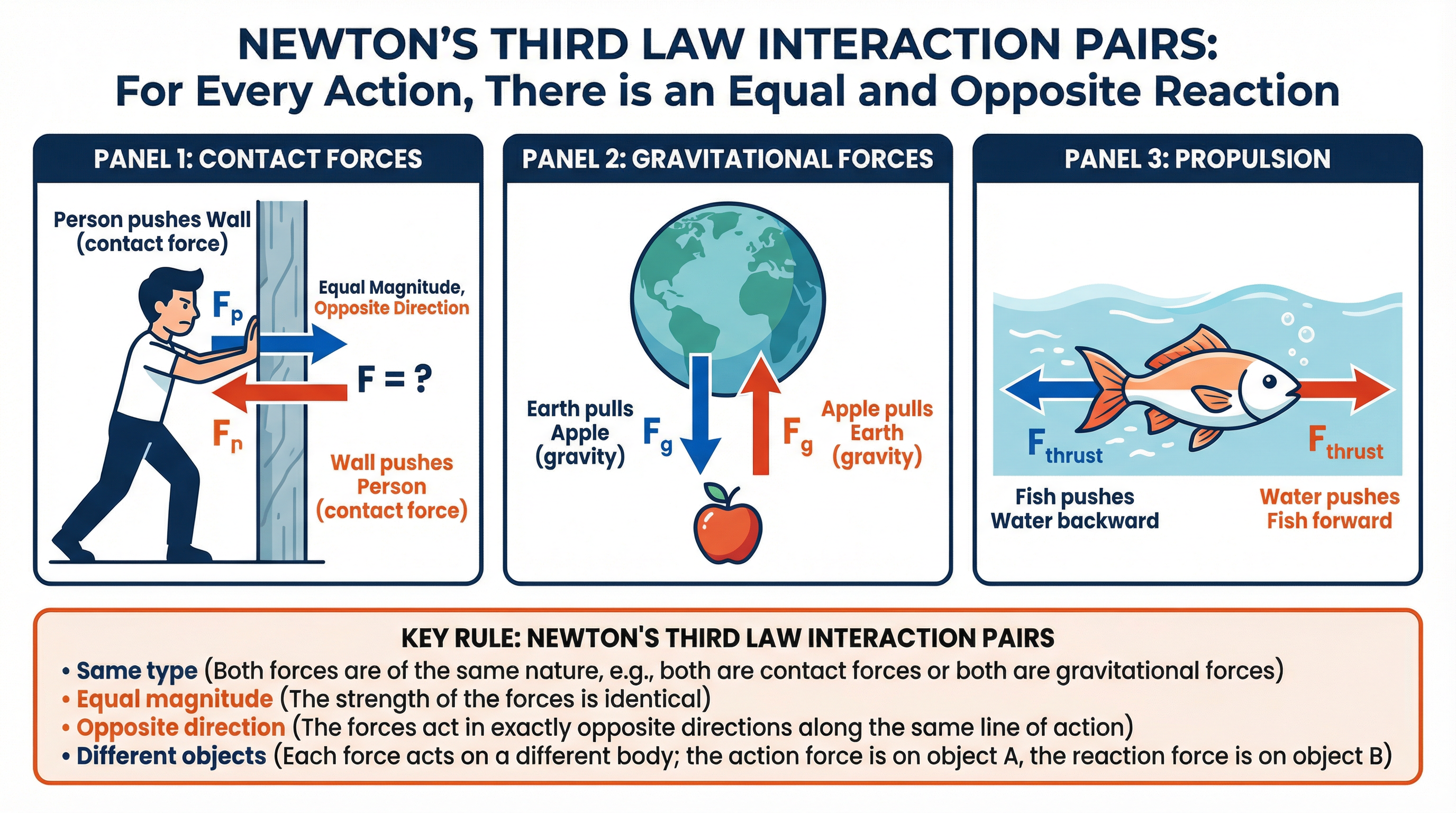
To earn credit, candidates must demonstrate a clear understanding that a Newton's Third Law interaction pair consists of two forces with four defining characteristics. These are non-negotiable. Forgetting any one of these can result in lost marks.
- Equal in Magnitude: The two forces are exactly the same size. If a book exerts a 5 N force on a table, the table exerts a 5 N force back on the book. The mass of the objects does not change the size of the forces in the pair.
- Opposite in Direction: The forces act along the same line but in opposite directions. If one force acts to the left, its partner force acts to the right.
- Act on Different Objects: This is the most critical point and the main source of confusion. The two forces in an interaction pair act on two separate bodies. One force is 'A on B', and the other is 'B on A'.
- Same Type of Force: The forces in the pair must be of the same fundamental type. Both must be gravitational, or both must be contact forces (like friction or normal reaction), or both must be electrostatic. You cannot have a gravitational force paired with a contact force.
Concept 2: The 'A on B, B on A' Mantra
To avoid ambiguity and ensure you are always describing forces on different objects, adopt this sentence structure in your exam answers: "The force of object A on object B is equal in magnitude and opposite in direction to the force of object B on object A." This phrasing makes it impossible to accidentally describe forces acting on a single body.
Example: When a footballer kicks a ball:
- Force 1: The force of the boot on the ball (contact force).
- Force 2 (The Pair): The force of the ball on the boot (contact force).
These two forces are equal in size, opposite in direction, are both contact forces, and act on different objects (the ball and the boot). This is a perfect Newton's Third Law pair.
Concept 3: The Critical Distinction - Third Law vs. Balanced Forces
Examiners will almost certainly test your ability to distinguish a Newton's Third Law pair from a situation of equilibrium where forces are balanced. This is the number one pitfall for candidates.
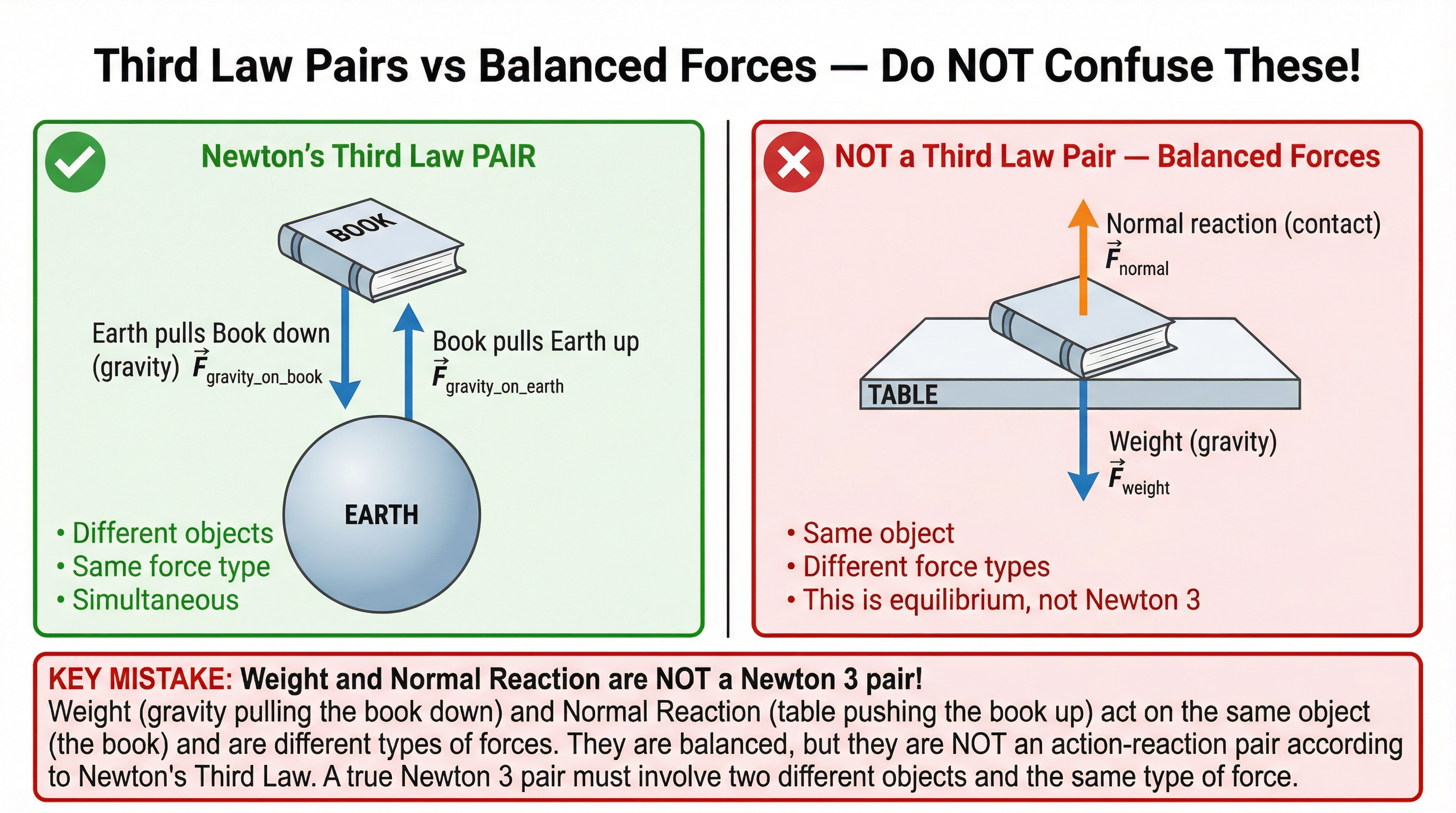
Consider a book resting on a table. There are two forces acting on the book: its weight (gravity pulling it down) and the normal contact force from the table pushing it up. These two forces are equal and opposite, so the book is in equilibrium. However, they are NOT a Newton's Third Law pair because:
- They act on the same object (the book).
- They are different types of force (weight is gravitational, normal force is contact).
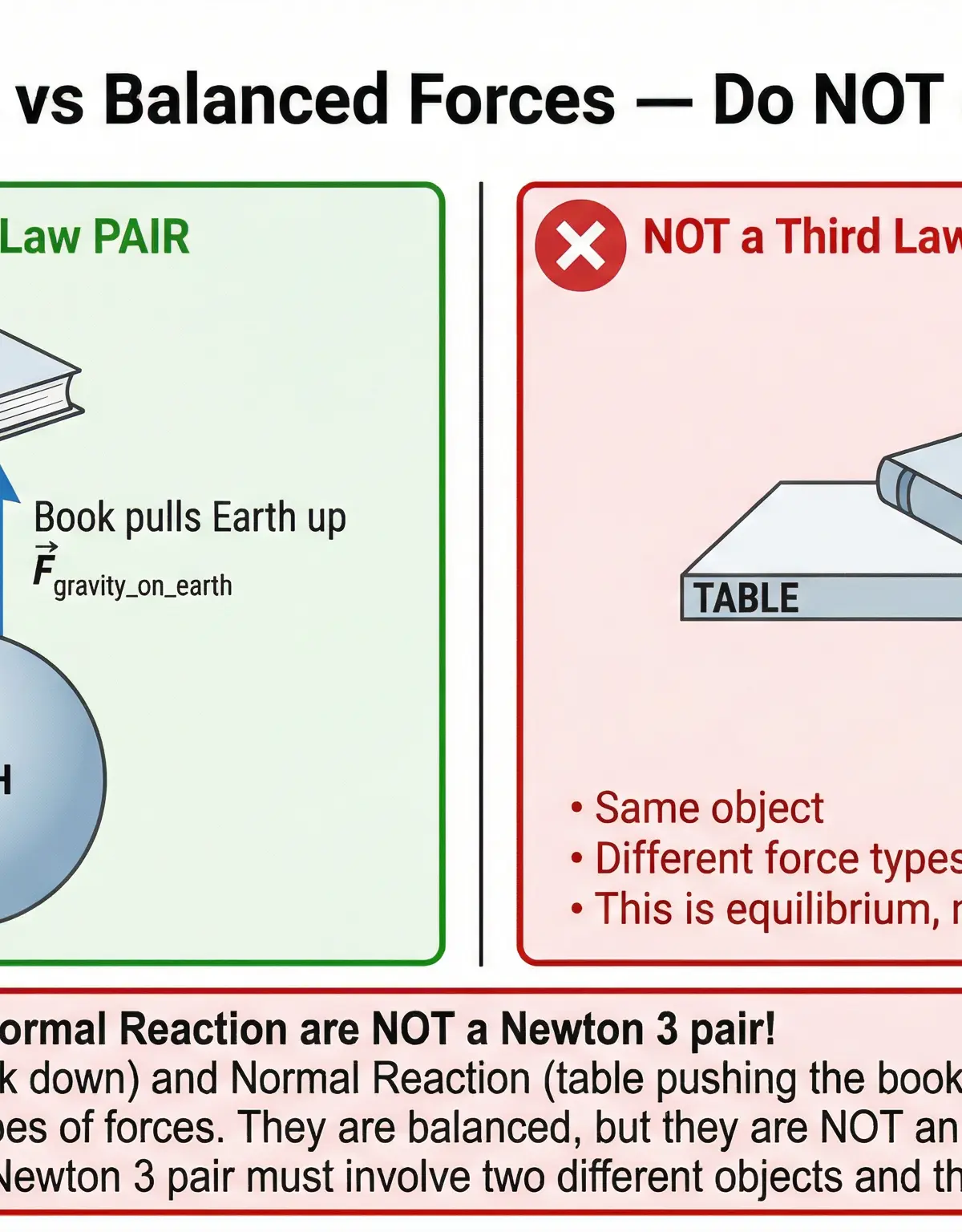
The actual Newton's Third Law pairs in this situation are:
- Pair 1 (Gravitational): The force of the Earth on the book (its weight) is paired with the force of the book on the Earth (the book's gravitational pull upwards on the planet).
- Pair 2 (Contact): The force of the table on the book (the normal force) is paired with the force of the book on the table (the book pushing down on the table).
Mathematical/Scientific Relationships
While there isn't a single formula for Newton's Third Law itself, it is expressed as a relationship between two forces, Force A on B (F_AB) and Force B on A (F_BA).
F_AB = -F_BA
- F_AB: Represents the force exerted by object A on object B.
- F_BA: Represents the force exerted by object B on object A.
- The negative sign (-): This is crucial. It mathematically signifies that the direction of F_BA is opposite to the direction of F_AB.
This law is often used in conjunction with Newton's Second Law (F=ma) to solve problems, especially in collisions and recoil.
Practical Applications
- Rocket Propulsion: A rocket expels hot gases downwards at high velocity. This is the 'action'. The 'reaction' is that the gases exert an equal and opposite force upwards on the rocket, causing it to accelerate.
- Swimming: A swimmer pushes water backwards with their hands and feet. The water, in turn, pushes the swimmer forwards with an equal and opposite force.
- Gun Recoil: When a gun fires a bullet forwards, it simultaneously exerts an equal and opposite force on the gun, causing it to recoil backwards.
- Walking: When you walk, your foot pushes the ground backwards. The ground pushes your foot forwards with an equal and opposite frictional force, propelling you forwards.
Podcast Episode: Mastering Newton's Third Law
For an in-depth audio walkthrough of these concepts, exam tips, and a quick-fire quiz, listen to our dedicated 10-minute podcast episode.
Visual Resources
2 diagrams and illustrations
Interactive Diagrams
2 interactive diagrams to visualise key concepts
Conceptual Flow Outline
A flowchart to determine if two forces constitute a Newton's Third Law interaction pair.
Conceptual Flow Outline
Concept map showing the two distinct interaction pairs for a book resting on a table: the contact force pair (Book-Table) and the gravitational pair (Book-Earth).
Worked Examples
3 worked examples — open one to explore the question and available guidance.
Practice Questions
Test your understanding — click to reveal model answers
A bird flies by pushing its wings down on the air. Identify the Newton's Third Law interaction pair that propels the bird upwards.
Hint: Think about what the air does in response to the bird's wings pushing on it.
When a person jumps, they push down on the Earth. The Earth pushes up on them, accelerating them upwards. Explain why the Earth does not appear to accelerate downwards.
Hint: Think about Newton's Second Law (F=ma) and the relative masses of the person and the Earth.
A stationary magnet A is placed near a stationary magnet B on a frictionless surface. They are repelling each other. Describe the forces and subsequent motion in terms of Newton's Laws.
Hint: This involves both Newton's Third and Second Laws.
State two reasons why the weight of a box and the normal contact force from the floor it rests on are not a Newton's Third Law pair.
A student states: 'When I hit a nail with a hammer, the hammer stops because the nail hits it back with the same force.' Evaluate this statement.
Test your understanding of Newton's Third Law
Active recall beats re-reading. Take an instant quiz now to test what you’ve learned and lock it into long-term memory.
7 days Premium · Then free forever · No card, no charge