OCR · GCSE · Physics
Course version: J249 · Version from Sept 2018
Recall typical speeds encountered in everyday experience for wind and…
Full specification wording
Physics on the move: recall typical speeds encountered in everyday experience for wind and sound, and for walking, running, cycling and other transportation systems
This recall target asks you to attach an order-of-magnitude speed to familiar moving things.
Checked against the OCR J249 specification (opens in a new tab) on .
- Point 1 of 8
- 4 key terms
Study notes
From the checked teaching notes for this specification point.
The idea
This recall target asks you to attach an order-of-magnitude speed to familiar moving things. Learn benchmark values in metres per second and be ready to convert to km/h by multiplying by 3.6. Typical figures: walking about 1.5 m/s (roughly 5 km/h); running about 3–6 m/s; cycling about 5–10 m/s; a car on a motorway about 30 m/s (about 110 km/h); a train about 50–60 m/s; sound in air about 340 m/s; wind typically a few m/s up to about 20–30 m/s in a gale. Use these as anchors: a value wildly outside the band signals a wrong choice. Remember sound is far faster than any everyday road vehicle, and wind is usually slower than a cyclist.
What earns the marks
- Selects a value of about 340 m/s for the speed of sound in air.
- Chooses a walking speed of roughly 1.5 m/s rather than a vehicle speed.
- Matches a cyclist to a value of roughly 5–10 m/s.
- Assigns a motorway car speed of about 30 m/s.
- Converts between m/s and km/h correctly using a factor of 3.6.
- Rejects an option that gives wind a speed greater than sound.
Common mistakes and how to put them right
Confuses the speed of sound with the speed of light.
Put it right: Keep sound at about 340 m/s in air.
Gives walking a speed of tens of metres per second.
Put it right: Keep it near 1.5 m/s.
Forgets to multiply by 3.6 when converting m/s to km/h.
Put it right: Apply the factor to every conversion.
Treats wind as faster than a car on a motorway.
Put it right: Keep typical wind well below 30 m/s.
Exam tips
- Memorise a small set of anchor values and compare each option against them.
- Check units before choosing: an answer in km/h needs converting to compare with m/s figures.
- Eliminate options that are orders of magnitude out before deciding between close ones.
Try the lesson
The start of the Physics on the move: recall typical speeds encountered in everyday experience for wind and sound, and for walking, running, cycling and other transportation systems lesson, made from checked teaching notes for this specification point.
Have a go first
Which typical speed is the best estimate for the speed of sound travelling through air?
Listen
This recall target asks you to attach an order-of-magnitude speed to familiar moving things. Learn benchmark values in metres per second and be ready to convert to km/h by multiplying by 3.6. Typical figures: walking about 1.5 m/s (roughly 5 km/h); running about 3–6 m/s; cycling about 5–10 m/s; a car on a motorway about 30 m/s (about 110 km/h); a train about 50–60 m/s; sound in air about 340 m/s; wind typically a few m/s up to about 20–30 m/s in a gale. Use these as anchors: a value wildly outside the band signals a wrong choice. Remember sound is far faster than any everyday road vehicle, and wind is usually slower than a cyclist. A strong answer earns marks for these points. Selects a value of about 340 m/s for the speed of sound in air. Chooses a walking speed of roughly 1.5 m/s rather than a vehicle speed. Matches a cyclist to a value of roughly 5–10 m/s. Assigns a motorway car speed of about 30 m/s. Exam tip: Memorise a small set of anchor values and compare each option against them.
See it
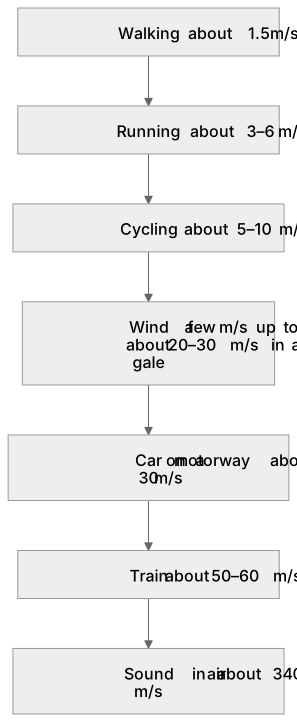
Put it in order
Put these steps in the order they happen.
- 1. Sound in air about 340 m/s
- 2. Train about 50–60 m/s
- 3. Cycling about 5–10 m/s
- 4. Car on a motorway about 30 m/s
- 5. Walking about 1.5 m/s
- 6. Running about 3–6 m/s
- 7. Wind a few m/s up to about 20–30 m/s in a gale
Key words
Say what each word means before you turn the card.
Order-of-magnitude estimation
Try answering aloud or in your head before turning the card.
Speed of sound in air
Try answering aloud or in your head before turning the card.
Everyday transport speeds
Try answering aloud or in your head before turning the card.
Unit conversion between m/s and km/h
Try answering aloud or in your head before turning the card.
See every definition
- Order-of-magnitude estimation
- Attaching a benchmark value to familiar moving things, so that a value wildly outside the band signals a wrong choice.
- Speed of sound in air
- About 340 m/s, which is far faster than any everyday road vehicle.
- Everyday transport speeds
- Typical figures such as walking about 1.5 m/s, running about 3–6 m/s, cycling about 5–10 m/s, a motorway car about 30 m/s and a train about 50–60 m/s.
- Unit conversion between m/s and km/h
- Converting to km/h by multiplying by 3.6, applying the factor to every conversion.
Label the diagram
Some boxes have lost their names. Pick the right name for each number.
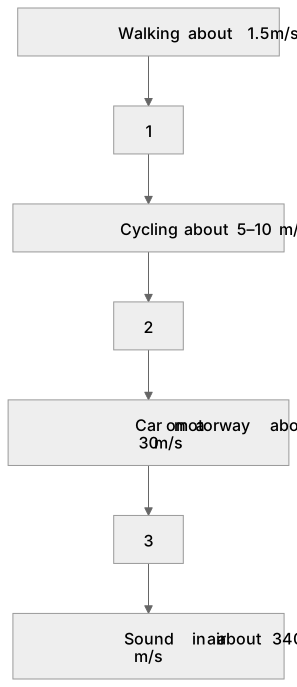
1Box 1
2Box 2
3Box 3
There is more to this lesson
The full lesson goes on to check your understanding and help you earn the marks. Create a free account to carry on, with your progress saved.
A week of Premium from your first lesson · Then the free plan continues · No card, no charge
Test your understanding of Physics on the move: recall typical speeds encountered in everyday experience for wind and sound, and for walking, running, cycling and other transportation systems
Active recall beats re-reading. Take an instant quiz now to test what you’ve learned and lock it into long-term memory.
A week of Premium from your first lesson · Then the free plan continues · No card, no charge