Power

    OCR
    GCSE
    Physics

    This guide provides a comprehensive, exam-focused breakdown of Power (OCR GCSE Physics 3.7). It covers the core definitions, the three essential power equations, and the critical skill of unit conversion, all designed to help you secure maximum marks.
    4
    Min Read
    3
    Examples
    5
    Questions
    6
    Key Terms
    🎙 Podcast Episode
    Power
    5:34
    0:00-5:34

    Study Notes

    Header image for OCR GCSE Physics: Power (3.7)

    Overview

    Power, in physics, is a fundamental concept that describes how quickly energy is used or transferred. For your OCR GCSE exam, mastering this topic is crucial as it bridges the concepts of energy, electricity, and mechanics. Examiners frequently test candidates' ability to not only define power but also to select and apply the correct equation from the three you need to know. This guide will break down the distinction between power and energy, a common point of confusion, and walk you through multi-step calculations involving efficiency and cost. Expect to see questions ranging from simple definitions (1-2 marks) to more complex, contextual problems requiring data analysis and equation rearrangement (5-6 marks). A solid understanding here provides a strong foundation for A-Level physics and demonstrates key problem-solving skills.

    Listen to our 10-minute revision podcast on Power.

    Key Concepts

    Concept 1: Power as the Rate of Energy Transfer

    The single most important definition to memorise is: Power is the rate at which work is done or energy is transferred. It is not the amount of energy, but how fast that energy is being used. A 100W light bulb is more powerful than a 60W bulb because it transfers 100 joules of electrical energy into light and heat every second, compared to the 60 joules transferred by the other bulb. The unit of power is the Watt (W), which is defined as 1 Joule per second (J/s). Stating this relationship often secures a mark.
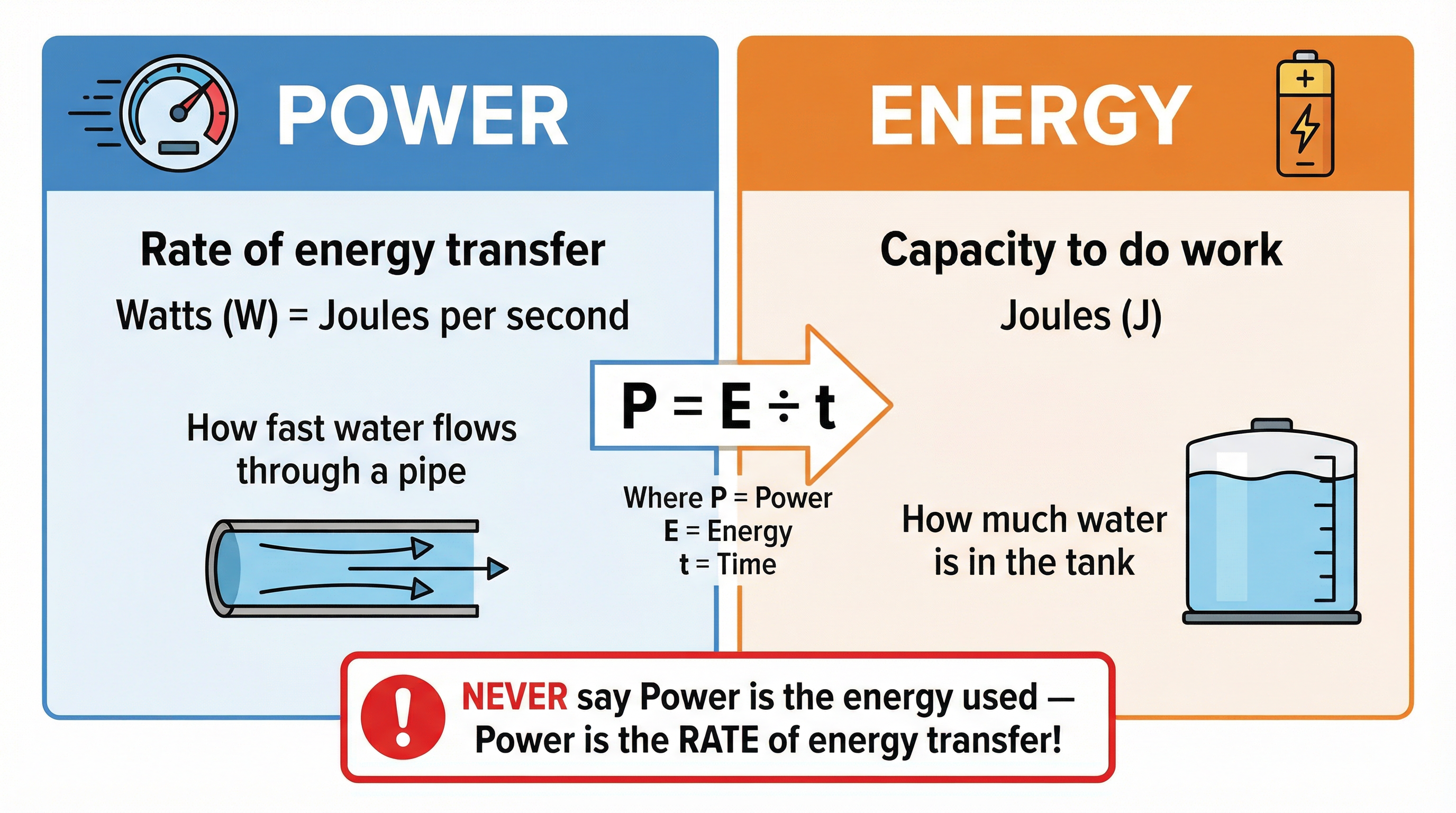
    Visual comparison of Power (the rate) and Energy (the amount).

    Analogy: Imagine two people are asked to empty a large water tank. Person A uses a small bucket, and Person B uses a large bucket. They both do the same amount of work (emptying the tank), but Person B does it faster. Person B has a higher power output.

    Concept 2: The Three Power Equations

    Fluency in selecting and applying the three key power equations is essential. You must be able to identify which equation to use based on the quantities provided in the question.
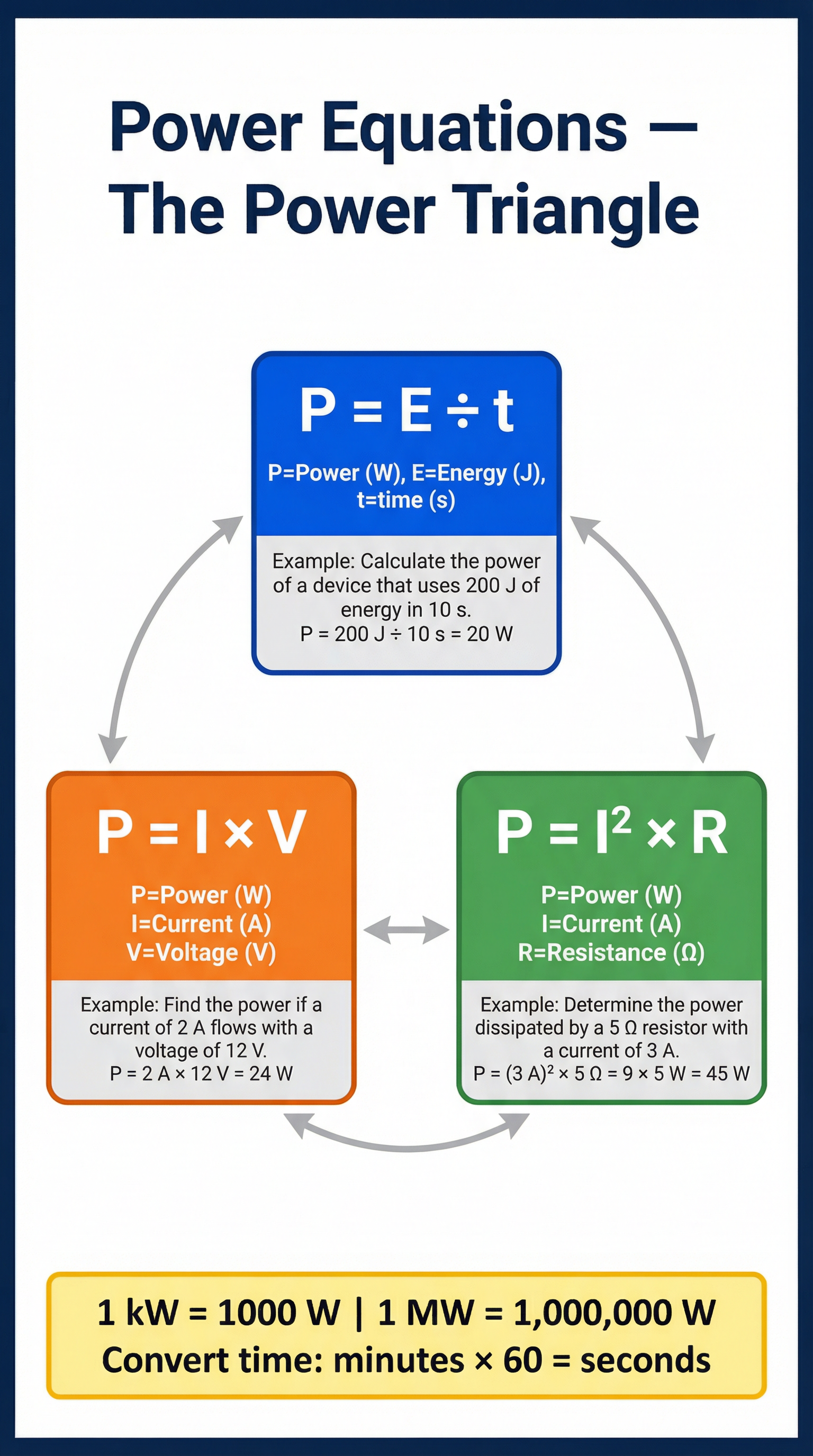
    The three essential power equations and their components.

    Mathematical/Scientific Relationships

    Here are the three core equations for this topic. You must be confident in using and rearranging them.

    1. P = E / t

      • P: Power (in Watts, W)
      • E: Energy transferred (in Joules, J)
      • t: time taken (in seconds, s)
      • When to use: When the question involves energy being used over a specific time period.
      • Status: Given on formula sheet.
    2. P = I × V

      • P: Power (in Watts, W)
      • I: Current (in Amperes, A)
      • V: Potential Difference / Voltage (in Volts, V)
      • When to use: In electrical circuits, when you know the current and voltage.
      • Status: Given on formula sheet.
    3. P = I² × R

      • P: Power (in Watts, W)
      • I: Current (in Amperes, A)
      • R: Resistance (in Ohms, Ω)
      • When to use: In electrical circuits, when you know the current and resistance but not the voltage.
      • Status: Given on formula sheet.

    Practical Applications

    Understanding power is vital for everyday life. When you look at an appliance like a kettle, microwave, or television, it will have a power rating in Watts or kilowatts (kW). This tells you how much energy it consumes per second. A 2000W (or 2kW) kettle will boil water much faster than a 1000W (1kW) kettle because it transfers energy at a higher rate. This concept is also central to electricity bills, where you are charged for the total energy used (measured in kilowatt-hours, kWh), which depends on the power of your appliances and how long you use them for. There are no specific required practicals for this topic, but questions often use the context of domestic appliances.

    Visual Resources

    4 diagrams and illustrations

    The three essential power equations and their components.
    The three essential power equations and their components.
    Visual comparison of Power (the rate) and Energy (the amount).
    Visual comparison of Power (the rate) and Energy (the amount).
    Flowchart for selecting the correct power equation.
    Flowchart for selecting the correct power equation.
    Concept map for the Power topic.
    Concept map for the Power topic.

    Interactive Diagrams

    2 interactive diagrams to visualise key concepts

    Energy E and Time tCurrent I and Voltage VCurrent I and Resistance RkW givenMW givenW alreadyStart: Power QuestionWhat quantities\are given?Use P = E ÷ t\n⚠️ Convert t to seconds!Use P = I × VUse P = I² × R\n⚠️ Square I first!Calculate P in Watts WCheck prefix\in questionMultiply by 1000\n1 kW = 1000 WMultiply by 1,000,000\n1 MW = 1,000,000 WNo conversion neededWrite answer with unit: W

    A flowchart to help you decide which power equation to use based on the information given in an exam question. {{asset:equation_selector.png}}

    (POWER\nTopic 3.7DefinitionRate of energy transferRate of work doneUnit: Watt W1 W = 1 J/sEquationsP = E / tE in Joulest in SECONDSP = I × VI in AmpsV in VoltsP = I² × RSquare I firstR in OhmsUnit ConversionskW × 1000 = WMW × 1000000 = Wmin × 60 = shours × 3600 = sCommon MistakesForgetting to square IUsing minutes not secondsSaying power = energyWrong rearrangementSynoptic LinksEfficiency Topic 3.6Electrical CircuitsEnergy StoresDomestic Electricity

    A concept map summarising the key ideas, equations, and common mistakes for the GCSE Power topic. {{asset:power_concept_map.png}}

    Worked Examples

    3 detailed examples with solutions and examiner commentary

    Practice Questions

    Test your understanding — click to reveal model answers

    Q1

    State the relationship between power, energy transferred and time.

    1 marks
    foundation

    Hint: Think about the main definition of power.

    Q2

    A lamp is connected to a 12 V supply and a current of 2.5 A flows through it. Calculate the power of the lamp.

    3 marks
    standard

    Hint: Which equation links P, I, and V?

    Q3

    A kettle takes 3 minutes to boil some water. It transfers 324,000 J of energy in this time. Calculate the power rating of the kettle in kW.

    4 marks
    standard

    Hint: Remember to convert units for both time and the final power answer.

    Q4

    Explain why a 10 Ω resistor with a 2 A current flowing through it dissipates more power than a 20 Ω resistor with a 1 A current.

    4 marks
    challenging

    Hint: Use P = I²R for both scenarios and compare the results. The key is the squared term.

    Q5

    A crane lifts a 500 kg load to a height of 20 m in 40 s. The crane is powered by a 230 V supply and draws a current of 60 A. Calculate the efficiency of the crane.

    6 marks
    challenging

    Hint: This is a multi-step problem. First, find the useful power output (gravitational potential energy gained per second). Then find the total electrical power input. Finally, calculate efficiency.

    Explore this topic further

    View Topic PageAll Physics Topics

    Key Terms

    Essential vocabulary to know

    More Physics Study Guides

    View all

    Refraction

    OCR
    GCSE

    This guide explains light refraction for OCR GCSE Physics (4.6), covering why light bends, how to draw ray diagrams, and the secrets to exam success. Master the concepts of optical density and total internal reflection to secure top marks.

    Isotopes

    OCR
    GCSE

    This guide provides a comprehensive overview of isotopes for OCR GCSE Physics (7.2), focusing on core definitions, calculations, and exam technique. It's designed to help you secure maximum marks by mastering the difference between isotopes and ions, understanding nuclear notation, and avoiding common pitfalls.

    Galaxies

    OCR
    GCSE

    Unlock top marks in your OCR GCSE Physics exam by mastering Galaxies (Topic 8.7). This guide breaks down the vastness of space into bite-sized, exam-focused chunks, from the structure of our Milky Way to the mind-bending evidence for the Big Bang.

    Planets

    OCR
    GCSE

    This topic covers the structure of our Solar System, the role of gravitational forces in maintaining planetary orbits, and the historical shift from geocentric to heliocentric models. Understanding these concepts is essential for securing marks in both Foundation and Higher Tier questions, particularly those testing orbital mechanics and the nature of scientific progress.

    Stars

    OCR
    GCSE

    Explore the dramatic life and death of stars, from stable main sequence suns to explosive supernovae. This guide for OCR GCSE Physics (8.6) provides everything candidates need to master stellar evolution, secure top marks, and understand our cosmic origins."

    The Solar System

    OCR
    GCSE

    This guide covers OCR GCSE Physics Topic 8.1, The Solar System. It explores the shift from geocentric to heliocentric models, the physics of orbital motion, and the complete life cycles of stars. Mastering this topic is crucial for tackling high-mark questions on stellar evolution and gravitational forces.