OCR · GCSE · Physics
Course version: J249 · Version from Sept 2018
Recall that step-up and step-down transformers are used to change the…
Full specification wording
Powering Earth: recall that step-up and step-down transformers are used to change the potential difference as power is transferred from power stations
A transformer changes the size of an alternating potential difference and works only with alternating current, because it relies on a changing magnetic field linking two coils wound on a shared…
Checked against the OCR J249 specification (opens in a new tab) on .
- Point 4 of 9
- 4 key terms
Study notes
From the checked teaching notes for this specification point.
The idea
A transformer changes the size of an alternating potential difference and works only with alternating current, because it relies on a changing magnetic field linking two coils wound on a shared iron core. A step-up transformer has more turns on its secondary coil than on its primary coil, so it raises the potential difference; a step-down transformer has fewer secondary turns and lowers it. In the National Grid, a step-up transformer near a power station raises the potential difference to a very high value for transmission, which reduces the current for the same transmitted power and so reduces energy wasted as heat in the cables. Step-down transformers then lower the potential difference in stages towards the safe level used in homes.
What earns the marks
- States that a step-up transformer increases the potential difference because it has more turns on the secondary coil than on the primary coil.
- States that a step-down transformer decreases the potential difference because it has fewer turns on the secondary coil than on the primary coil.
- Explains that transformers are used in the transfer of power from power stations so that the potential difference is raised for transmission and lowered again for use.
- Recognises that a transformer changes an alternating potential difference and does not work with a steady direct current.
Common mistakes and how to put them right
Confuses the two types.
Put it right: Step-up raises the potential difference and step-down lowers it.
Claims a transformer changes the frequency of the supply.
Put it right: State instead that it changes the size of the potential difference.
Assumes a step-up transformer increases the power delivered.
Put it right: Explain that it raises the potential difference while the current falls, so the transmitted power is unchanged apart from losses.
Exam tips
- Link each transformer type to its coil turns: more secondary turns means step-up, fewer secondary turns means step-down.
- When a question mentions the National Grid, say why the potential difference is raised for transmission and lowered before supply to homes.
- Read the stem carefully to check whether it asks about the transformer's effect on potential difference or on current before choosing an option.
Try the lesson
The start of the Powering Earth: recall that step-up and step-down transformers are used to change the potential difference as power is transferred from power stations lesson, made from checked teaching notes for this specification point.
Have a go first
What is the main job of a transformer in the national grid?
Listen
A transformer changes the size of an alternating potential difference and works only with alternating current, because it relies on a changing magnetic field linking two coils wound on a shared iron core. A step-up transformer has more turns on its secondary coil than on its primary coil, so it raises the potential difference; a step-down transformer has fewer secondary turns and lowers it. In the National Grid, a step-up transformer near a power station raises the potential difference to a very high value for transmission, which reduces the current for the same transmitted power and so reduces energy wasted as heat in the cables. Step-down transformers then lower the potential difference in stages towards the safe level used in homes. A strong answer earns marks for these points. States that a step-up transformer increases the potential difference because it has more turns on the secondary coil than on the primary coil. States that a step-down transformer decreases the potential difference because it has fewer turns on the secondary coil than on the primary coil. Explains that transformers are used in the transfer of power from power stations so that the potential difference is raised for transmission and lowered again for use. Recognises that a transformer changes an alternating potential difference and does not work with a steady direct current. Exam tip: Link each transformer type to its coil turns: more secondary turns means step-up, fewer secondary turns means step-down.
See it
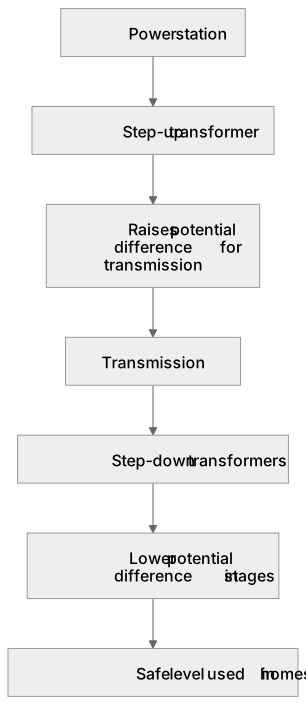
Put it in order
Put these steps in the order they happen.
- 1. Safe level used in homes
- 2. Lower potential difference in stages
- 3. Raises potential difference for transmission
- 4. Step-down transformers
- 5. Power station
- 6. Step-up transformer
- 7. Transmission
Key words
Say what each word means before you turn the card.
Step-up transformer
Try answering aloud or in your head before turning the card.
Step-down transformer
Try answering aloud or in your head before turning the card.
Changing potential difference in power transfer
Try answering aloud or in your head before turning the card.
Turns ratio and coil arrangement
Try answering aloud or in your head before turning the card.
See every definition
- Step-up transformer
- A transformer that increases the potential difference because it has more turns on the secondary coil than on the primary coil.
- Step-down transformer
- A transformer that decreases the potential difference because it has fewer turns on the secondary coil than on the primary coil.
- Changing potential difference in power transfer
- Transformers are used in the transfer of power from power stations so that the potential difference is raised for transmission and lowered again for use.
- Turns ratio and coil arrangement
- More secondary turns means step-up, fewer secondary turns means step-down, linking each transformer type to its coil turns.
Label the diagram
Some boxes have lost their names. Pick the right name for each number.
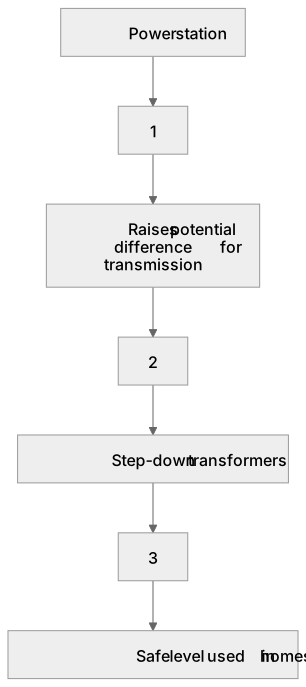
1Box 1
2Box 2
3Box 3
There is more to this lesson
The full lesson goes on to check your understanding and help you earn the marks. Create a free account to carry on, with your progress saved.
A week of Premium from your first lesson · Then the free plan continues · No card, no charge
Test your understanding of Powering Earth: recall that step-up and step-down transformers are used to change the potential difference as power is transferred from power stations
Active recall beats re-reading. Take an instant quiz now to test what you’ve learned and lock it into long-term memory.
A week of Premium from your first lesson · Then the free plan continues · No card, no charge