OCR · GCSE · Physics
Pressure in Liquids
Pressure in Liquids (OCR Topic 2.9) explores how the pressure exerted by a fluid increases with depth and acts equally in all directions, governed by the equation P = hρg. Mastery of this topic requires both confident numerical calculation — with precise unit handling — and the ability to explain the physical mechanism by which pressure differences at different depths give rise to upthrust, the force responsible for floating and sinking. This topic carries significant exam weight across both AO1 recall and AO2 application questions, making it essential for candidates targeting grades 4 through 9.
- 9 min read
- 5 worked examples
- 5 practice questions
- 8 key terms
Study Notes

Overview
Pressure in Liquids is one of the most elegantly connected topics in the OCR GCSE Physics specification. At its heart, it asks a deceptively simple question: why does it hurt your ears when you dive to the bottom of a swimming pool? The answer — that the weight of the water column above you creates a force pressing inward from every direction — unlocks a chain of understanding that leads from a single formula all the way to explaining why ships float, why submarines must be built with reinforced hulls, and why deep-sea fish would be crushed at the surface.
OCR assesses this topic through both quantitative and qualitative questions. Candidates at Foundation tier are expected to recall and apply the formula P = hρg and describe qualitatively how pressure varies with depth. Higher tier candidates must additionally explain the origin of upthrust in terms of pressure differences, apply Archimedes' Principle, and evaluate floating and sinking scenarios using force comparisons. Typical exam question styles include short-answer calculations (2–4 marks), explain questions requiring mechanistic reasoning (3–4 marks), and extended response questions linking pressure to upthrust and buoyancy (5–6 marks).
This topic connects directly to forces and Newton's Laws (Topic 5), density (Topic 2.8), and atmospheric pressure (Topic 2.9 extension). Understanding pressure in liquids also underpins the study of hydraulic systems in engineering contexts. Examiners consistently report that the most common source of lost marks is unit conversion errors and vague explanations of upthrust — both of which this guide addresses in detail.
Key Concepts
Concept 1: Pressure Increases with Depth
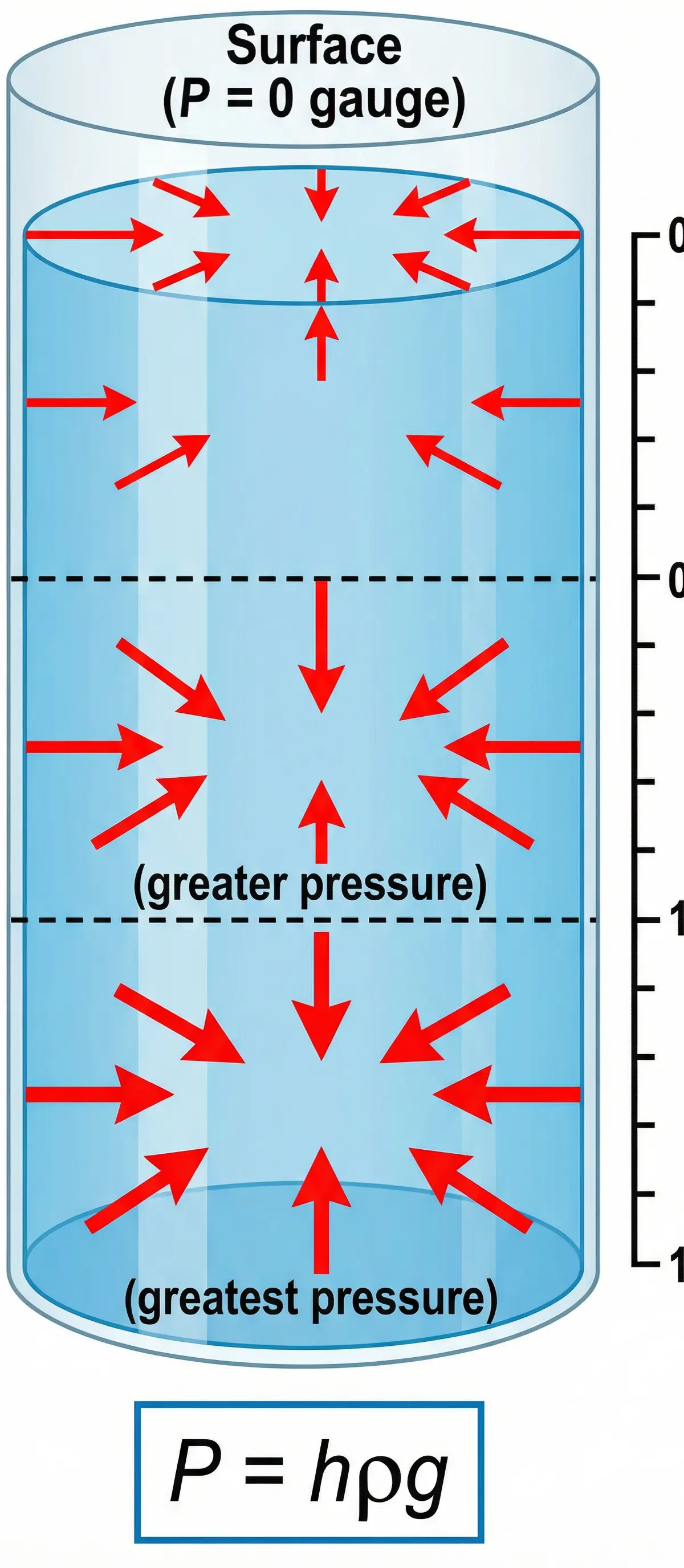
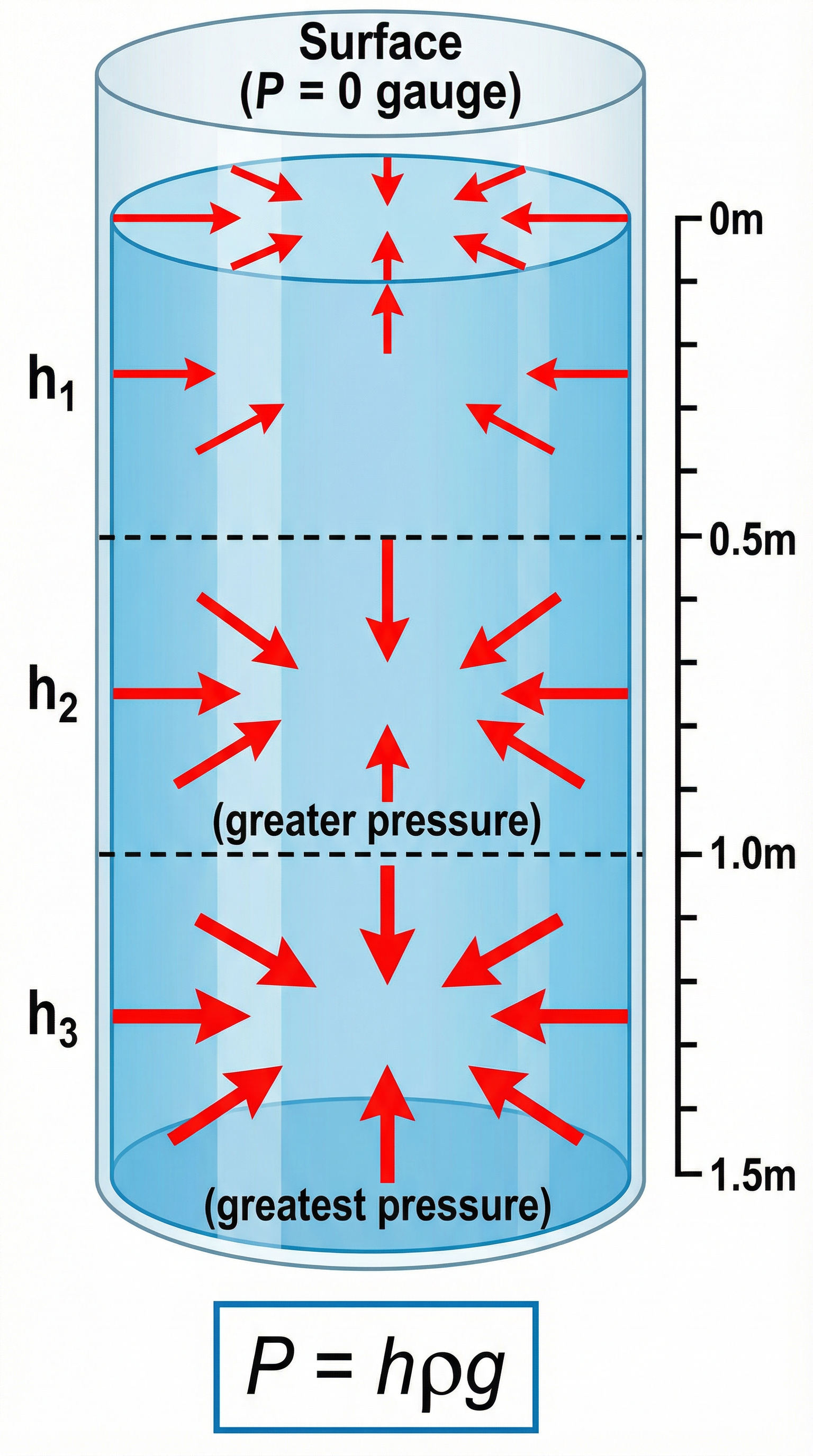
The fundamental principle of pressure in liquids is that pressure increases as depth increases. To understand why, consider a horizontal layer of liquid at depth h below the surface. The liquid above this layer has a certain weight, and that weight must be supported by the pressure at depth h. The greater the depth, the greater the weight of liquid above, and therefore the greater the pressure.
This relationship is not merely qualitative — it is precisely linear. Doubling the depth exactly doubles the pressure (assuming constant density and gravitational field strength). This linearity is captured in the formula P = hρg, where every variable has a direct proportional effect on pressure.
A critical qualitative point that OCR tests regularly is that pressure at a given depth acts equally in all directions — upward, downward, and sideways. This is a property of fluids that distinguishes them from solids. If you place a small sensor at a depth of 2 m in a tank of water, it will register the same pressure regardless of which direction it faces. This omnidirectional nature of fluid pressure is why a submarine hull must be equally strong in all directions, and why a balloon inflated underwater is compressed uniformly rather than squashed from one side.
Real-world example: A diver at 10 m depth in seawater (density ≈ 1025 kg/m³) experiences a pressure of approximately 100,500 Pa above atmospheric — roughly equivalent to an additional atmosphere of pressure pressing in from every direction.
Concept 2: The Formula P = hρg
The pressure due to a column of liquid is calculated using:
P = hρg
where P = pressure (Pa), h = depth below the liquid surface (m), ρ = density of the liquid (kg/m³), g = gravitational field strength (N/kg, use 10 N/kg unless told otherwise)
Each variable must be in SI units before substitution. This is the single most important practical requirement for this topic. OCR frequently provides data in non-SI units specifically to test whether candidates can convert correctly.
Unit conversion table:
| Quantity | Non-SI unit given | Conversion | SI unit |
|---|---|---|---|
| Depth (h) | centimetres (cm) | ÷ 100 | metres (m) |
| Depth (h) | millimetres (mm) | ÷ 1000 | metres (m) |
| Density (ρ) | g/cm³ | × 1000 | kg/m³ |
| Density (ρ) | g/m³ | ÷ 1000 | kg/m³ |
Note: The formula sheet provided by OCR in the examination includes P = hρg, so candidates do not need to memorise the formula itself — but they must know what each symbol represents and be able to apply it correctly.
The critical distinction for h: h is always the vertical distance from the free surface of the liquid down to the point of interest. It is not the height of any object placed in the liquid, and it is not the distance from the bottom of the container. If a 0.4 m tall block rests on the floor of a tank filled to 1.2 m depth, the pressure at the top of the block is calculated using h = 0.8 m (the depth of the top of the block below the surface), not h = 0.4 m.
Concept 3: Upthrust and Its Origin
Upthrust is the net upward force exerted on any object submerged (fully or partially) in a fluid. It arises directly from the pressure difference between the bottom and top surfaces of the object.
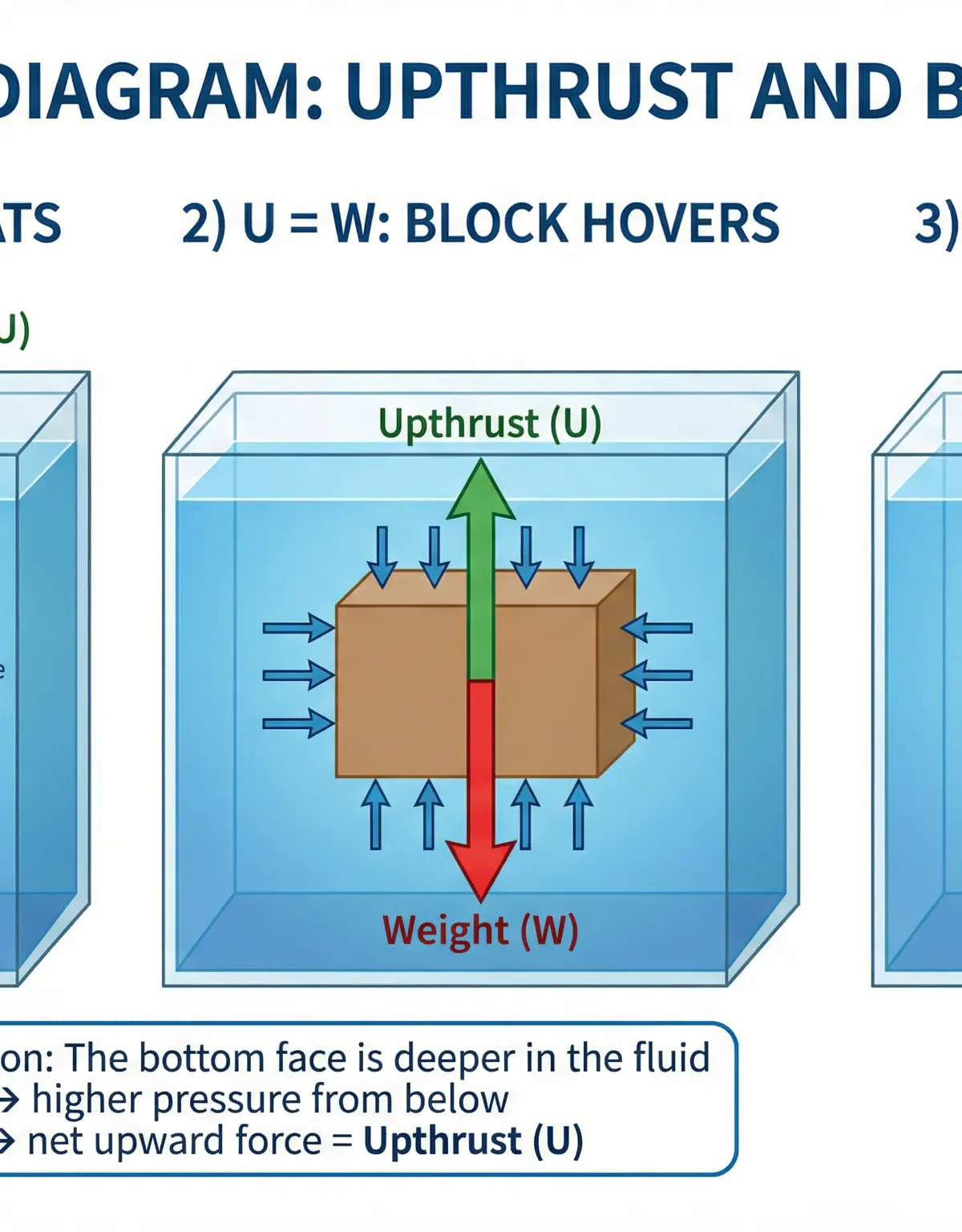
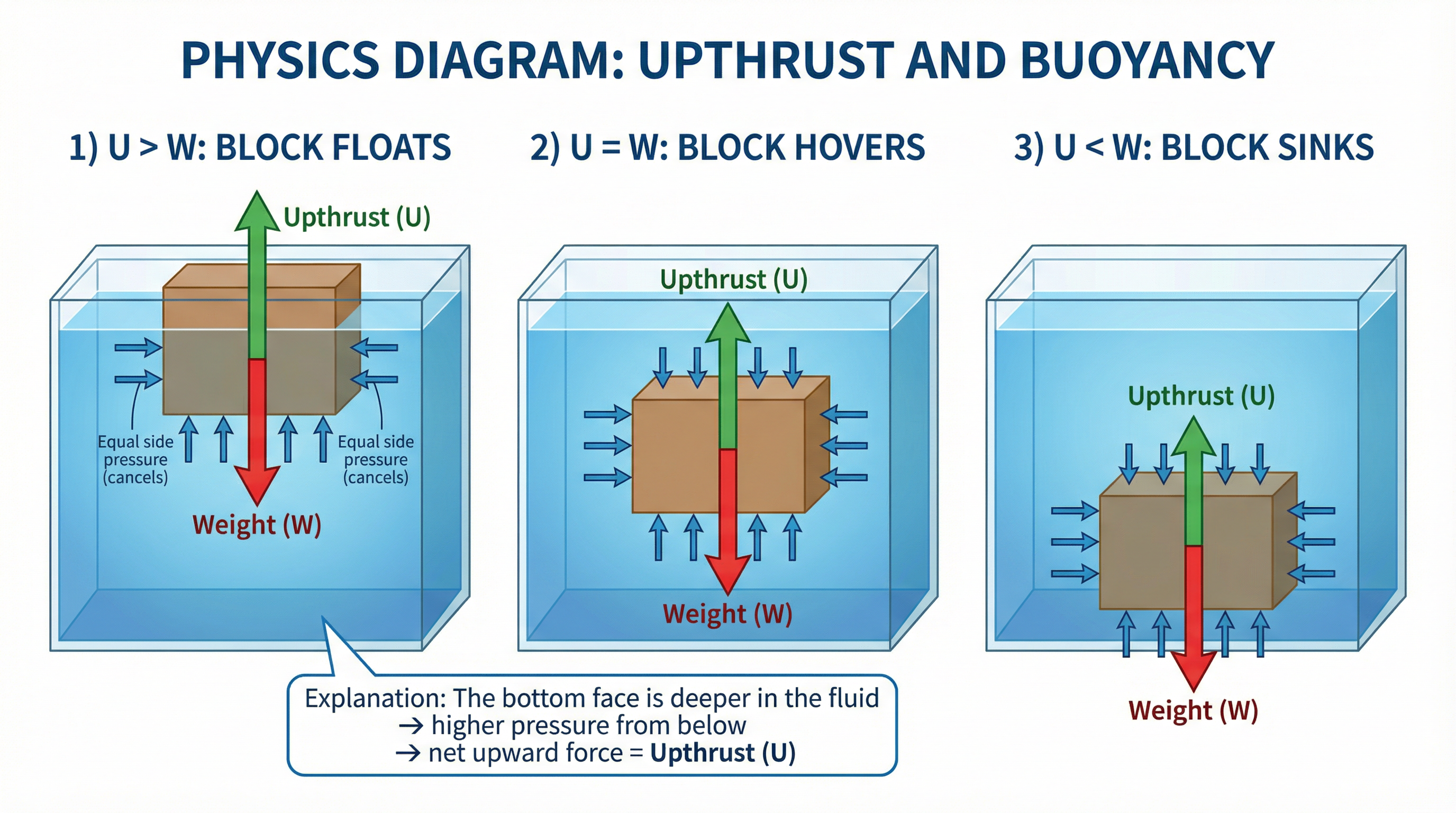
Consider a rectangular block fully submerged in water. The water exerts pressure on all six faces of the block. The pressures on the left and right faces are equal (both faces are at the same average depth), so their horizontal forces cancel. Similarly, the front and back faces cancel. However, the bottom face is deeper than the top face. Since pressure increases with depth, the upward pressure force on the bottom face is greater than the downward pressure force on the top face. The difference between these two forces is the upthrust — a net upward force.
This is the mechanistic explanation OCR requires. Candidates who write only "the water pushes the object up" will not receive credit for an explain question. The full chain of reasoning must be present: greater depth → greater pressure → greater force on bottom face → net upward force = upthrust.
Concept 4: Floating, Hovering, and Sinking
The behaviour of an object in a fluid depends entirely on the comparison between its weight (W, acting downward) and the upthrust (U, acting upward):
| Condition | Behaviour | Explanation |
|---|---|---|
| U > W | Object floats | Rises until partially out of fluid; upthrust reduces until U = W |
| U = W | Object hovers | Equilibrium — resultant force is zero |
| U < W (even when fully submerged) | Object sinks | Resultant downward force; object accelerates to the bottom |
For a floating object, the upthrust always adjusts to equal the weight. As the object rises and less of it is submerged, it displaces less fluid, reducing the upthrust until equilibrium is reached. This is why a heavy ship floats: its hull displaces an enormous volume of water, generating an upthrust equal to the ship's entire weight.
An object sinks when its weight exceeds the maximum possible upthrust — that is, the upthrust when the object is fully submerged. If even at full submersion the upthrust is less than the weight, the object will sink to the bottom.
Higher tier — Archimedes' Principle: The upthrust on an object equals the weight of fluid displaced by that object. Mathematically: U = ρ_fluid × V_displaced × g. This principle allows calculation of upthrust without knowing the pressure distribution directly.
Mathematical Relationships
Formula Summary
| Formula | Variables | Status | Notes |
|---|---|---|---|
| P = hρg | P (Pa), h (m), ρ (kg/m³), g (N/kg) | Given on formula sheet | Use g = 10 N/kg unless stated |
| U = ρ_fluid × V × g | U (N), ρ (kg/m³), V (m³), g (N/kg) | Must derive / Higher only | Archimedes' Principle |
| P = F/A | P (Pa), F (N), A (m²) | Given on formula sheet | General pressure formula |
Rearranging P = hρg
The formula can be rearranged to find any unknown:
- To find depth: h = P ÷ (ρg)
- To find density: ρ = P ÷ (hg)
- To find pressure: P = h × ρ × g (standard form)
Always state which rearrangement you are using before substituting values.
Practical Applications
Pressure in liquids has direct applications in engineering, medicine, and everyday life. Dam walls are built thicker at the base than at the top because the water pressure is greatest at the bottom — engineers must account for P = hρg when calculating the structural requirements at each depth. Hydraulic systems in car brakes and construction equipment exploit the fact that pressure is transmitted equally in all directions through a fluid (Pascal's Law). Blood pressure in the human body varies with height — blood pressure in the legs is higher than in the head because the column of blood above the measurement point is taller. Deep-sea submersibles must withstand pressures exceeding 60,000,000 Pa at the deepest ocean trenches, requiring specially engineered titanium spheres.
Listen to the 10-minute revision podcast above for a full audio walkthrough of all key concepts, exam tips, and a quick-fire recall quiz.
Visual Resources
2 diagrams and illustrations
Interactive Diagrams
3 interactive diagrams to visualise key concepts
Conceptual Flow Outline
Complete cause-and-effect flowchart: from depth increase to pressure, upthrust, and the conditions for floating, hovering, and sinking. Each arrow represents a logical step that could earn a mark in an explain question.
Conceptual Flow Outline
Formula map for P = hρg showing each variable, its unit, and the required unit conversion. Use this as a checklist before every calculation.
Conceptual Flow Outline
Decision flowchart for approaching different command words in Pressure in Liquids exam questions. Follow the branch that matches your question's command word.
Worked Examples
5 worked examples — open one to explore the question and available guidance.
Practice Questions
Test your understanding — click to reveal model answers
State two factors that affect the pressure exerted by a liquid at a given point. [2 marks]
Hint: Think about the variables in the formula P = hρg — which ones can change?
A diver descends to a depth of 25 m in seawater. The density of seawater is 1025 kg/m³ and g = 10 N/kg. Calculate the pressure due to the seawater at this depth. Give your answer in kPa. [4 marks]
Hint: Use P = hρg, then convert your answer from Pa to kPa by dividing by 1000.
A student investigates pressure in a liquid. She places a pressure sensor at a depth of 50 cm in a tank of water (density 1000 kg/m³). She then moves the sensor to a depth of 150 cm. Calculate the increase in pressure between the two depths. Use g = 10 N/kg. [4 marks]
Hint: Convert depths from cm to m first. Calculate pressure at each depth separately, then find the difference.
Explain why a ship made of steel can float on water, even though steel is much denser than water. [4 marks]
Hint: Think about the shape of the ship and what volume of water it displaces. Compare the upthrust to the weight of the ship.
A cube of side 0.1 m is fully submerged in water (density 1000 kg/m³). The top face of the cube is at a depth of 0.3 m below the surface. Use g = 10 N/kg.
(a) Calculate the pressure on the top face of the cube. [2 marks]
(b) Calculate the pressure on the bottom face of the cube. [2 marks]
(c) The area of each face of the cube is 0.01 m². Calculate the upthrust on the cube. [2 marks]
Hint: For part (c), upthrust = force on bottom face − force on top face. Use F = P × A to find each force.
Test your understanding of Pressure in Liquids
Active recall beats re-reading. Take an instant quiz now to test what you’ve learned and lock it into long-term memory.
7 days Premium · Then free forever · No card, no charge