Redshift
Discover the secrets of the expanding universe with this essential guide to Redshift for OCR GCSE Physics. We will explore the core evidence for the Big Bang, master the exam technique needed to secure top marks, and provide you with the tools to remember it all.
Study Notes
Overview
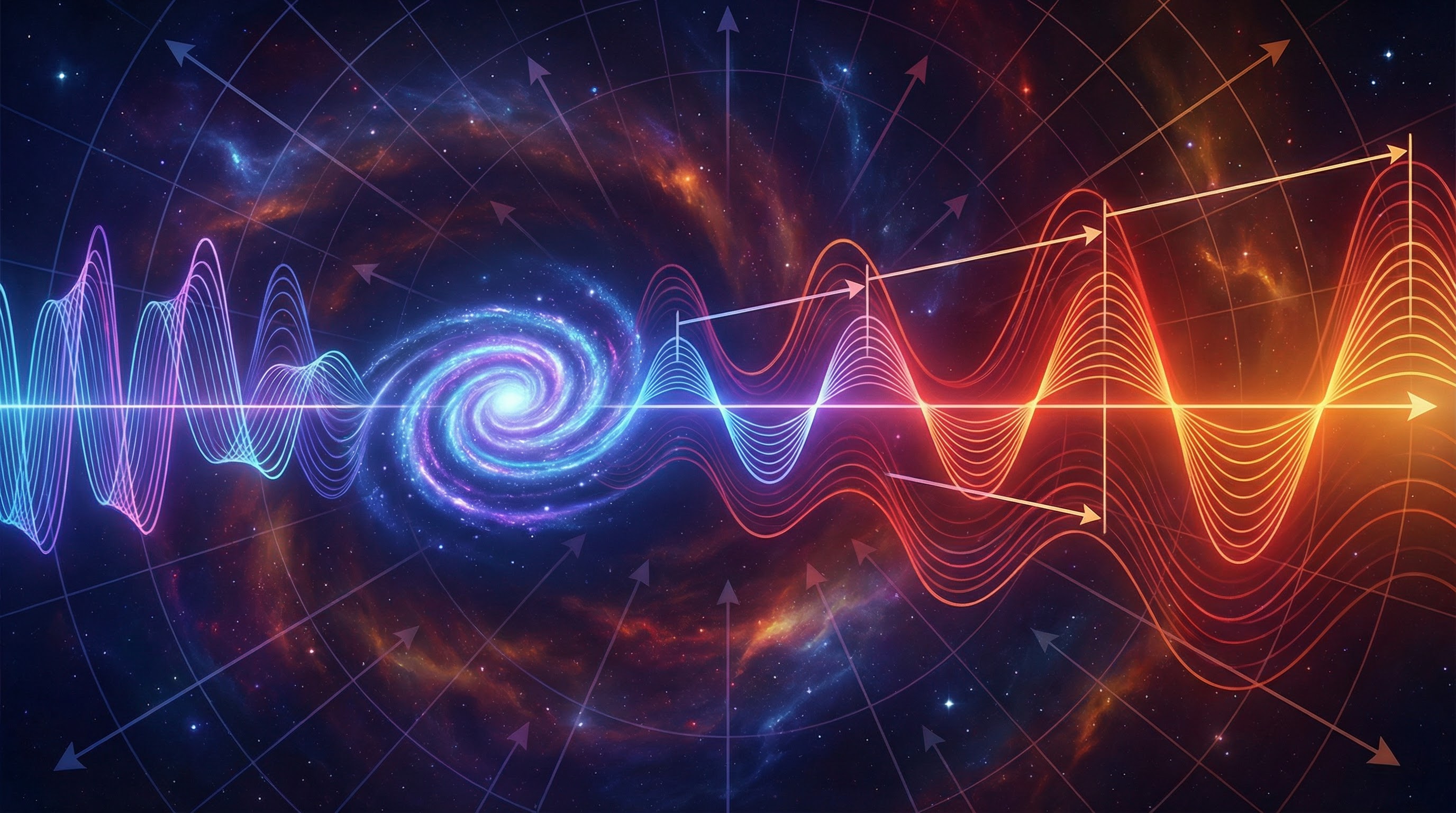
Redshift is one of the most profound concepts in physics, providing the key observational evidence for the expansion of our universe and the Big Bang theory. For your OCR GCSE exam, understanding redshift isn't just about knowing a definition; it's about linking an observation (the stretching of light) to a conclusion (the universe is expanding). This topic, specification point 8.10, frequently appears in longer, 6-mark questions where examiners are looking for a clear, logical argument. You'll need to connect ideas from waves (the Doppler effect) to cosmology. Mastering this topic shows you can handle abstract concepts and construct a scientific argument – a skill highly valued by examiners.
Key Concepts
Concept 1: The Doppler Effect and Light
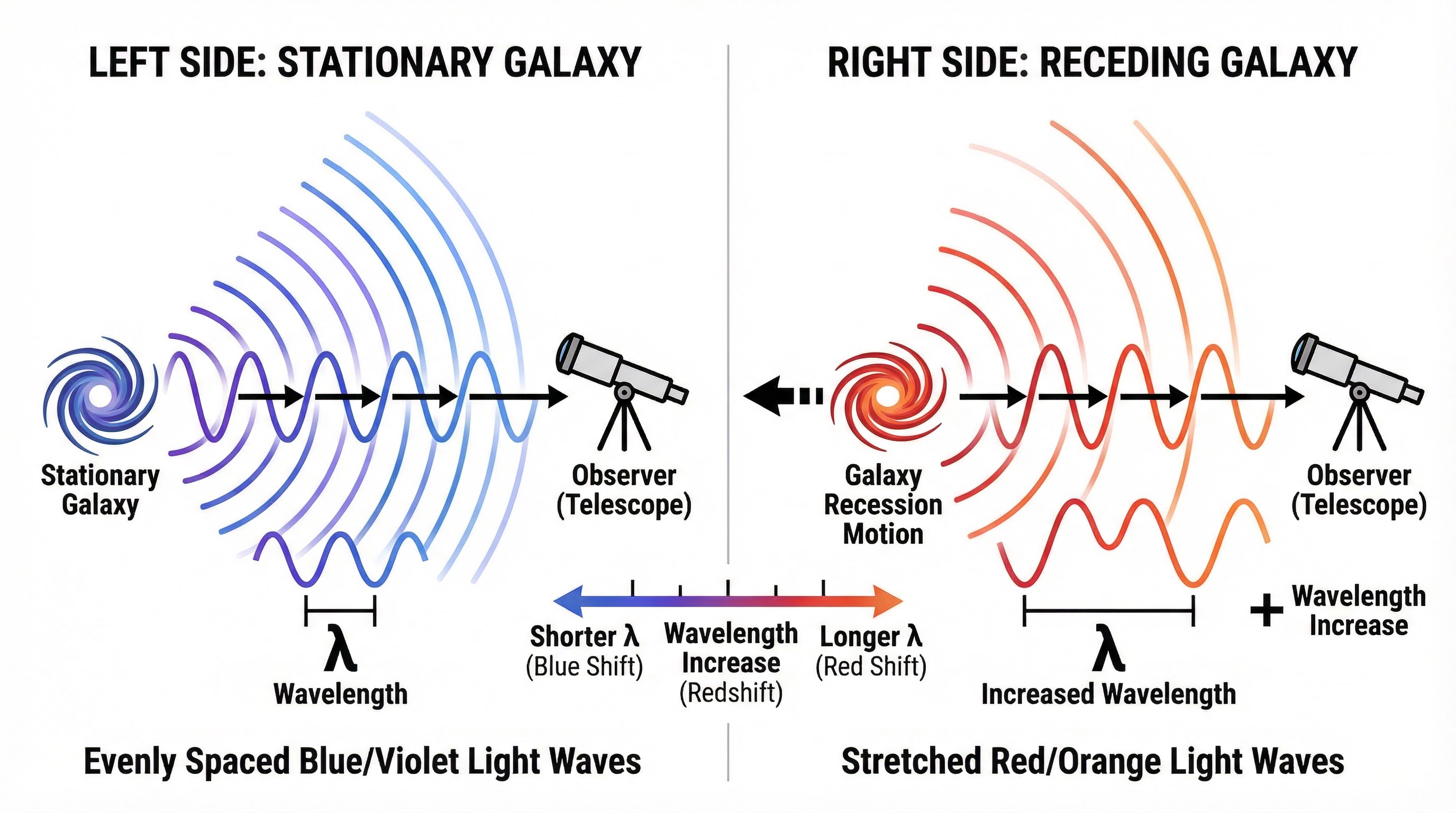
You've probably experienced the Doppler effect with sound: an ambulance siren sounds higher-pitched as it comes towards you and lower-pitched as it moves away. The same thing happens with light. Light is a wave, and its colour is determined by its wavelength. Blue light has a shorter wavelength, and red light has a longer wavelength.
- Blueshift: If a light source (like a galaxy) is moving towards an observer, the light waves get squashed together. This decreases their wavelength, shifting the light towards the blue end of the spectrum.
- Redshift: If a light source is moving away from an observer, the light waves get stretched out. This increases their wavelength, shifting the light towards the red end of the spectrum. This is the crucial observation for an expanding universe.
Concept 2: Hubble's Law
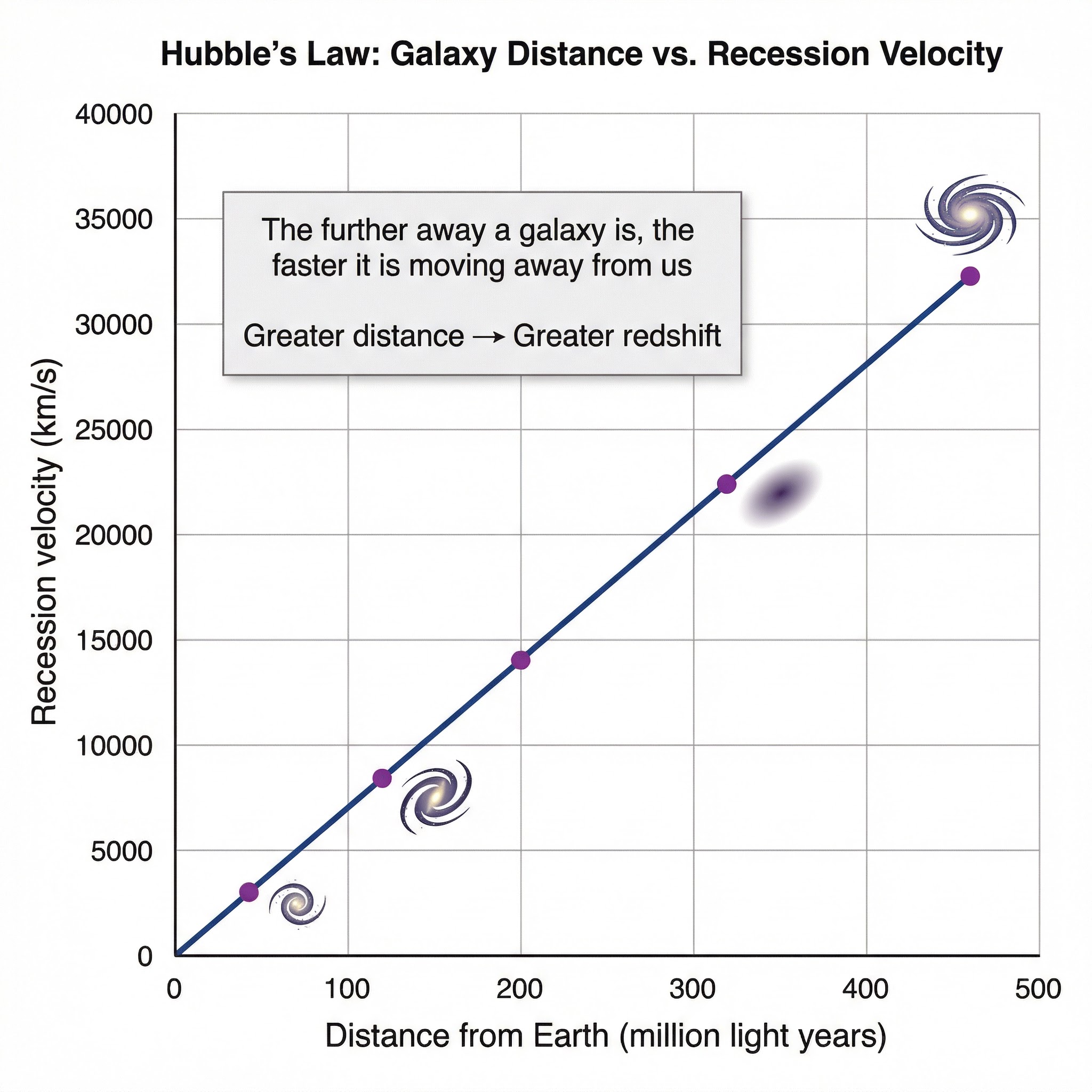
In the 1920s, astronomer Edwin Hubble observed the light from distant galaxies. He discovered that virtually every galaxy was redshifted, meaning they were all moving away from us. But he also found a stunningly simple relationship, now known as Hubble's Law:
**The recession velocity of a galaxy is directly proportional to its distance from us.**This means that a galaxy twice as far away is moving away from us twice as fast. This isn't because we are at the centre of the universe; it's because the entire fabric of space is expanding. Imagine baking a raisin loaf: as the dough expands, every raisin moves away from every other raisin. From the perspective of any single raisin, all the others appear to be moving away from it.
Concept 3: The Big Bang Theory
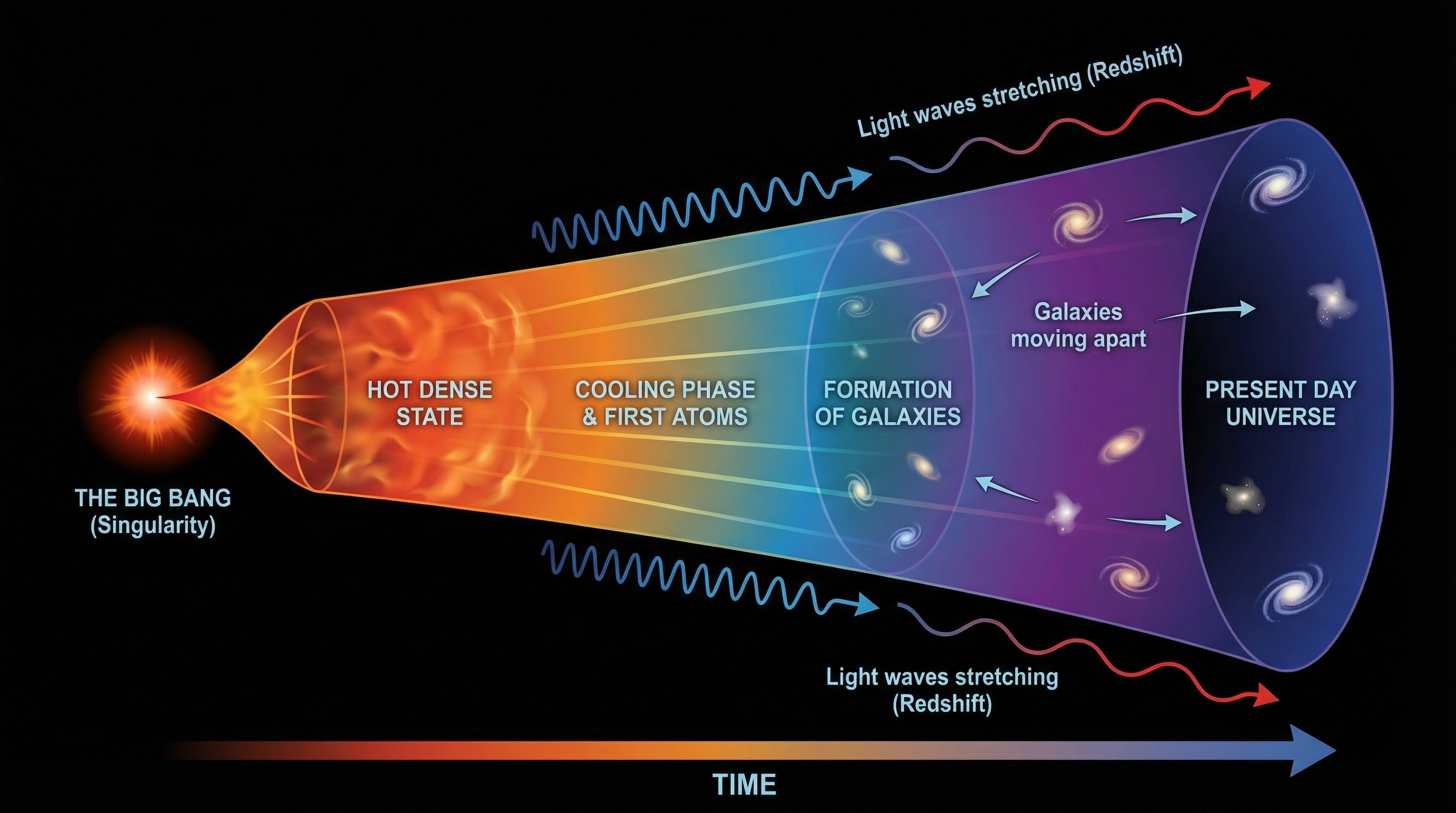
If the universe is expanding, it must have been smaller in the past. If we rewind the clock, all the matter and energy in the universe would have been concentrated into a single, incredibly hot and dense point – a singularity. The Big Bang theory states that approximately 13.8 billion years ago, this singularity began to expand, and has been expanding and cooling ever since. Redshift is the primary piece of evidence supporting this theory.
It is critical to use precise language: the Big Bang was not an explosion in space, but an expansion of space itself.
Mathematical/Scientific Relationships
For GCSE, you are not required to perform calculations with the redshift formula, but you must understand the conceptual relationship:
Change in wavelength / Original wavelength = Velocity of a galaxy / Speed of lightThis shows that the fractional change in wavelength (the redshift) is directly proportional to the velocity of the galaxy. You must also know Hubble's Law conceptually:
Velocity ∝ Distance
Practical Applications
Redshift is a fundamental tool in modern astronomy. By measuring the redshift of a galaxy, astronomers can calculate its recession velocity and, using Hubble's Law, estimate its distance from Earth. This allows us to map the large-scale structure of the universe and understand the distribution of galaxies.
Visual Resources
3 diagrams and illustrations
Interactive Diagrams
2 interactive diagrams to visualise key concepts
Conceptual Flow Outline
This flowchart shows the logical steps from the observation of redshift to the conclusion of the Big Bang theory. Following this structure in a 6-mark question will ensure a coherent and high-scoring answer.
Conceptual Flow Outline
A concept map comparing Redshift and Blueshift as consequences of the Doppler effect for light.
Worked Examples
3 detailed examples with solutions and examiner commentary
Practice Questions
Test your understanding — click to reveal model answers
State two pieces of evidence that support the Big Bang theory. (2 marks)
Hint: One piece of evidence is redshift. What is the other key observation that points to a hot, early universe?
Explain why the observation of redshift is considered strong evidence for an expanding universe. (4 marks)
Hint: Link the observation to what it means for motion, and then what that motion implies for the universe as a whole.
A student writes: 'The Big Bang was a huge explosion that threw galaxies outwards. Redshift proves this.' Evaluate the student's statement. (5 marks)
Hint: Break the statement down. What parts are correct, and what parts are scientifically inaccurate? Use precise terminology in your evaluation.
What is the Cosmic Microwave Background (CMB) and why is it important? (3 marks)
Hint: Think about what would be left over from a very hot, early universe.
If we observed a distant galaxy that was blueshifted, what would that imply about its motion relative to us? (1 mark)
Hint: Blueshift is the opposite of redshift.