OCR · GCSE · Physics
Reflection
Master the principles of reflection for your OCR GCSE Physics exam. This guide breaks down everything from the law of reflection and ray diagrams to the crucial differences between specular and diffuse reflection, ensuring you can secure every mark available on this core topic.
- 6 min read
- 3 worked examples
- 5 practice questions
- 6 key terms
Study Notes
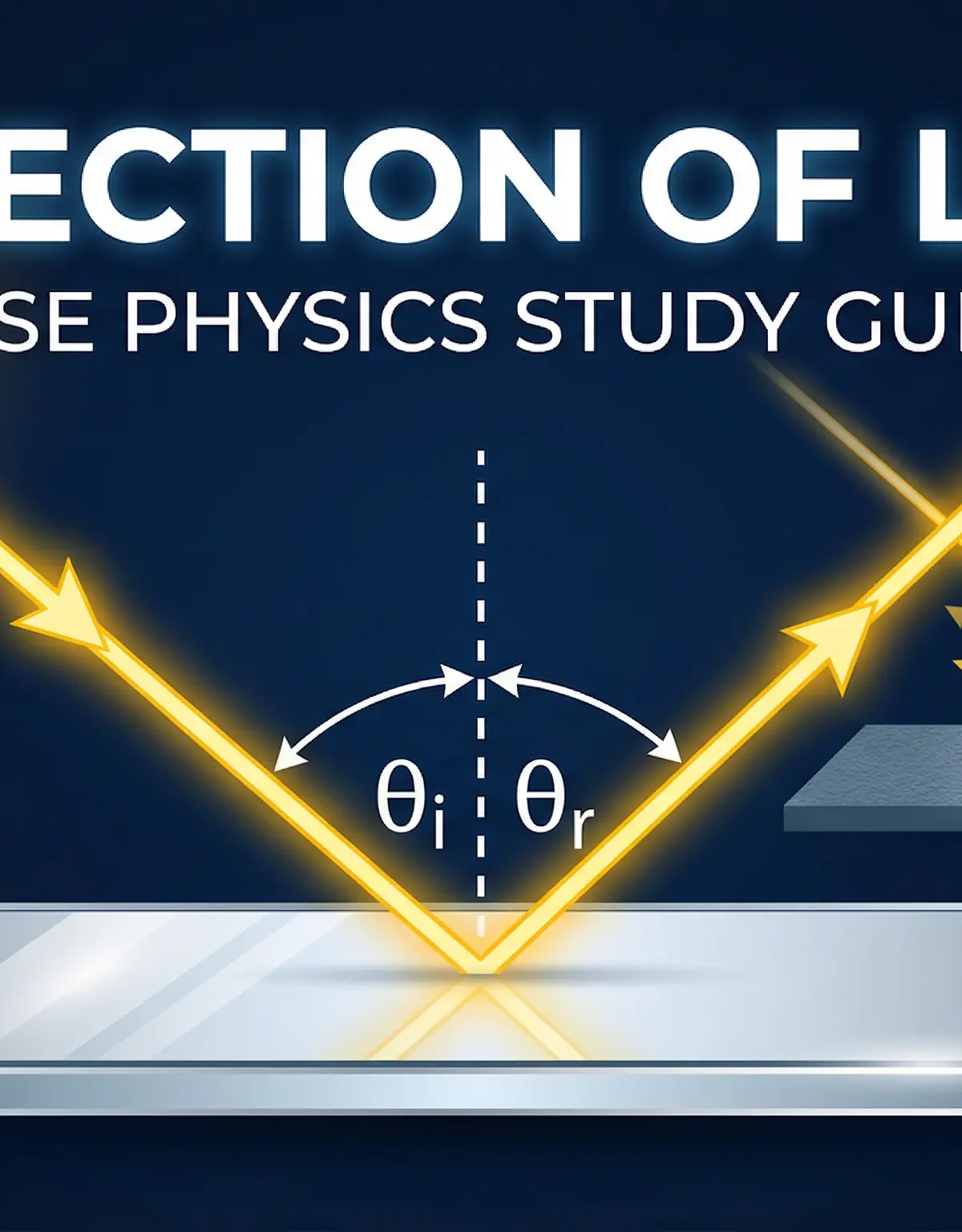
Overview
Reflection is a fundamental wave behaviour that describes how light bounces off surfaces. For your OCR GCSE Physics exam (specification reference 4.5), a precise understanding of reflection is essential, as it underpins topics in optics and wave properties. Examiners frequently test this through ray diagram construction, calculations involving angles, and explanations of image formation. Candidates are expected to apply the wave model to explain how light interacts with both smooth and rough surfaces, leading to specular and diffuse reflection respectively. This topic has strong synoptic links to the nature of waves (Topic 4.1), image formation in lenses (Topic 4.6), and the practical use of mirrors in devices like periscopes and telescopes. A solid grasp of reflection is crucial for achieving high marks in AO1 (knowledge) and AO2 (application) questions.
Key Concepts
The Law of Reflection
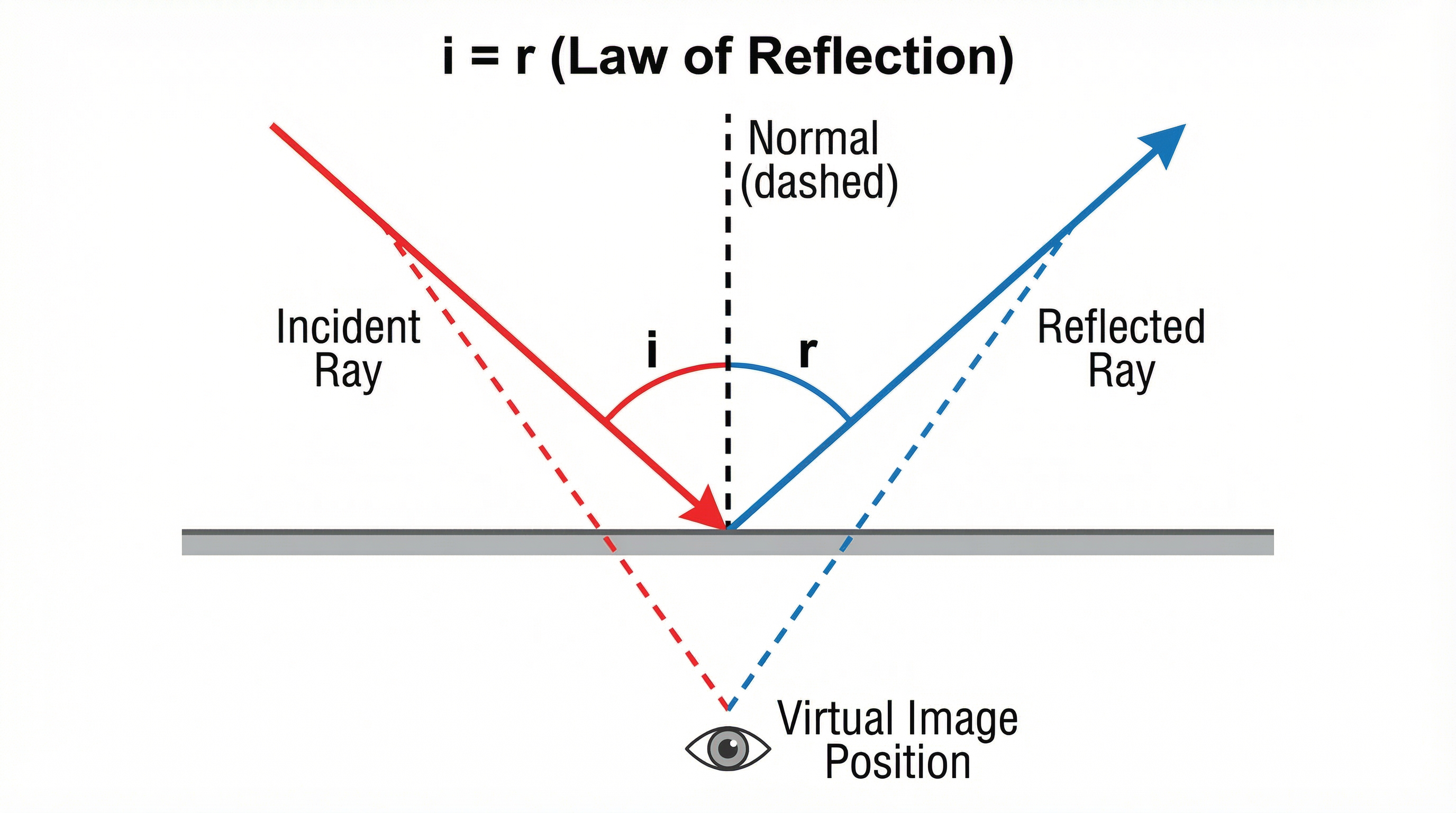
The cornerstone of this topic is the Law of Reflection, which governs how light behaves when it strikes a surface. It is defined by the relationship between two angles, both measured relative to a critical construction line called the normal. The normal is an imaginary line drawn at a right angle (90°) to the surface at the exact point where the light ray hits (the point of incidence). Examiners require the normal to be drawn as a dashed line to distinguish it from physical rays.
- Incident Ray: The ray of light travelling towards the surface.
- Reflected Ray: The ray of light that bounces off the surface.
- Angle of Incidence (i): The angle between the incident ray and the normal.
- Angle of Reflection (r): The angle between the reflected ray and the normal.
The Law of Reflection states that: the angle of incidence is equal to the angle of reflection (i = r).
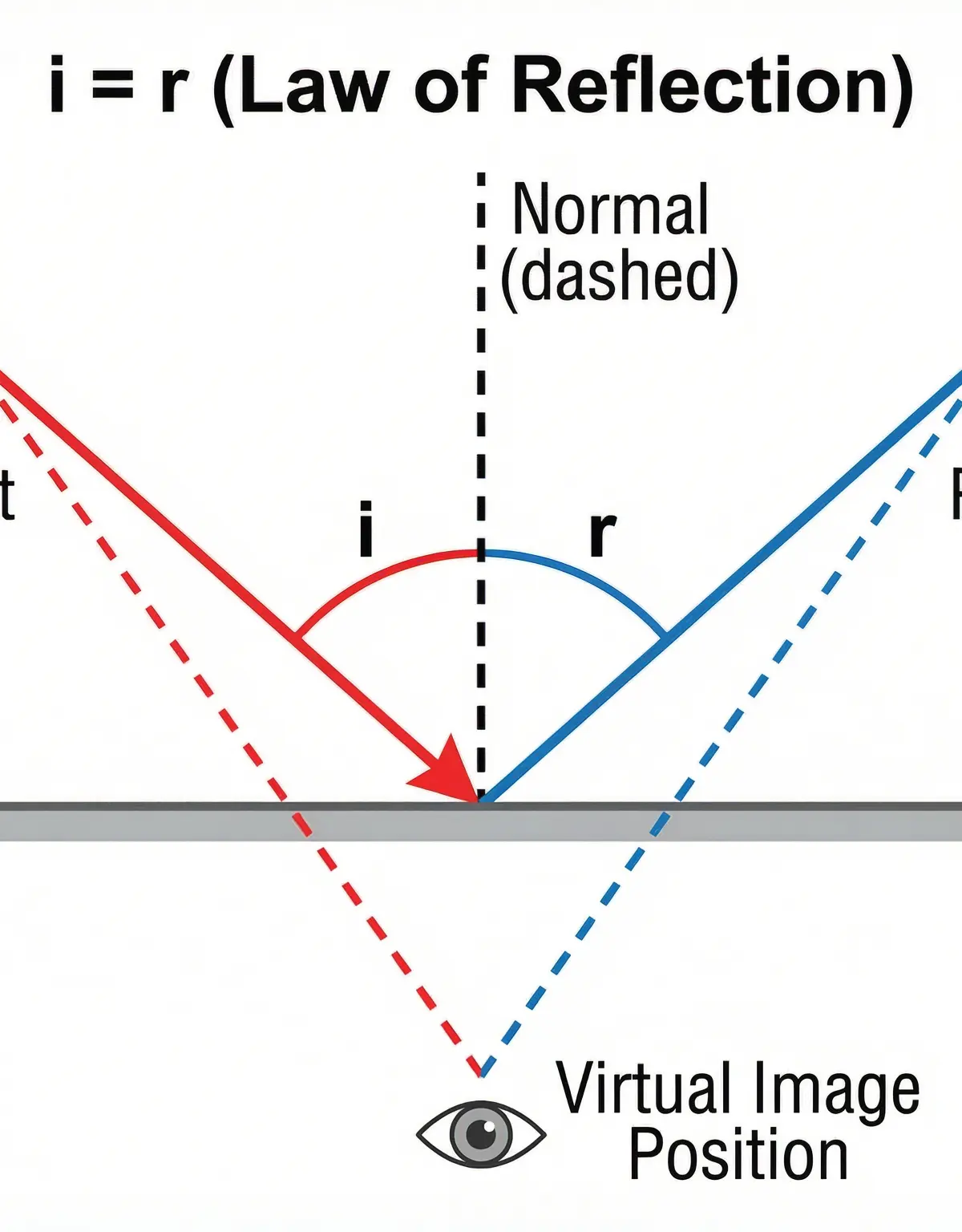
Example: If an incident ray strikes a mirror with an angle of incidence of 40°, the angle of reflection will also be 40°. A common mistake is to measure the angle from the mirror surface itself. If a ray hits the mirror at an angle of 30° to the surface, the angle of incidence is actually 90° - 30° = 60°, and so the angle of reflection will also be 60°.
Specular vs. Diffuse Reflection
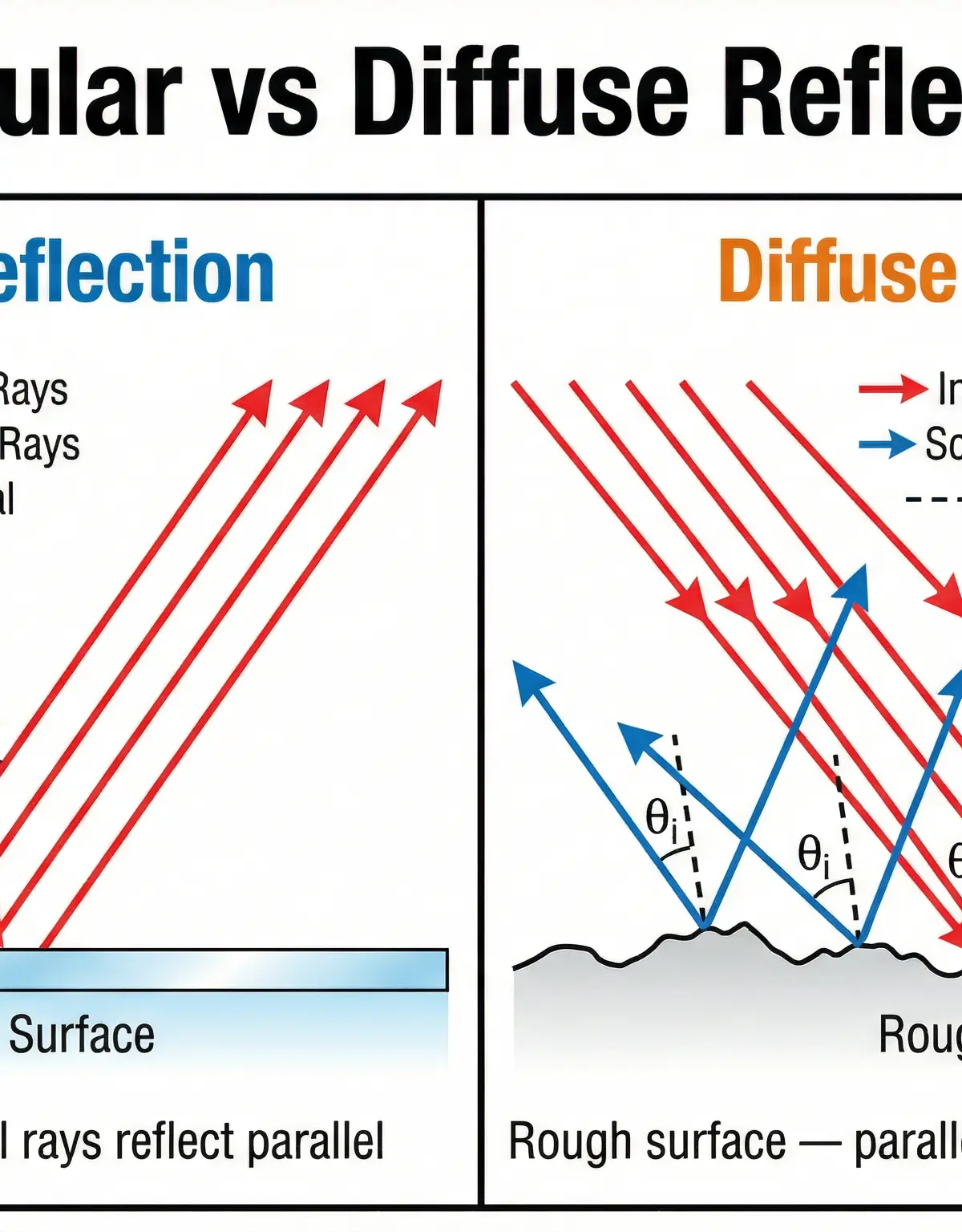
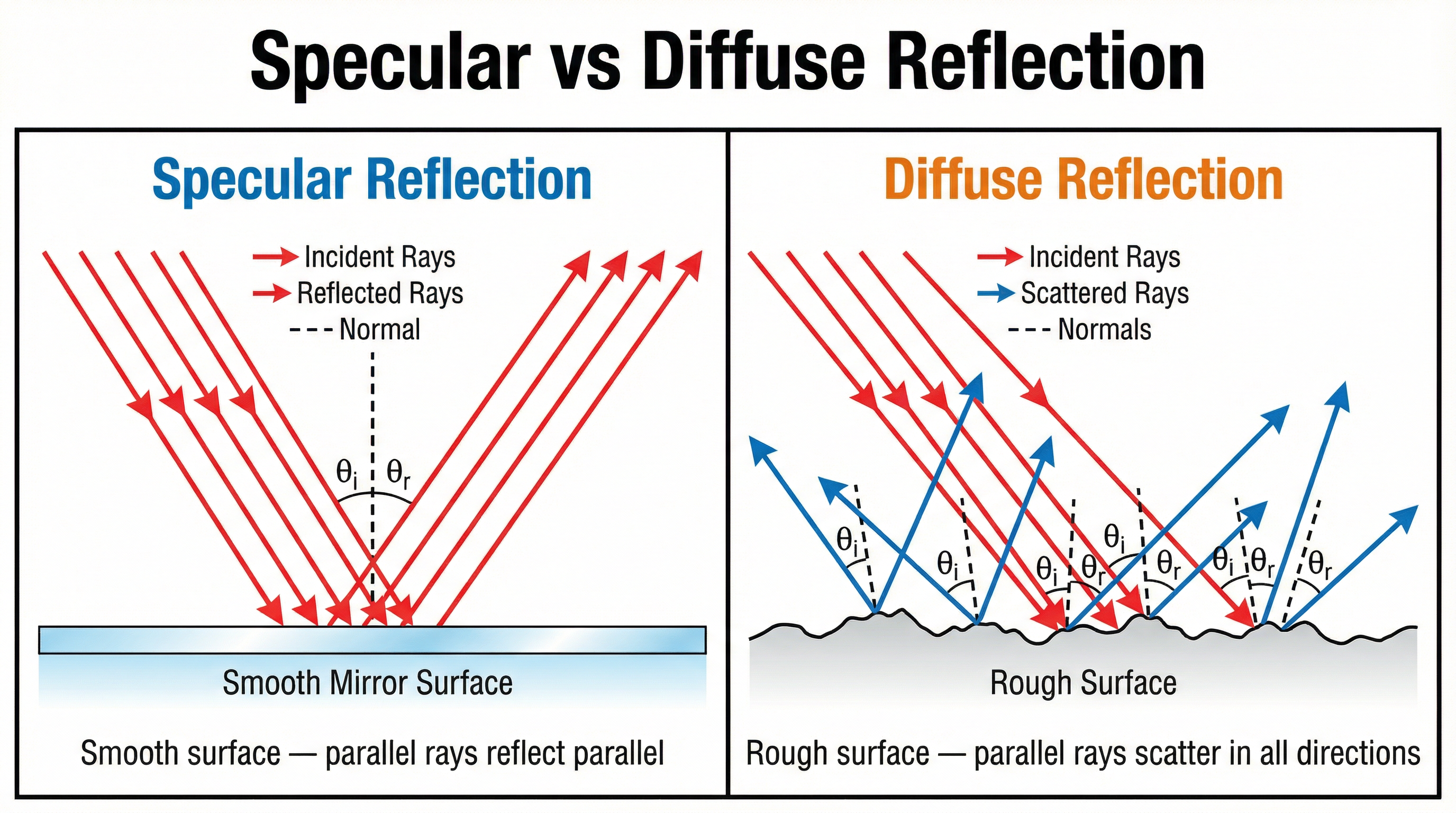
Examiners award significant marks for comparing these two types of reflection. The key distinction lies in the nature of the surface, not a change in the fundamental law of reflection.
| Feature | Specular Reflection | Diffuse Reflection |
|---|---|---|
| Surface Type | Smooth and flat (e.g., plane mirror, still water) | Rough and uneven (e.g., paper, wood, clothing) |
| Ray Behaviour | Parallel incident rays reflect as parallel rays. | Parallel incident rays are scattered in many directions. |
| Image Formation | A clear, sharp image is formed. | No image is formed; the surface appears illuminated. |
| The Normal | All normals across the surface are parallel. | The normals at different points on the surface point in random directions. |
| Law of Reflection | Obeyed for all rays. | Obeyed at every individual point on the surface. |
It is a major misconception that the law of reflection does not apply to diffuse reflection. It does. The roughness of the surface means that at each point a ray hits, the local normal is different, causing the reflected rays to scatter. This is a high-level point that distinguishes top-tier answers.
Virtual Images in Plane Mirrors
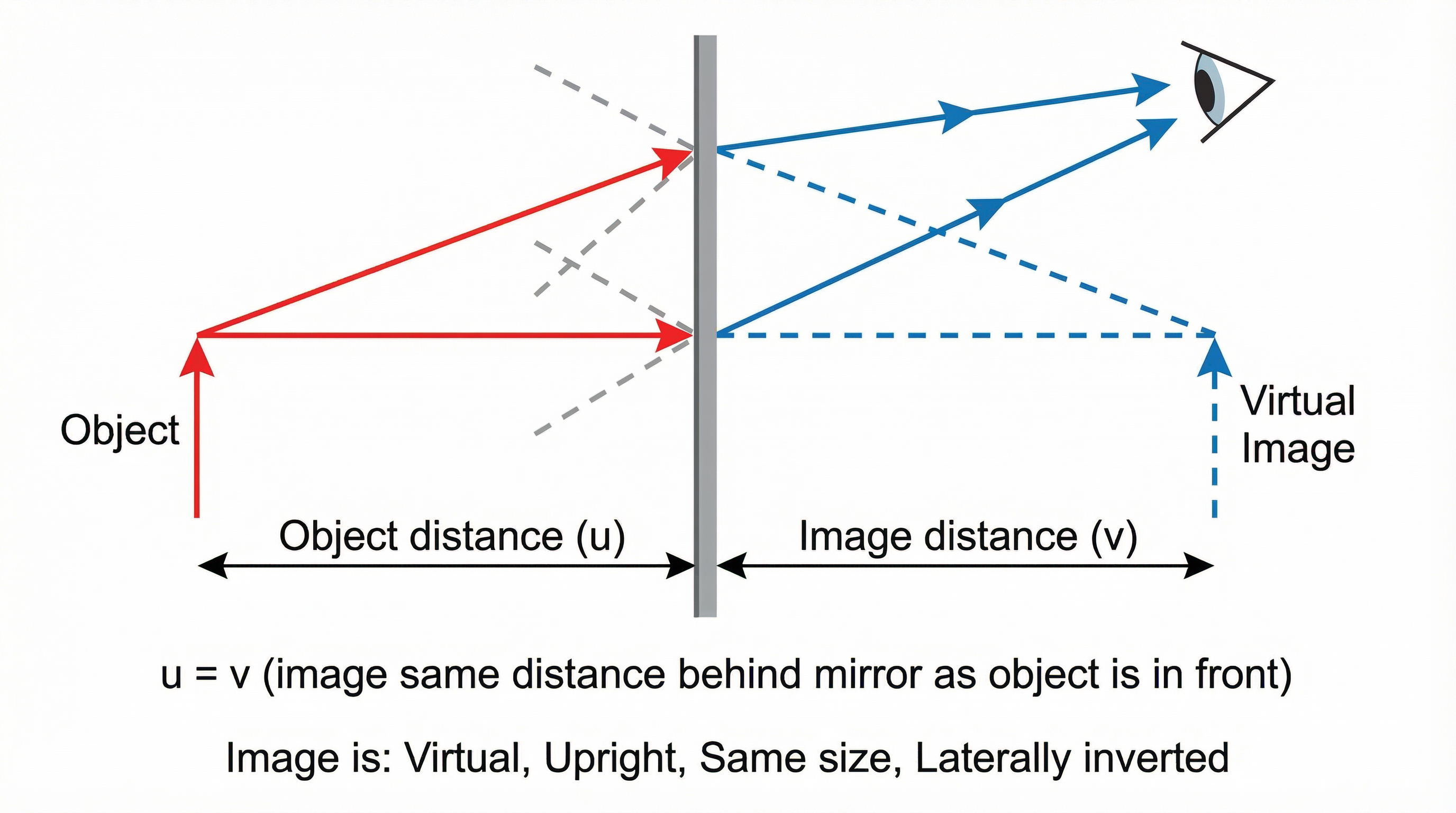
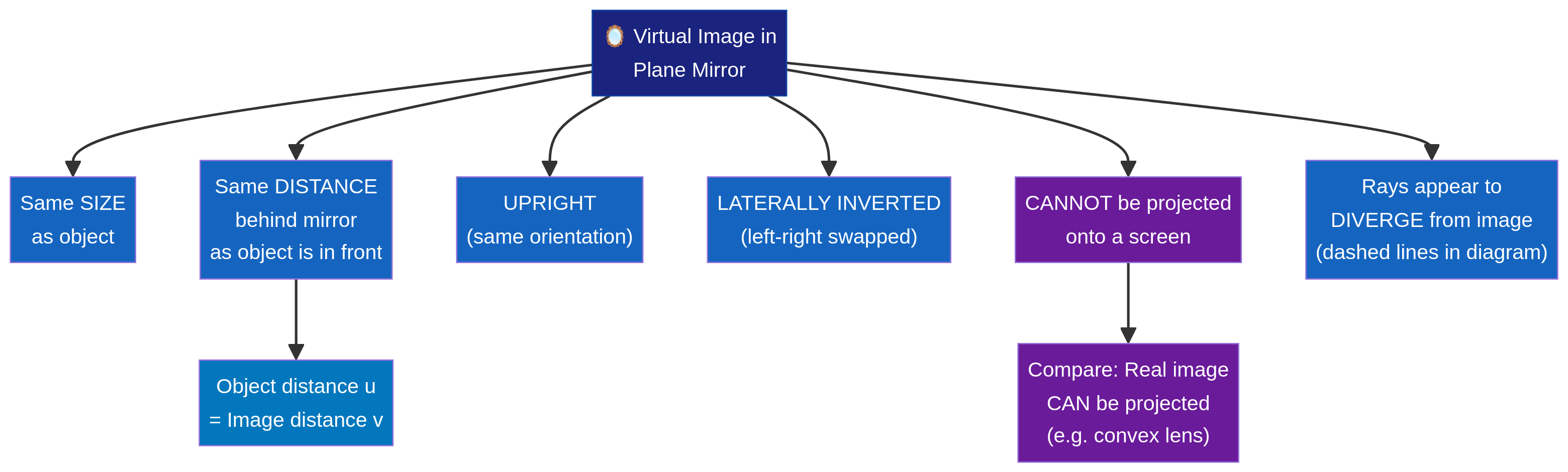
When you look into a plane (flat) mirror, you see a virtual image. It is called 'virtual' because the light rays do not actually converge at the image location; they only appear to originate from there. Your brain traces the diverging reflected rays back to a point behind the mirror.
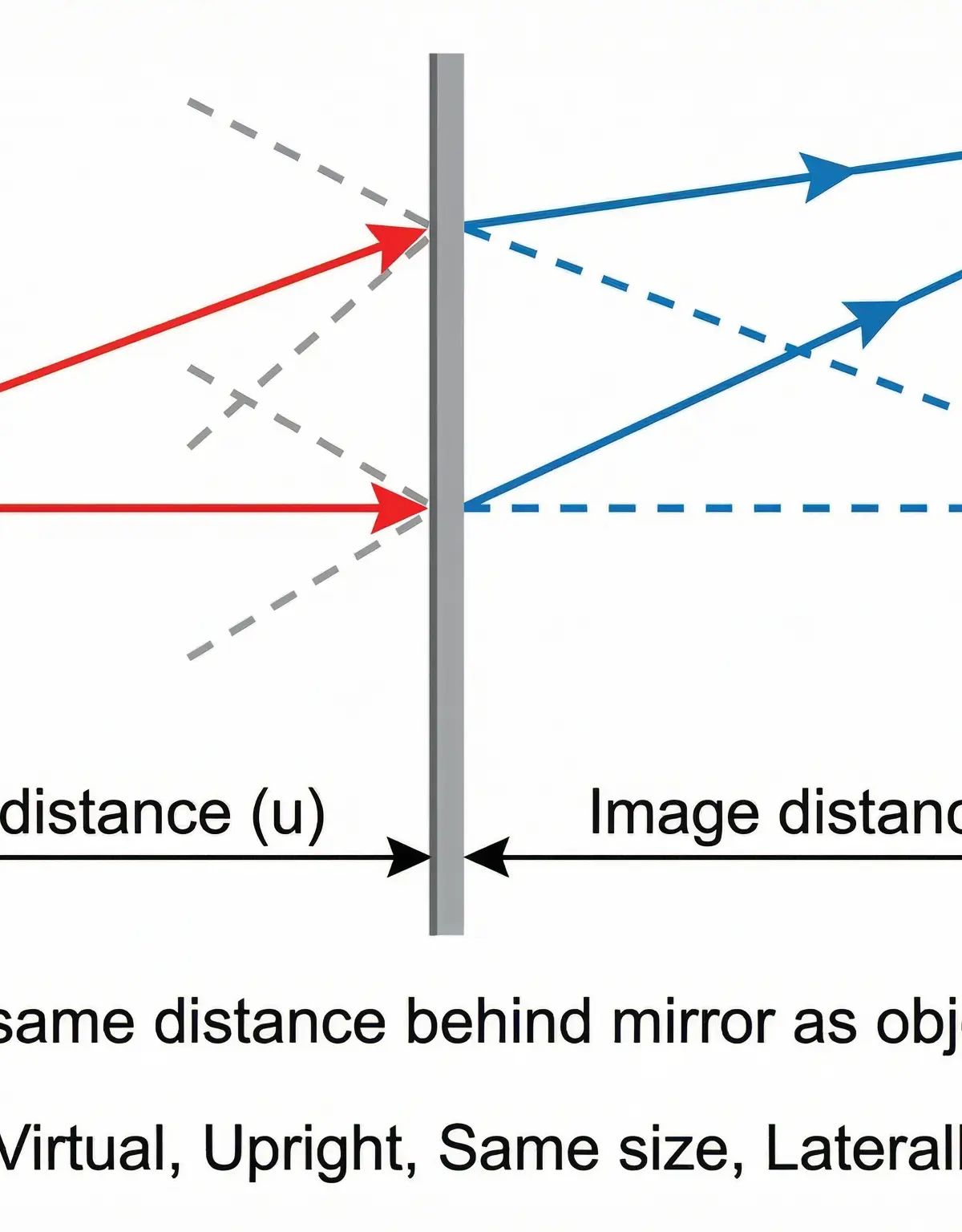
An image formed in a plane mirror has four key properties that you must be able to recall:
- Virtual: It cannot be projected onto a screen.
- Upright: It is the same way up as the object.
- Same Size: The image is the same size as the object.
- Laterally Inverted: Left and right are swapped (e.g., text appears reversed).
Furthermore, the image is located the same distance behind the mirror as the object is in front of it. In diagrams, virtual rays behind the mirror must be drawn as dashed lines.
Mathematical/Scientific Relationships
- The Law of Reflection:
i = ri: Angle of incidence (must memorise)r: Angle of reflection (must memorise)
- Relationship between angle to surface and angle of incidence:
Angle of Incidence = 90° - Angle to Surface(must memorise) - Plane Mirror Image Distance:
Object distance (u) = Image distance (v)(must memorise)
Practical Applications
Reflection is not just a theoretical concept; it is fundamental to many technologies. The required practical for this topic involves investigating the law of reflection using a ray box, a plane mirror, and a protractor.
- Periscopes: Use two parallel plane mirrors, typically angled at 45°, to allow observation from a concealed position. Light from the object reflects off the top mirror, down to the bottom mirror, and then into the observer's eye.
- Rear-view mirrors: Car mirrors use reflection to provide a view of traffic behind the vehicle.
- Kaleidoscopes: Use multiple internal reflections to create intricate, symmetrical patterns.
- Fibre Optics: While primarily based on Total Internal Reflection (a later topic), the principles of light travelling and bouncing are related.
Visual Resources
5 diagrams and illustrations
Interactive Diagrams
2 interactive diagrams to visualise key concepts
Conceptual Flow Outline
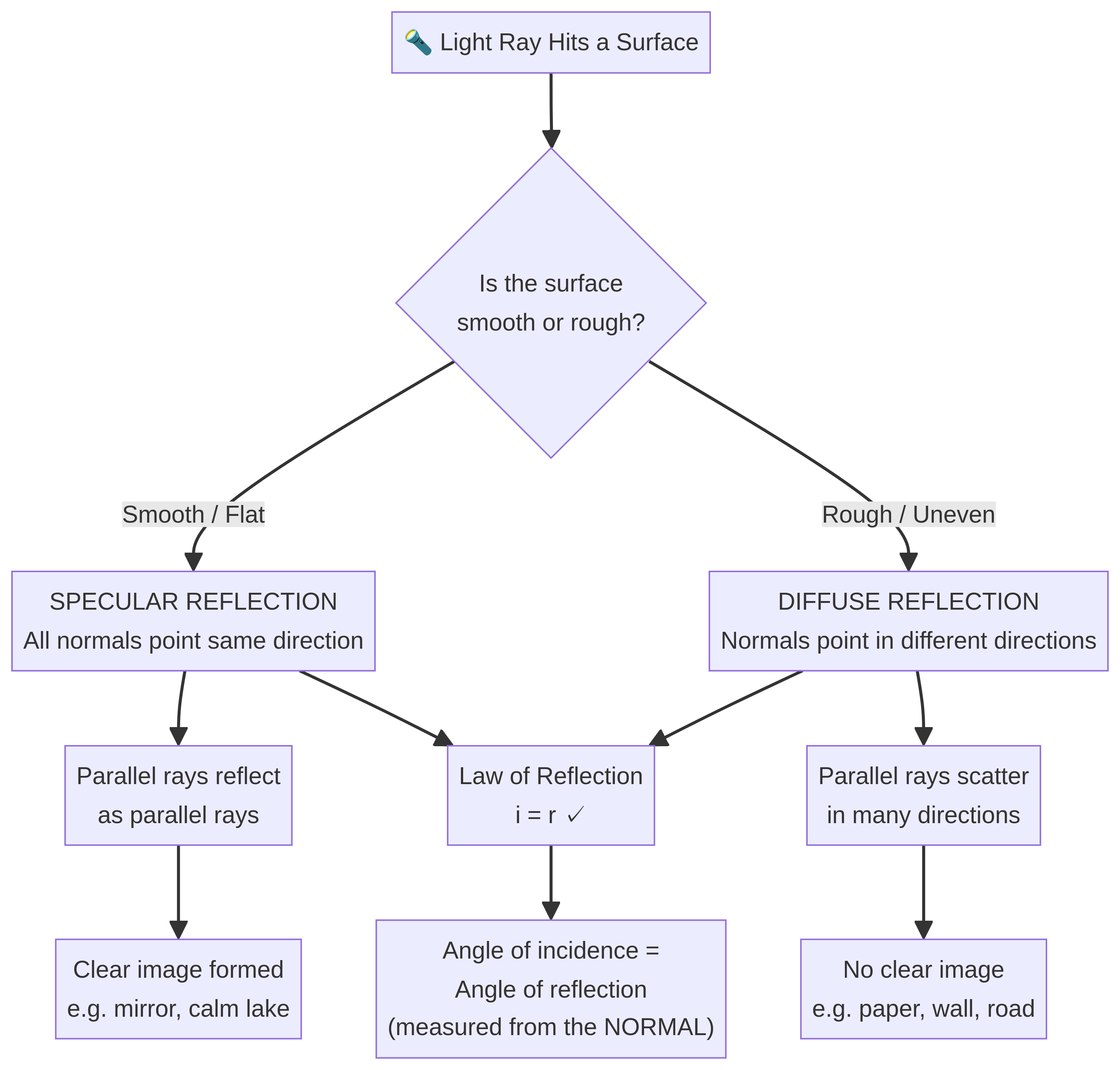
A flowchart summarising the process of determining whether reflection is specular or diffuse and the consequences of each. Note that the Law of Reflection applies in both cases.
Conceptual Flow Outline
A concept map showing the key properties of a virtual image formed by a plane mirror. This is essential knowledge for descriptive questions.
Worked Examples
3 worked examples — open one to explore the question and available guidance.
Practice Questions
Test your understanding — click to reveal model answers
A ray of light travels from a lamp to a plane mirror. State the law of reflection. [1 mark]
Hint: This is a direct recall of the main rule. How are the two important angles related?
A periscope uses two plane mirrors to see over an obstacle. Draw a simple diagram of a periscope, showing the path of a single ray of light from an object to the observer's eye. [3 marks]
Hint: You'll need a 'Z' shape for the periscope tube and two mirrors. Where should the mirrors be placed and at what angle?
Explain why you can see a clear reflection of yourself in a calm lake but not when the water is rough and wavy. [4 marks]
Hint: This question is about the difference between specular and diffuse reflection. Use the correct terminology.
An object is placed 1.2 m in front of a plane mirror. The object is 0.5 m tall. State the distance of the image from the object and the height of the image. [2 marks]
Hint: Remember the rules for image distance and size in a plane mirror. The question asks for the distance from the *object* to the image, not from the mirror.
A student investigates the law of reflection. They shine a ray of light at a plane mirror and measure the angle of incidence as 50°. They measure the angle of reflection as 55°. The student concludes the law of reflection is incorrect. Evaluate this conclusion. [3 marks]
Hint: Is it more likely that a fundamental law of physics is wrong, or that there was an error in the experiment? What could have caused the error?
Test your understanding of Reflection
Active recall beats re-reading. Take an instant quiz now to test what you’ve learned and lock it into long-term memory.
7 days Premium · Then free forever · No card, no charge