OCR · GCSE · Physics
Resultant Forces
Master OCR GCSE Physics Topic 2.3: Resultant Forces. This guide breaks down vector addition, free-body diagrams, and Newton's Laws into exam-focused, easy-to-understand sections. Secure top marks by learning how to link resultant force to acceleration and how to tackle both Foundation and Higher Tier questions with confidence.
- 6 min read
- 3 worked examples
- 5 practice questions
- 6 key terms
Study Notes
Overview
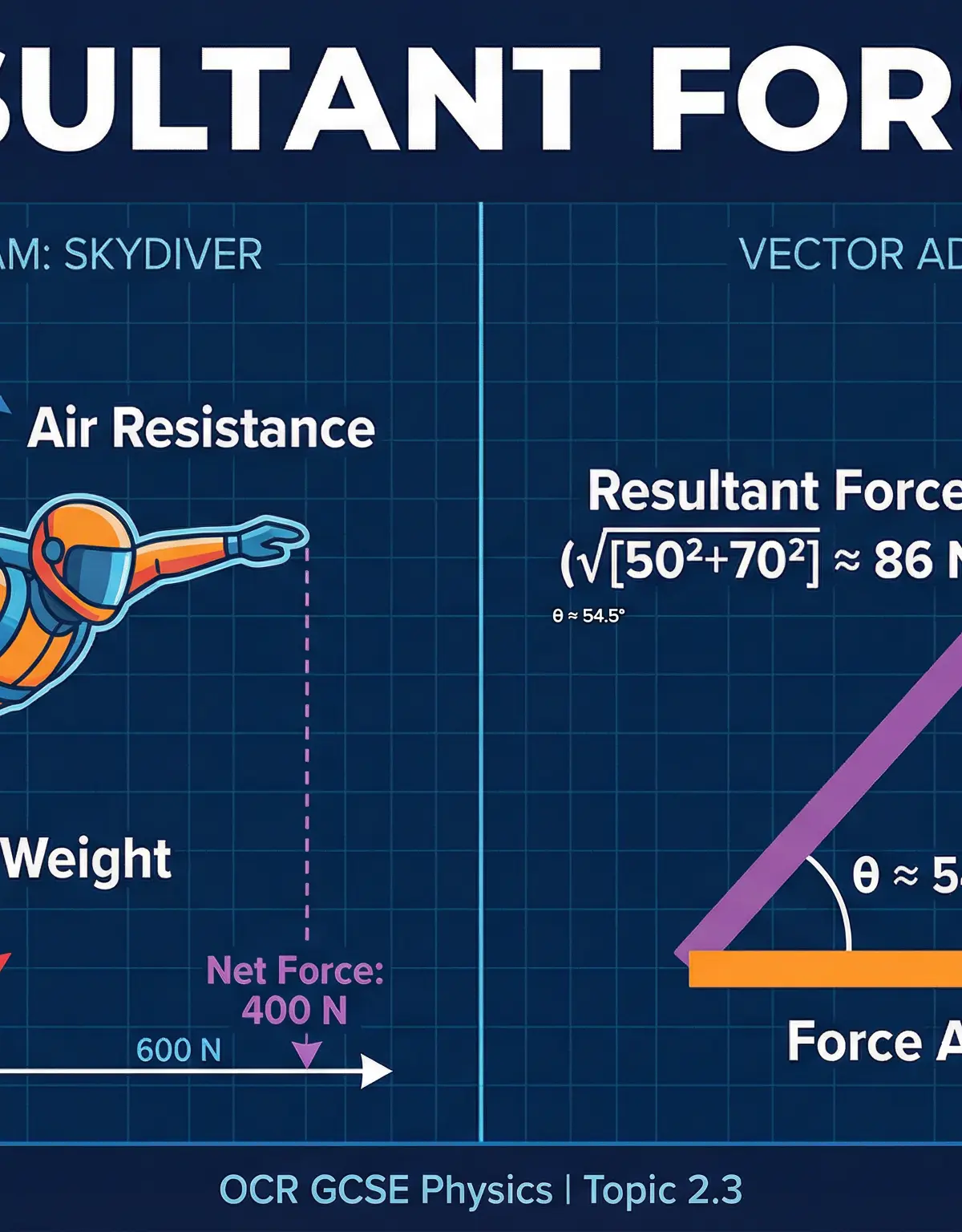
Resultant forces are the cornerstone of understanding motion in physics. This topic explores how multiple forces acting on an object combine to produce a single, overall force—the resultant force. It's this resultant force that dictates whether an object will accelerate, decelerate, or continue at a constant velocity. For your OCR GCSE exam, a firm grasp of this concept is crucial as it forms the foundation for Newton's Laws and connects directly to energy, momentum, and motion graphs. Examiners will test your ability to calculate resultant forces in one and two dimensions, draw and interpret free-body diagrams, and apply the concept to real-world scenarios like a falling skydiver or a vehicle in motion. Expect to see a mix of calculation, explanation, and diagram-based questions.
Key Concepts
Concept 1: Scalars and Vectors
In physics, we must distinguish between two types of quantities. A scalar quantity has only magnitude (size). Examples include distance (5 metres), speed (10 m/s), and mass (2 kg). A vector quantity has both magnitude and direction. Examples include displacement (5 metres to the east), velocity (10 m/s north), and, most importantly for this topic, force (20 N downwards). This distinction is critical because when we combine forces, we must account for their direction, not just add the numbers.
Example: A car travels 50 metres. This is a scalar (distance). A car travels 50 metres east. This is a vector (displacement).
Concept 2: Calculating Resultant Forces in One Dimension
This is the most common type of calculation for all candidates. The rules are simple:
- If forces act in the same direction, you add them.
- If forces act in opposite directions, you subtract the smaller force from the larger one.
The direction of the resultant force will be the same as the direction of the larger force.
Example: A tug-of-war team on the left pulls with 800 N, and the team on the right pulls with 750 N. The resultant force is 800 N - 750 N = 50 N. The direction is to the left.
Concept 3: Free-Body Diagrams
A free-body diagram is a simplified diagram that shows all the forces acting on a single object. Examiners use these to test your understanding of forces in a given situation. To earn full marks:
- Draw the object as a simple box or circle.
- Draw arrows starting from the centre of the object, pointing outwards.
- Each arrow represents a force. The length should be roughly proportional to the force's magnitude.
- Crucially, every arrow must have an arrowhead to indicate its direction.
- Label each arrow with the name of the force (e.g., 'Weight', 'Friction') and its magnitude in Newtons (N) if known.
Concept 4: Balanced and Unbalanced Forces
This is the direct link to Newton's First Law.
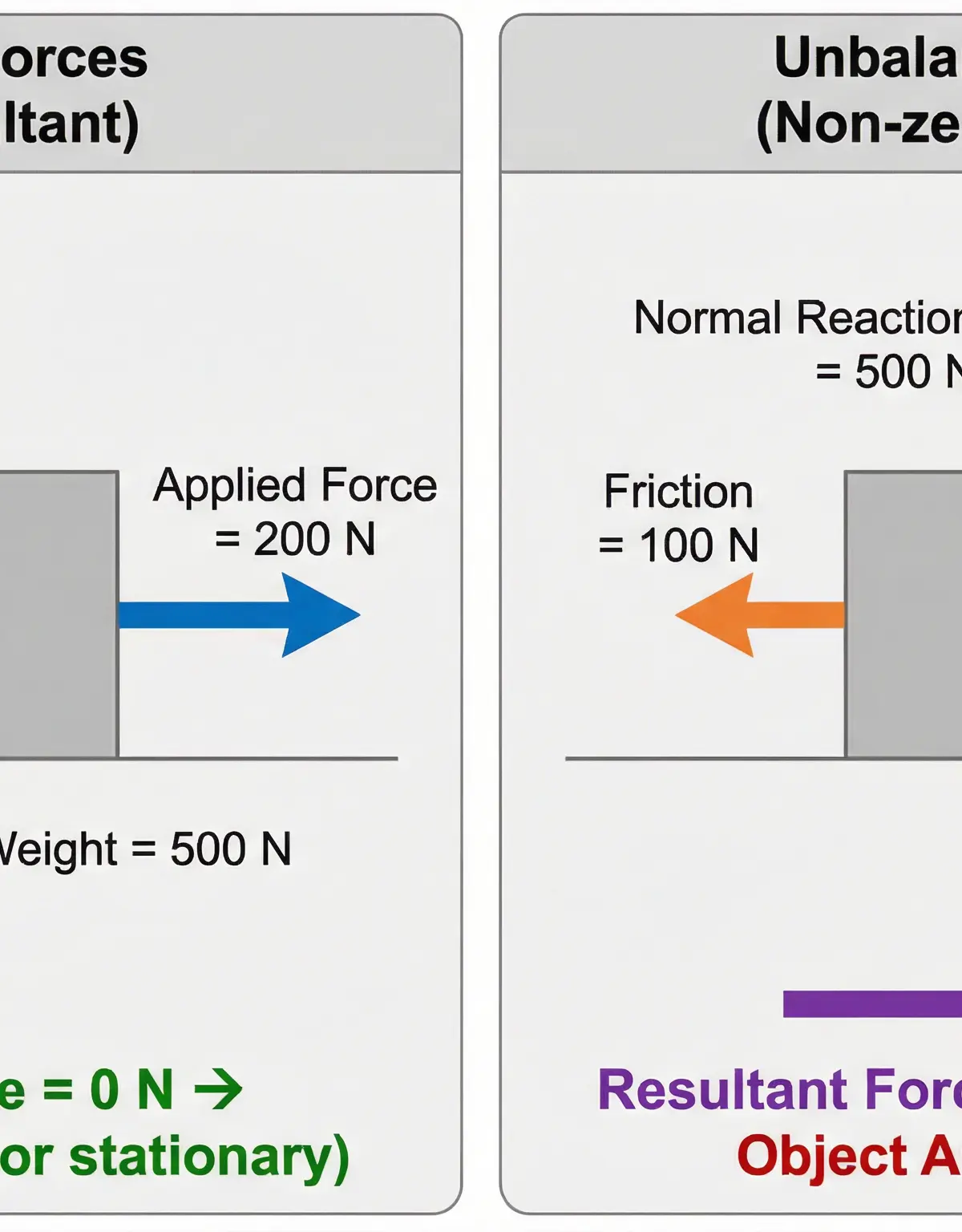
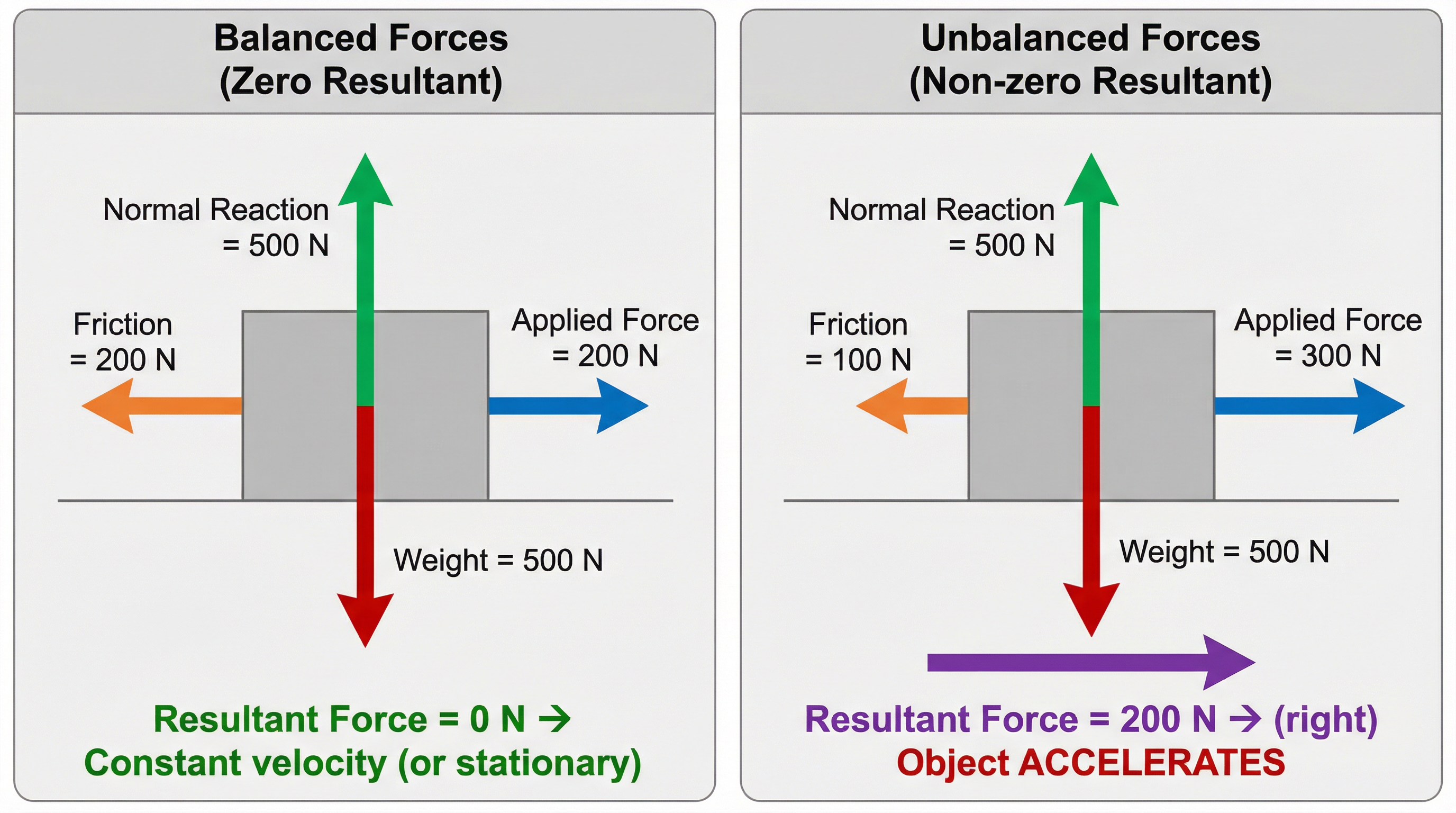
- Balanced Forces: If the forces acting on an object cancel each other out, the resultant force is zero. A zero resultant force means the object's motion will not change. It will either remain stationary or continue to move at a constant velocity (constant speed in a straight line). This is a common pitfall: many candidates assume zero resultant force means the object must be stationary, which is incorrect.
- Unbalanced Forces: If the forces do not cancel out, there is a non-zero resultant force. This resultant force will cause the object to accelerate in the direction of the force (Newton's Second Law). This acceleration can be a change in speed (speeding up or slowing down) or a change in direction.
Concept 5: Resolving Perpendicular Forces (Higher Tier Only)
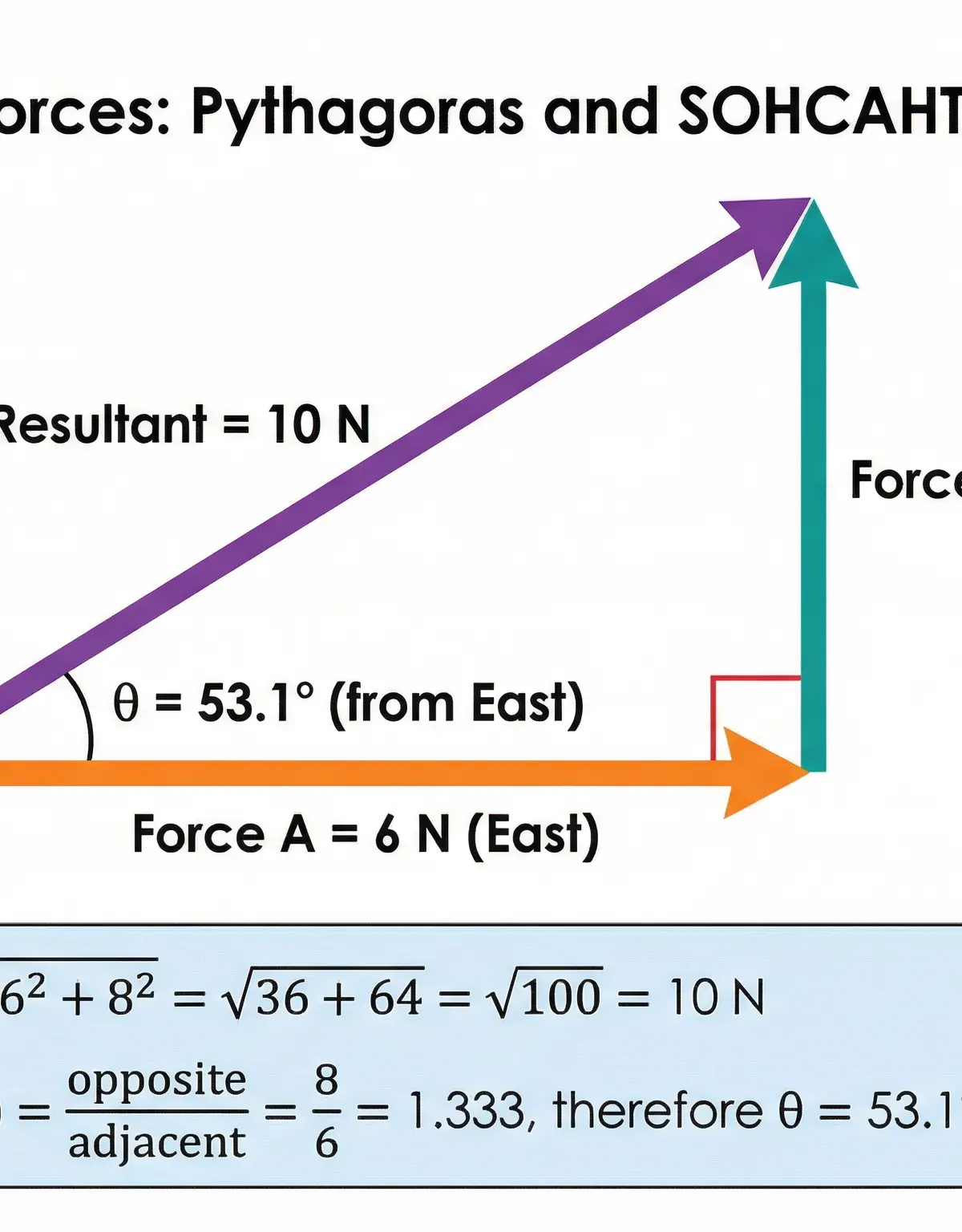
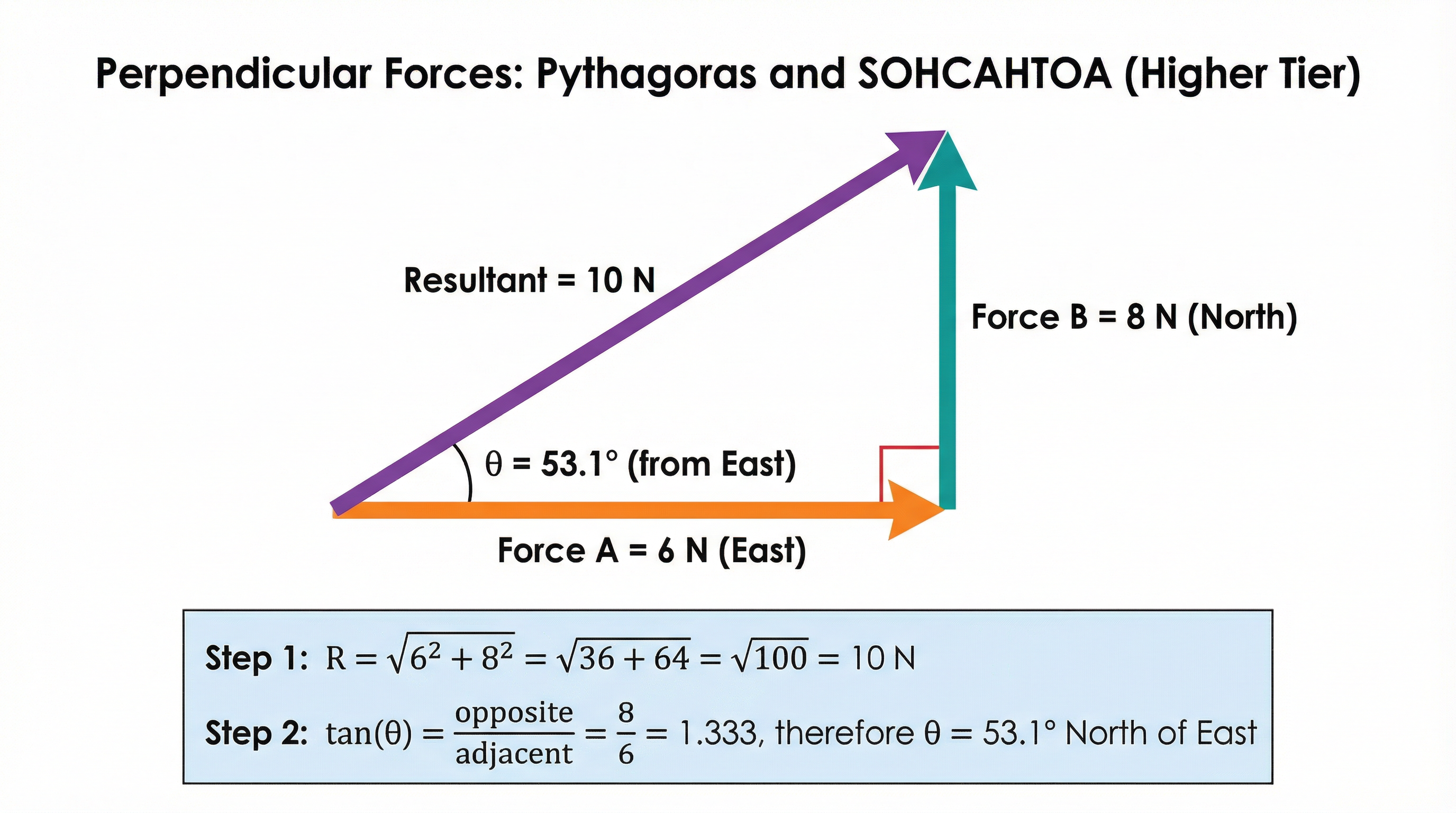
When two forces act on an object at a right angle (90°) to each other, you cannot simply add or subtract them. You must use vector addition. This can be done in two ways:
- Scale Drawing: Draw the two force vectors to scale (e.g., 1 cm = 10 N), arranged 'tip-to-tail'. The resultant is the arrow drawn from the start of the first vector to the tip of the second. You then measure the length and angle of the resultant to find its magnitude and direction.
- Pythagoras and Trigonometry: A more accurate method. The two perpendicular forces form the shorter sides of a right-angled triangle. The resultant force is the hypotenuse.
- Use Pythagoras' Theorem (a² + b² = c²) to find the magnitude of the resultant.
- Use trigonometry (SOHCAHTOA) to find the direction (the angle).
Mathematical/Scientific Relationships
1. Resultant Force (One Dimension)
F_resultant = F_forward - F_backward- Symbols:
Fstands for force, measured in Newtons (N). - When to use: For forces acting along the same straight line.
2. Newton's Second Law (Must memorise)
Force = mass × accelerationorF = ma- Symbols:
Fis the resultant force (N),mis mass (kg),ais acceleration (m/s²). - When to use: To link the resultant force on an object to its mass and the acceleration it experiences.
3. Pythagoras' Theorem (Given on formula sheet)
a² + b² = c²- Symbols: For a right-angled triangle,
aandbare the lengths of the shorter sides,cis the length of the hypotenuse. - When to use: (Higher Tier) To find the magnitude of the resultant of two perpendicular forces.
4. Trigonometry (SOHCAHTOA) (Must memorise)
sin(θ) = Opposite/Hypotenusecos(θ) = Adjacent/Hypotenusetan(θ) = Opposite/Adjacent- Symbols:
θis the angle. Opposite, Adjacent, and Hypotenuse are the sides of the right-angled triangle relative to the angle. - When to use: (Higher Tier) To find the direction (angle) of the resultant of two perpendicular forces.
Practical Applications
This topic is everywhere in the real world. The design of vehicles, from cars to aeroplanes, is all about managing resultant forces—maximising thrust and lift while minimising drag. When a bridge is designed, engineers must ensure that all forces are balanced so the resultant force on the structure is zero. In sports, understanding resultant forces helps an athlete know how to apply a force to a ball to make it travel in the desired direction with the right acceleration.
Visual Resources
3 diagrams and illustrations
Interactive Diagrams
2 interactive diagrams to visualise key concepts
Conceptual Flow Outline
Flowchart showing the logical steps to determine an object's motion based on the forces acting upon it.
Conceptual Flow Outline
Concept map illustrating the two methods available to Higher Tier candidates for finding the resultant of perpendicular forces.
Worked Examples
3 worked examples — open one to explore the question and available guidance.
Practice Questions
Test your understanding — click to reveal model answers
A boat is floating stationary on the water. Its weight is 5000 N. What is the magnitude of the upthrust on the boat?
Hint: Think about what 'stationary' means for the forces acting on the boat.
A rocket has a mass of 50,000 kg. At launch, its engines provide a thrust of 1,200,000 N. Calculate the initial acceleration of the rocket. (Gravitational field strength = 9.8 N/kg)
Hint: First, you need to calculate the weight of the rocket. Remember that weight is a force that acts downwards.
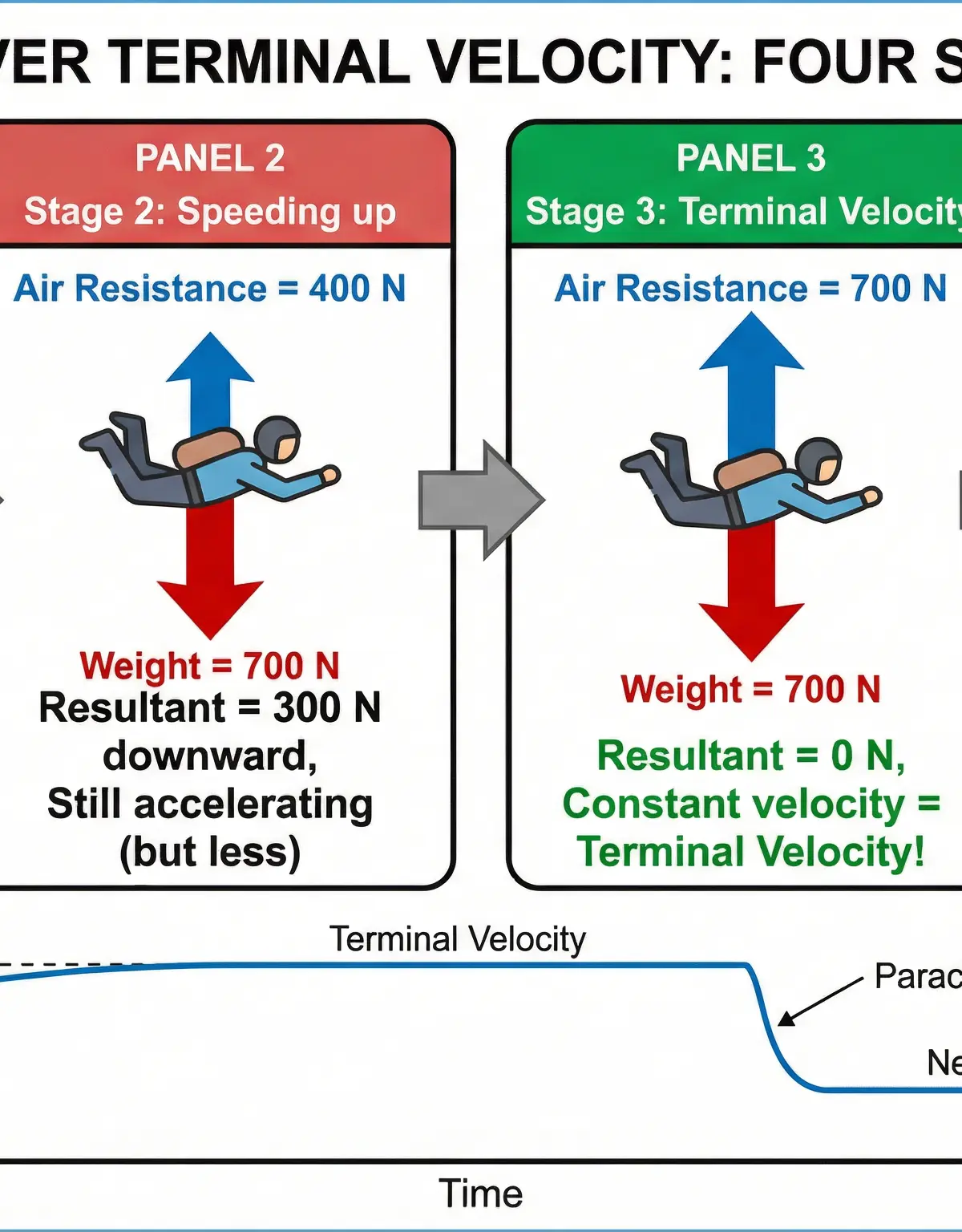
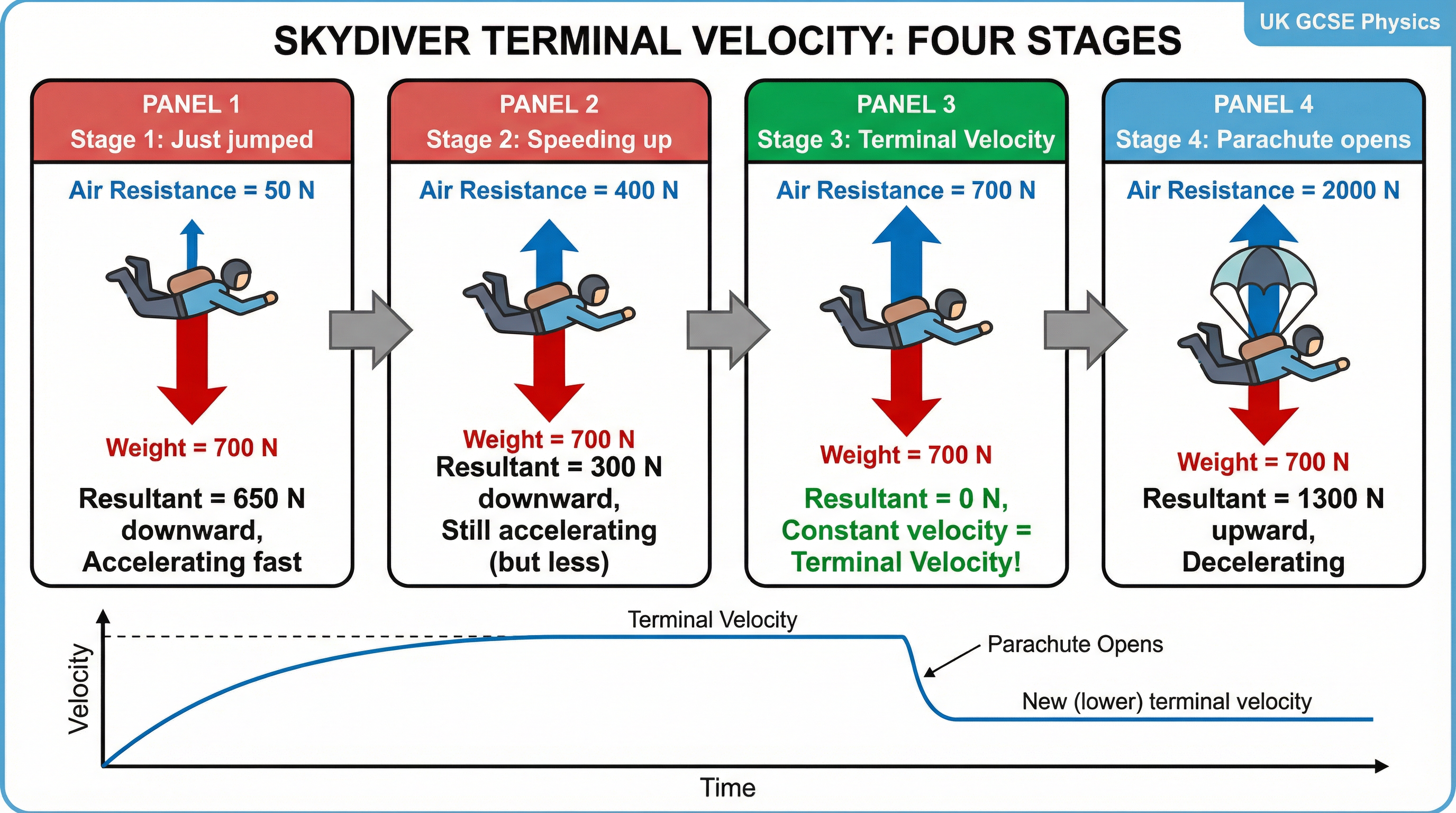
Describe the changes in the forces acting on a skydiver from the moment they jump out of a plane until they land safely using a parachute.
Hint: Structure your answer chronologically. For each stage, discuss weight, air resistance, and the resultant force.
A box is pulled along a rough horizontal surface by a rope at an angle of 30° to the horizontal. Explain why the force needed to move the box is greater than if the rope were horizontal.
Hint: Think about how the force from the rope can be split into horizontal and vertical components.
A student says: 'If an object isn't moving, there are no forces acting on it.' Explain why this statement is incorrect.
Hint: Think about a book resting on a table. Is it moving? Are there forces acting on it?
Test your understanding of Resultant Forces
Active recall beats re-reading. Take an instant quiz now to test what you’ve learned and lock it into long-term memory.
7 days Premium · Then free forever · No card, no charge