OCR · GCSE · Physics
Seismic Waves
This OCR GCSE Physics guide for topic 4.10, Seismic Waves, provides a comprehensive breakdown of how P-waves and S-waves are used to determine the Earth's internal structure. It focuses on exam-critical knowledge, such as the properties of each wave type and the formation of shadow zones, to help candidates secure maximum marks.
- 7 min read
- 3 worked examples
- 5 practice questions
- 6 key terms
Study Notes
Overview
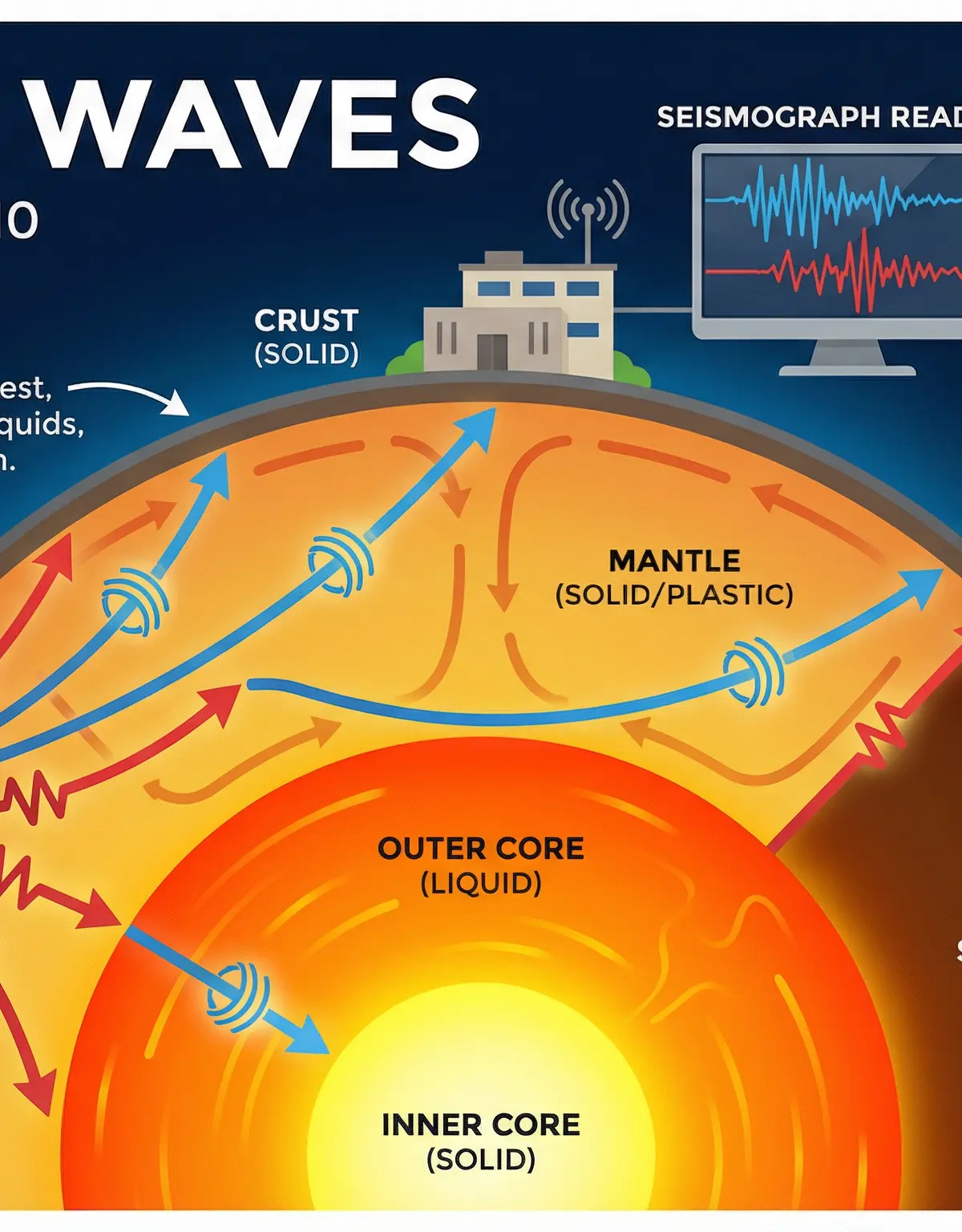
Seismic waves are one of the most powerful tools geophysicists use to probe the Earth's interior. This topic, falling under the 'Global Challenges' or 'Waves in Matter' modules for OCR GCSE Physics, explores how the properties of waves generated by earthquakes reveal the layered structure of our planet. Understanding the distinct behaviours of P-waves and S-waves is fundamental. Examiners will expect candidates to not only recall the properties of these waves but also to apply this knowledge to explain how we know the outer core is liquid and the mantle is solid. Questions often involve interpreting diagrams of wave paths and explaining the formation of 'shadow zones' where waves are not detected. A strong grasp of this topic is crucial as it links fundamental wave properties (longitudinal vs. transverse, refraction) to a large-scale application, making it a prime candidate for higher-mark, synoptic questions.
Key Concepts
Concept 1: P-waves (Primary Waves)
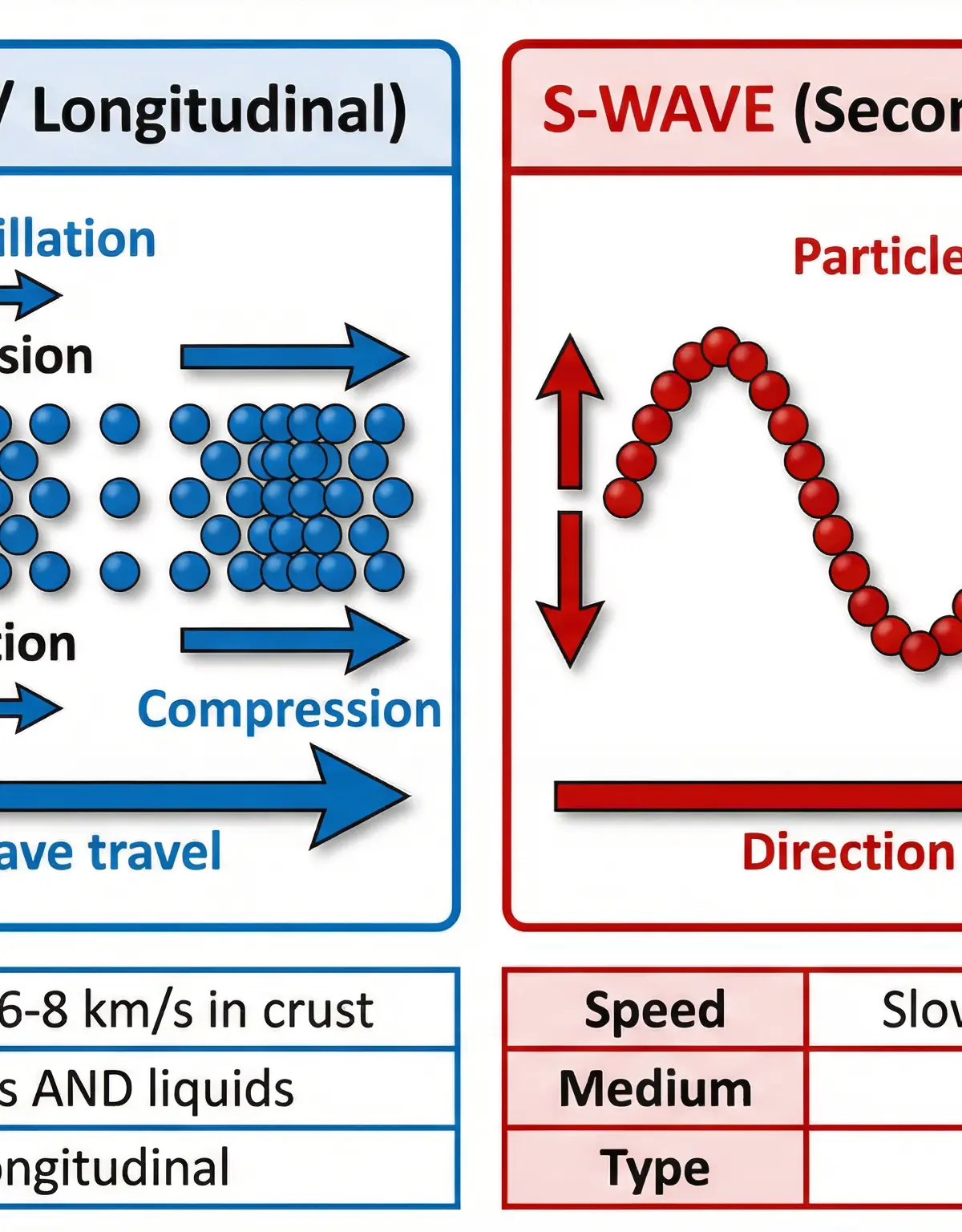
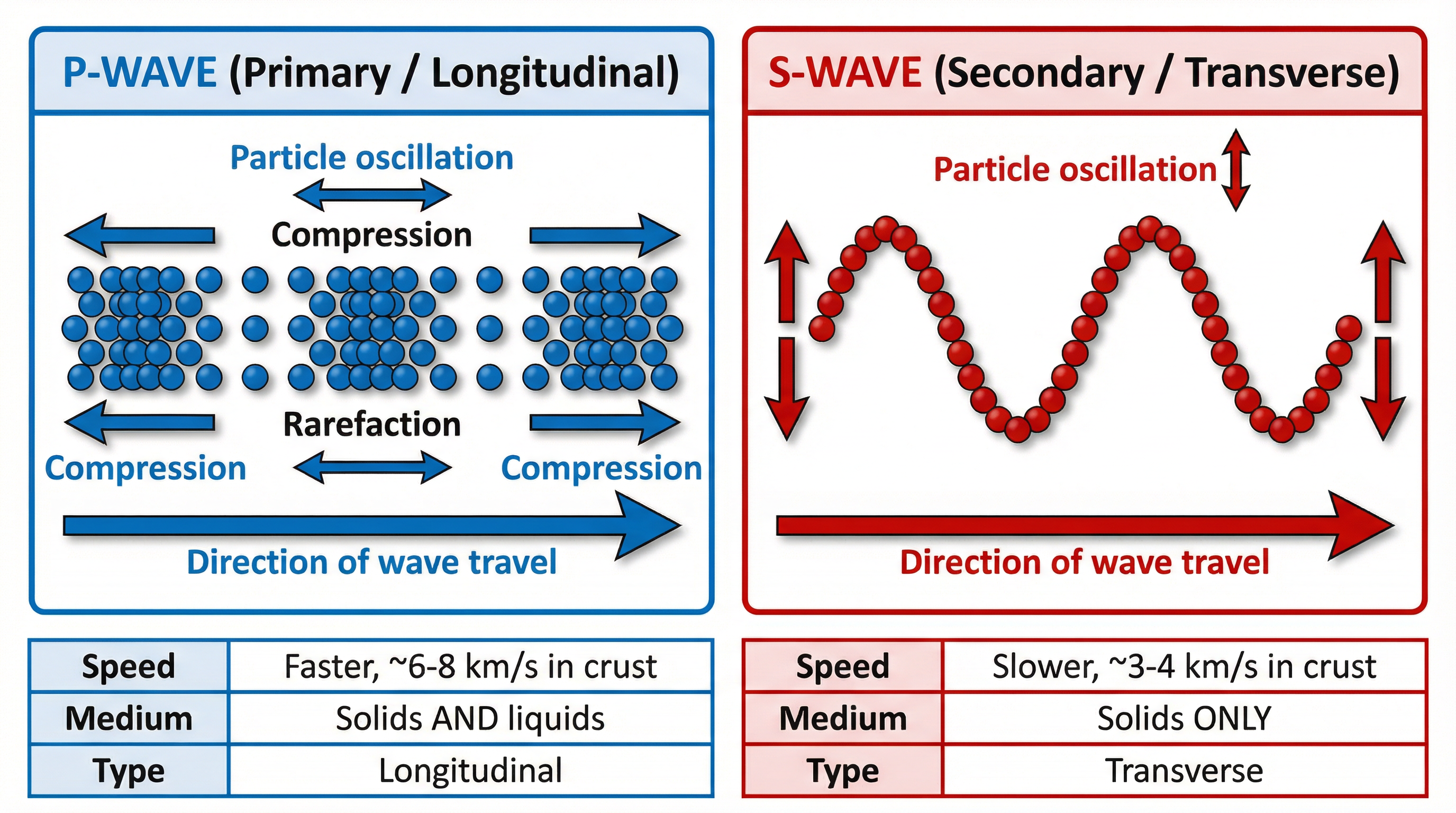
P-waves are the faster of the two main seismic wave types, meaning they are the first to be detected by a seismograph after an earthquake – hence 'Primary'. They are longitudinal waves. This means the vibrations of the rock particles are parallel to the direction of energy transfer. Imagine a slinky spring: if you push one end, a compression travels along its length. This is exactly how P-waves propagate, through a series of compressions and rarefactions. A critical property that examiners require you to know is that P-waves can travel through both solids and liquids. This is because both solids and liquids can be compressed. When they travel from the solid mantle into the liquid outer core, they slow down and refract, which is key to understanding the P-wave shadow zone.
Concept 2: S-waves (Secondary Waves)
S-waves are the 'Secondary' waves because they arrive at seismographs after the P-waves. They are transverse waves, meaning the particle vibrations are perpendicular (at a right angle) to the direction of energy transfer. Think of making a wave by flicking a rope up and down. The most important fact for your exam is that S-waves can only travel through solids. They cannot propagate through liquids or gases. This is because liquids cannot resist shear forces; they simply flow. This property provides the single most important piece of evidence for the Earth's liquid outer core. When S-waves travelling through the solid mantle reach the liquid outer core, they are stopped completely. This creates a large 'shadow zone' on the opposite side of the Earth where no S-waves are detected.
Concept 3: Wave Paths and Refraction
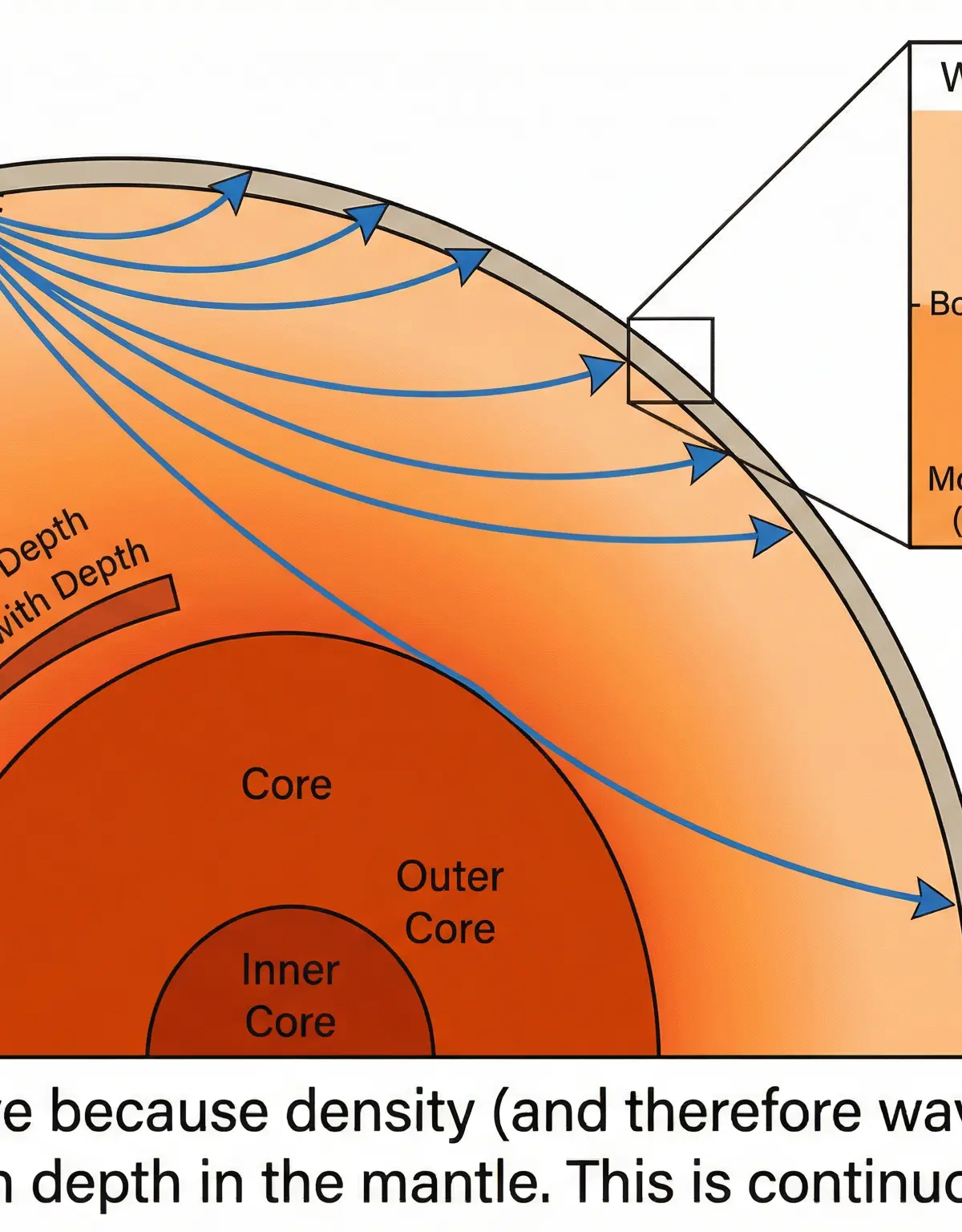
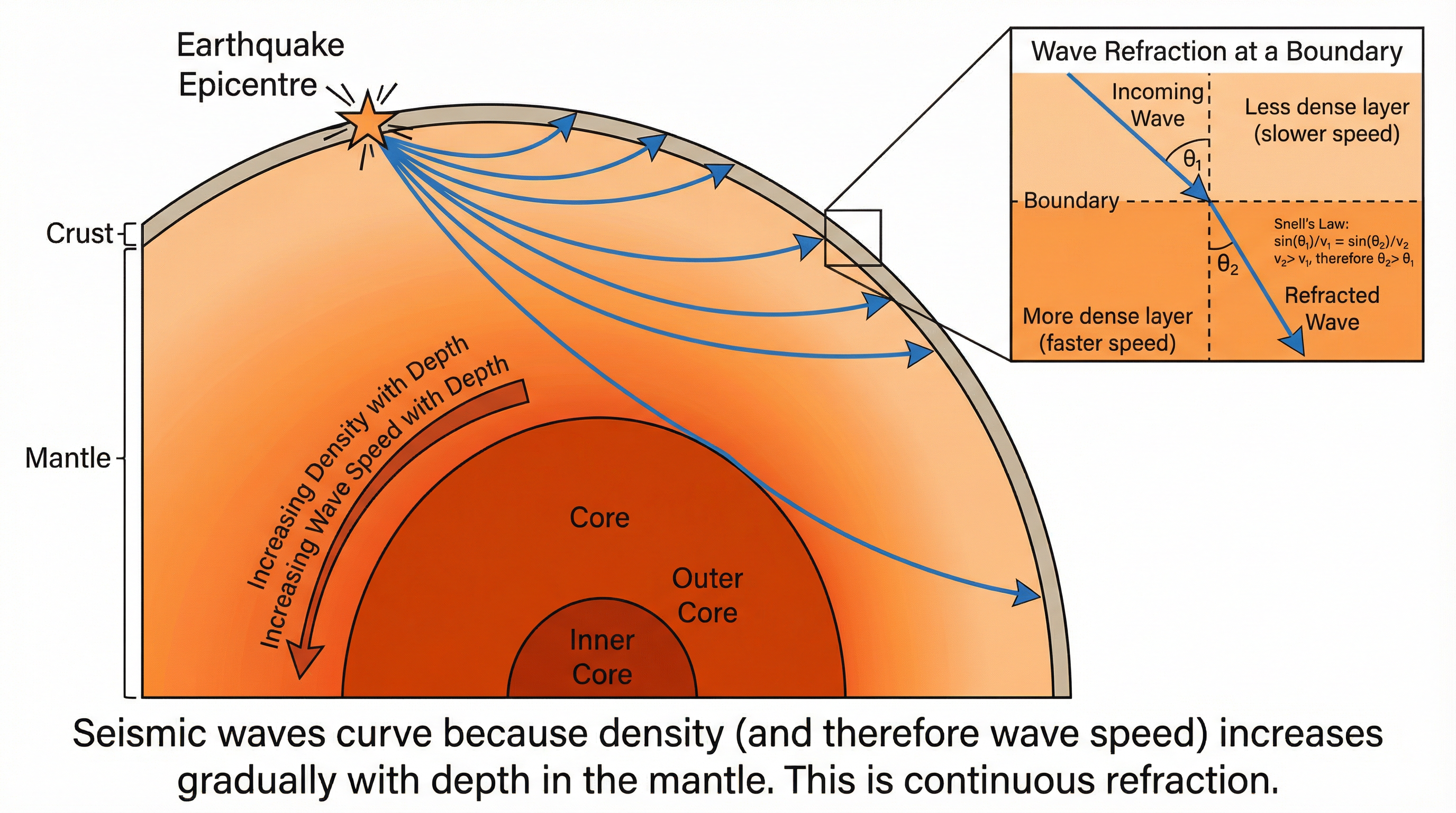
Seismic waves do not travel in straight lines through the Earth. Instead, their paths are curved. This is due to refraction. As waves travel deeper into the mantle, the material becomes denser and more rigid. This change in medium properties causes the wave speed to increase. According to the principles of refraction, when a wave speeds up, it bends away from the normal. Because the density and pressure in the mantle increase gradually with depth, the waves refract continuously, resulting in a smooth, curved path. Candidates often lose marks by drawing wave paths as straight lines. Credit is given for showing wave paths as curves within the mantle and showing a sharp change in direction (refraction) at the boundary between distinct layers, like the core-mantle boundary.
Concept 4: Shadow Zones
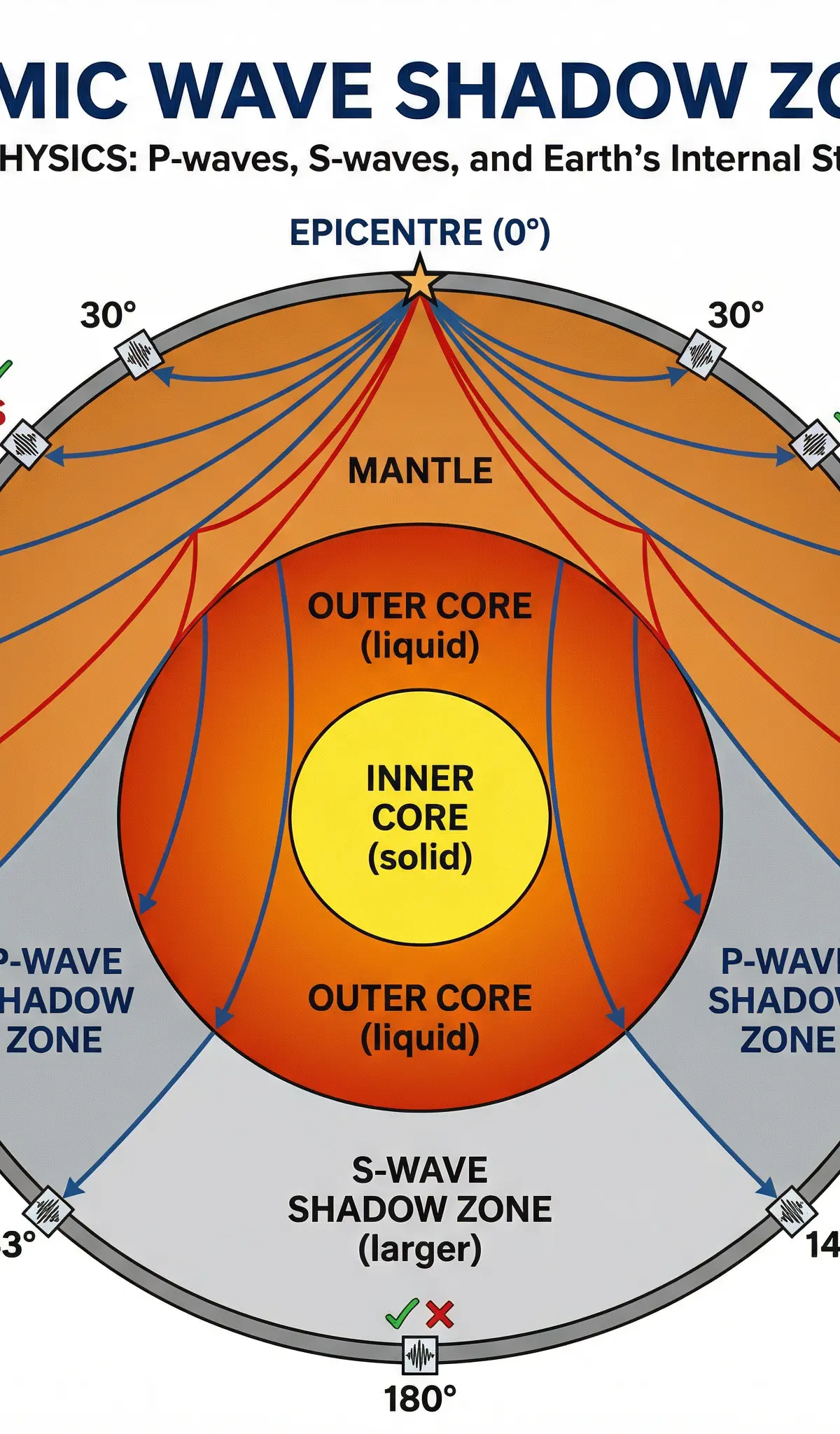
The analysis of seismic wave detection patterns across the globe reveals 'shadow zones' – areas where seismographs do not detect waves from a distant earthquake. These zones are the key evidence for the Earth's internal structure.
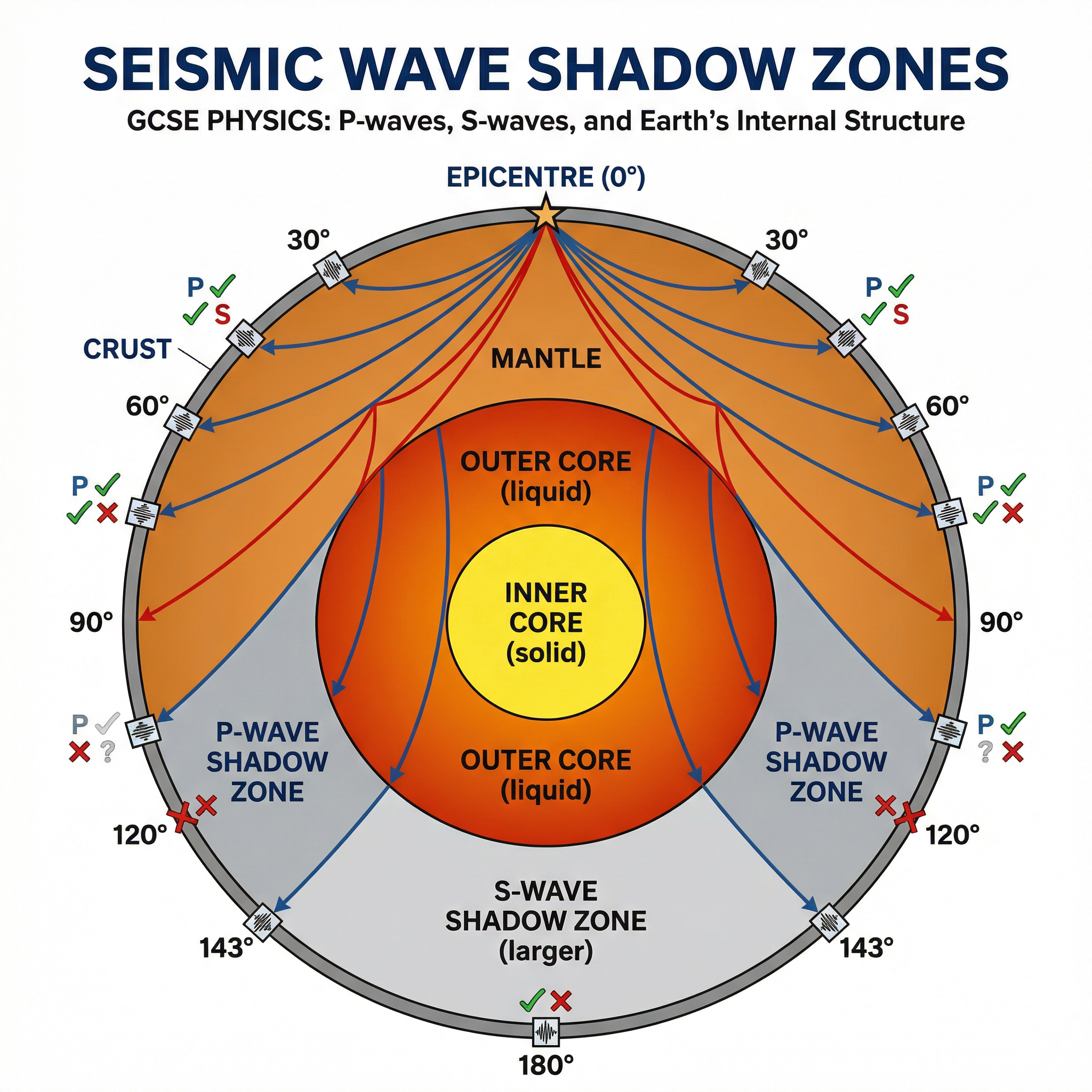
- The S-wave Shadow Zone: This is a large area on the far side of the Earth from an earthquake, extending from an angular distance of 103° onwards. No direct S-waves are detected here. The explanation is simple and crucial for 4-6 mark questions: S-waves cannot travel through the liquid outer core. Their inability to pass through this layer creates the extensive shadow zone.
- The P-wave Shadow Zone: This is a smaller, ring-shaped zone between approximately 103° and 143° from the earthquake's epicentre. P-waves can travel through the liquid outer core, but as they cross the core-mantle boundary, they slow down significantly and are refracted (bent) inwards. This refraction directs them away from this specific zone. The fact that P-waves are detected again beyond 143° (after passing through the inner and outer core) provides evidence that the inner core is solid, as it refracts the waves outwards again.
Mathematical/Scientific Relationships
The fundamental wave equation is essential for this topic. Examiners may ask you to perform calculations using it.
Wave Speed Equation: wave speed (v) = frequency (f) × wavelength (λ)
v: wave speed, measured in metres per second (m/s)f: frequency, measured in hertz (Hz)λ: wavelength, measured in metres (m)
This formula is Given on the formula sheet. However, you must be confident in rearranging it to find frequency or wavelength. For example, f = v / λ and λ = v / f.
Example Calculation: A P-wave is detected with a frequency of 0.5 Hz and a wavelength of 12 km. Calculate its speed in m/s.
- Step 1: Convert units. Wavelength = 12 km = 12,000 m.
- Step 2: Use the formula.
v = f × λ - Step 3: Substitute values.
v = 0.5 Hz × 12,000 m - Step 4: Calculate.
v = 6,000 m/s.
Practical Applications
While there isn't a specific required practical for this topic, the principles are applied in several real-world contexts:
- Mapping Earth's Interior: As discussed, this is the primary application. By analyzing data from thousands of seismographs worldwide, scientists have built a detailed model of the Earth's crust, mantle, and core.
- Oil and Gas Exploration: Geologists use artificially created seismic waves (using controlled explosions or large vibrating trucks) to map underground rock structures. They analyze the reflected and refracted waves to locate rock formations (like anticline traps) where oil and gas may be present.
- Earthquake Monitoring and Prediction: Seismographs constantly monitor for seismic activity. The time difference between the arrival of P-waves and S-waves at a station can be used to calculate the distance to the earthquake's epicentre. Data from at least three stations is needed to triangulate the exact location.
Visual Resources
3 diagrams and illustrations
Interactive Diagrams
2 interactive diagrams to visualise key concepts
Conceptual Flow Outline
Flowchart showing how P-waves and S-waves lead to evidence for Earth's structure.
Diagram could not be rendered
Sequence diagram illustrating the arrival times of P-waves and S-waves at different distances, and the absence of S-waves in the shadow zone.
Worked Examples
3 worked examples — open one to explore the question and available guidance.
Practice Questions
Test your understanding — click to reveal model answers
A seismograph is located at an angular distance of 120° from an earthquake's epicentre. Explain which type(s) of seismic waves would be detected and why. [3 marks]
Hint: Consider the location of the P-wave and S-wave shadow zones.
State two ways in which the path of a seismic wave is different from the path of a light ray travelling from air into a glass block. [2 marks]
Hint: Think about the shape of the path and how speed changes with the medium.
An earthquake occurs. At a detection centre, the P-waves arrive 3 minutes before the S-waves. At a second detection centre further away, will the time difference between P- and S-wave arrival be smaller, larger, or the same? Explain your answer. [3 marks]
Hint: P-waves and S-waves travel at different speeds. How does this difference accumulate over a longer distance?
Describe the motion of a particle on the Earth's surface as a pure S-wave passes it. [2 marks]
Hint: What type of wave is an S-wave? How do particles move in that type of wave?
A P-wave has a speed of 6 km/s. It has a wavelength of 3000 m. Calculate the frequency of the P-wave. [3 marks]
Hint: Start with v = f x λ and rearrange. Watch your units!
Test your understanding of Seismic Waves
Active recall beats re-reading. Take an instant quiz now to test what you’ve learned and lock it into long-term memory.
7 days Premium · Then free forever · No card, no charge